
QIGONG & DAOYIN · 气功与导引

The Microcosmic Orbit (Xiaozhoutian) in Wudang Quiet Sitting: Conception and Governing Vessels, Three Passes, and Safe Practice 武当静功“小周天(任督二脉)”调息与安全实修指南:下丹田筑基、后三关与勿忘勿助法则

A grounded classical guide to the Microcosmic Orbit (Xiaozhoutian / Ren-Du Er Mai) in Wudang Taoist meditation — explaining the Lower Dantian root, the Three Posterior Passes (Weilü, Jiaji, Yuzhen), the Magpie Bridge of the tongue, and why safe practice relies on 'neither forgetting nor forcing' (Wuwang Wuzhu).


A standing qigong class in a sunlit room: students seen from behind hold both arms open at shoulder height in the same alignment, facing a teacher in dark clothing before a tall window with green trees outside.

1. What the Microcosmic Orbit (Xiaozhoutian) Means in Classical Taoist Texts

In the contemplative curriculum of Wudang Taoism — rooted in the Huangting Jing (Yellow Court Classic), the Cantong Qi (Seal of the Unity of the Three), and the Wuzhen Pian (Awakening to Reality) — the Microcosmic Orbit (Xiaozhoutian 小周天, literally the "Small Heavenly Cycle," also called Ren-Du Er Mai Yunzhuan 任督二脉运转) describes the continuous circular pathway formed by two of the Eight Extraordinary Vessels (Qijing Bamai 奇经八脉): the Governing Vessel (Dumai 督脉) along the back midline and the Conception Vessel (Renmai 任脉) along the front midline.

Why did classical masters compare this internal loop to the orbit of the sun and moon (zhoutian 周天)? Because in traditional physiology, Dumai governs all the Yang meridians of the body (rising up the spine like the waxing sun), whereas Renmai governs all the Yin meridians (descending down the front of the torso like cooling rain). When these two vessels communicate smoothly — bridged at the top by the tongue touching the palate (Qiaoqiao 鹊桥, the "Magpie Bridge") and at the bottom through the perineum (Huiyin 会阴) — the body's Yin and Yang remain balanced and self-renewing.

2. The Geography of the Loop: Lower Dantian, Three Posterior Passes (Sanguan), and the Magpie Bridge

Understanding the classical landmarks of the Xiaozhoutian prevents confusion during quiet sitting:

  • The Starting Root — Lower Dantian (下丹田): Located in the lower abdomen between the navel (Shenque), Qihai (气海), and the lumbar gate (Mingmen 命门, see Warming the Kidneys and Mingmen Daoyin). All authentic Wudang meditation begins by settling breath and awareness here first (Shouyi 守一).
  • The Ascending Path — Dumai and the Three Passes (Sanguan 三关): From the lower dantian and perineum (Huiyin), the posterior pathway ascends the spine through three natural anatomical bottlenecks where tension commonly accumulates: 1) Weilü Guan (尾闾关 — the Tailbone/Coccyx Pass); 2) Jiaji Guan (夹脊关 — the Mid-Thoracic Pass between the shoulder blades); and 3) Yuzhen Guan (玉枕关 — the Jade Pillow Pass at the base of the occiput), before reaching the crown (Baihui 百会).
  • The Upper Bridge and Anterior Descent — Qiaoqiao and Renmai: With the tip of the tongue resting lightly against the upper palate behind the front teeth (da Qiaoqiao 搭鹊桥), the pathway descends down the face, throat, sternum (Danzhong 膻中), and middle abdomen (Zhongwan 中脘) back into the lower dantian, often accompanied by the natural generation and swallowing of sweet saliva (Swallowing the Jade Fluid).
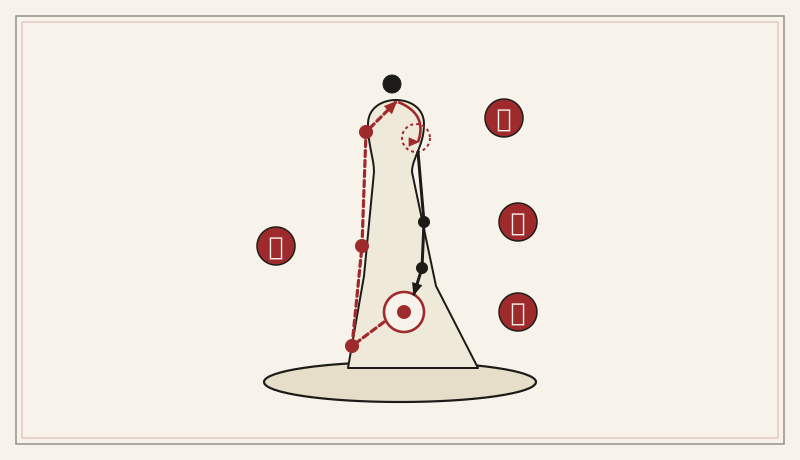
Classical ink-and-cinnabar side-profile diagram of the Microcosmic Orbit (Xiaozhoutian) with four numbered markers (①–④) illustrating the Lower Dantian, the ascending Governing Vessel and Three Passes, the Magpie Bridge of the tongue, and the descending Conception Vessel.

Figure 1: The Classical Microcosmic Orbit (Xiaozhoutian / Ren-Du Loop) — ① The Lower Dantian (Qihai / Guanyuan) where breath and awareness first gather; ② The ascending Governing Vessel (Dumai) passing through the Three Passes (Weilü, Jiaji, Yuzhen) up the spine; ③ The Magpie Bridge (Qiaoqiao) formed by the tongue resting lightly against the upper palate; ④ The descending Conception Vessel (Renmai) flowing down the front midline back to the Lower Dantian.

  1. ① Lower Dantian Root (Xia Dantian 下丹田): The primary furnace beneath the navel where Jing and Qi are quietly gathered before circulation begins.
  2. ② Ascending Governing Vessel & Three Passes (Dumai Sanguan 督脉三关): The posterior pathway rising through the Tailbone Pass (Weilü), Mid-Back Pass (Jiaji), and Jade Pillow Pass (Yuzhen).
  3. ③ The Magpie Bridge (She Di Shang E · Qiaoqiao 舌抵上腭·鹊桥): Touching the tip of the tongue lightly to the roof of the mouth to link the Governing and Conception Vessels.
  4. ④ Descending Conception Vessel (Renmai Jiangchen 任脉降沉): The anterior pathway descending smoothly through the chest (Danzhong) and epigastrium (Zhongwan) back to the Lower Dantian.

3. The Golden Safety Rule: "When Qi Is Full, the Channels Open Naturally" (Qi Man Zi Tong)

Across the history of Taoist meditation, experienced teachers have issued one emphatic warning about the Microcosmic Orbit: never use forceful mental visualization to push imaginary heat up the spine into the head. When an impatient beginner strains their willpower (yi 意) to drag sensation up to the crown without first building a quiet foundation in the lower dantian, beginners often report tension in the head and chest, a heavy head, or restlessness.

Instead, the Wudang tradition strictly follows the classical rule: "Neither forget nor forcefully assist" (wuwang wuzhu 勿忘勿助) and "When Qi is full in the Dantian, the orbit opens of itself" (qi man zi tong 气满自通). Just as a mountain spring basin naturally overflows into its stream bed once the basin is full of water, spending the first months quietly nurturing Natural Abdominal Breathing in the lower dantian and loosening the spine physically with Daoyin (such as Yijinjing Bowing and Tail-Wagging) allows the Ren-Du circuit to harmonize safely without strain.

4. Gentle Breath-Guided Ren-Du Relaxation Practice (10 Minutes)

In the meditation halls of Wudang Mountain and in our Singapore classes, beginners practice a safe, gentle Breath-Guided Ren-Du Relaxation (Tongdu Jiangren Tiaoxi 通督降任调息) that emphasizes downward settling along the front rather than forceful upward pushing: 1) Sit upright on a cushion or chair with the chin slightly tucked, crown suspended, and tongue touching the upper palate; 2) Rest your awareness quietly in the lower dantian for three minutes until the breath becomes slow and even; 3) For the next five minutes, as you inhale softly through the nose, simply feel the back of the waist and spine lengthen gently from the tailbone to the crown without forcing; as you exhale, let your awareness flow like warm water down the front of the chest and abdomen (Renmai) to settle deeply into the lower dantian.

4) Finish by resting in quiet stillness (Sitting in Forgetfulness, Zuowang) for two minutes, swallowing any clear saliva, and rubbing the hands and face warm (Standing Post Closing and Self-Massage). Traditional Taoist meditation supports calm breathing and stress relief and never replaces professional medical diagnosis or clinical care.

Seeker’s Q&A · Frequently Asked Questions

What is the core takeaway of The Microcosmic Orbit (Xiaozhoutian) in Wudang Quiet Sitting?

A grounded classical guide to the Microcosmic Orbit (Xiaozhoutian / Ren-Du Er Mai) in Wudang Taoist meditation — explaining the Lower Dantian root, the Three Posterior Passes (Weilü, Jiaji, Yuzhen), the Magpie Bridge of the tongue, and why safe practice relies on 'neither forgetting nor forcing' (Wuwang Wuzhu).
