QIGONG & DAOYIN · 气功与导引

Warming Laogong (劳宫 PC-8) and Pressing Hegu (合谷 LI-4): Wudang Hand-Gate Daoyin for Releasing Neck-Shoulder Tension and Settling Heart-Fire 武当导引“温煦劳宫与按揉合谷”精解:圆撑虎口、清降心火与苏醒太极掌心气感的手部养生法

How pairing the Yangming source gate at the Tiger’s Mouth with the Jueyin hearth in the center of the palm clears upper-body stagnation and prepares the hands for Zhan Zhuang and Tuishou.

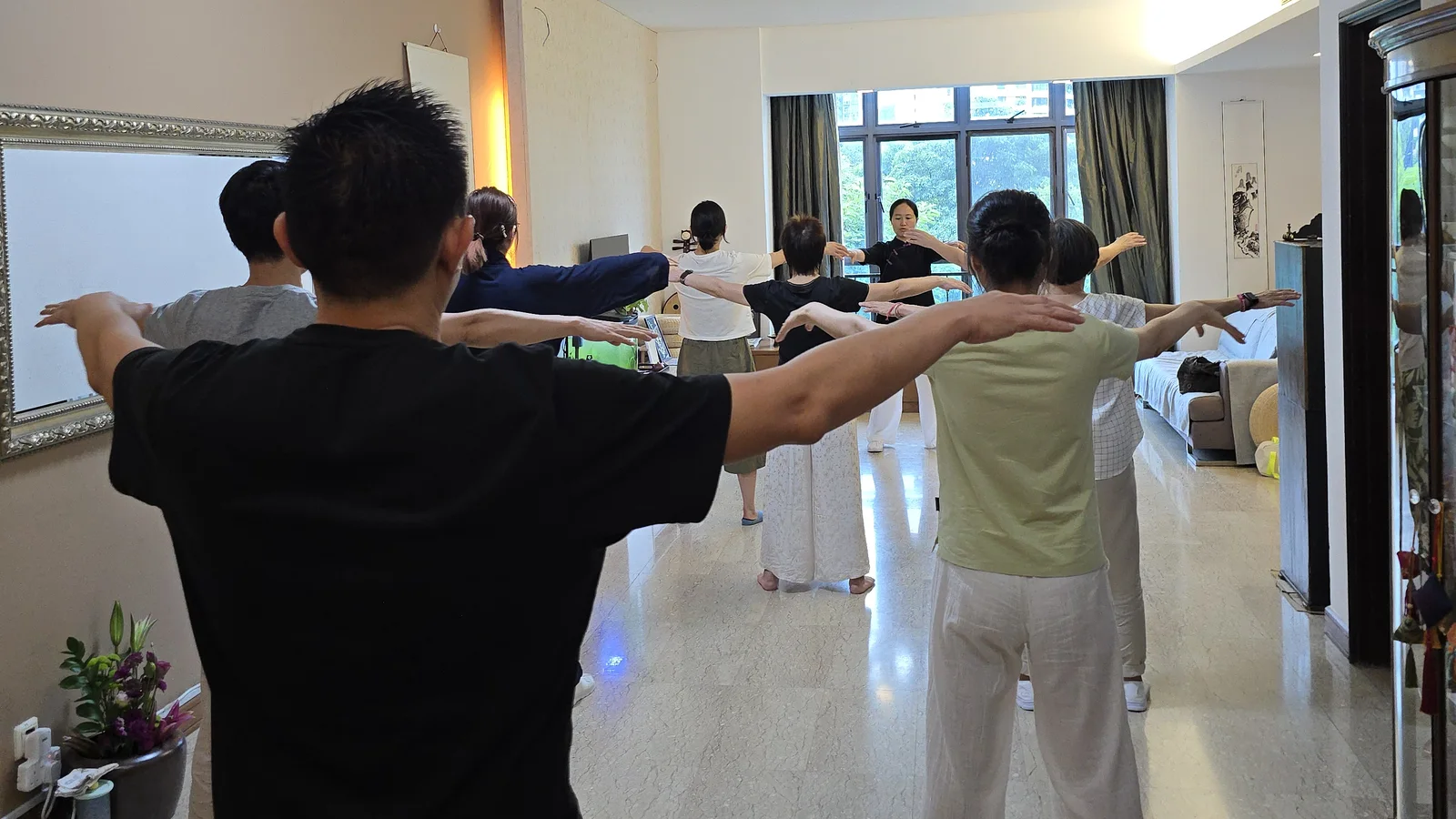
A standing qigong class in a sunlit room: students seen from behind hold both arms open at shoulder height in the same alignment, facing a teacher in dark clothing before a tall window with green trees outside.

In Wudang Qigong, Daoyin self-massage, and Taijiquan palm training, two gateways on the hand are cultivated as a complementary Yin-Yang pair: Hegu (合谷, LI-4, at the muscular mound of the "Tiger’s Mouth" between thumb and index finger) on the external Hand-Yangming Large Intestine channel, and Laogong (劳宫, PC-8, "Palace of Toil" in the hollow of the palm) on the internal Hand-Jueyin Pericardium channel. Gently kneading Hegu and warming Laogong eases neck, jaw, and wrist stiffness after desk work while awakening the "hollow tile-roof palm" (Waleng Zhang 瓦楞掌) needed for standing meditation.

1. Classical Meridian Pairing: Outer Yangming (Hegu 合谷) and Inner Jueyin (Laogong 劳宫)

Why do Wudang Daoyin routines pair the back of the thumb-web with the center of the palm before and after Zhan Zhuang standing meditation?

  1. Hegu (合谷, LI-4 — "Joining Valley" at the Tiger's Mouth Hukou 虎口): The Yuan-Source point (Yuan Xue 原穴) of the Hand-Yangming Large Intestine meridian, which travels up the radial forearm, across the shoulder and neck (passing near Jianjing GB-21), to the jaw and face. In classical meridian lore (Si Zong Xue Ge 四总穴歌), "The face and mouth are governed by Hegu" (面口合谷收). Opening and softening Hegu directly releases the forearm-shoulder-jaw tension chain.
  2. Laogong (劳宫, PC-8 — "Palace of Toil"): The Ying-Spring point (Ying Xue 荥穴) of the Hand-Jueyin Pericardium channel, which wraps and protects the Heart-Mind (Shen 神). When the fingers curl softly into a natural fist, the tip of the middle finger rests directly in the central hollow of Laogong between the second and third metacarpal bones. Warming Laogong quiets restless mental fire (Xin Huo 心火) and serves as the primary emitter of warm palm touch in facial and eye-warming Daoyin and kidney-gate (Mingmen) warming.

2. Step-by-Step Wudang Hand-Gate Daoyin Protocol

Step Point Location & Hand Alignment Kneading & Warming Action Breath & Internal Intention (Yi 意)
1. Brisk Palm Friction (Cuo Zhang Sheng Re 搓掌生热) Sit or stand with sunk shoulders and dropped elbows (Chen Jian Zhui Zhou); bring both palms together in front of the chest Rub the palms briskly together 36 times until the Laogong centers feel noticeably warm and supple Breathe naturally through the nose; let the collarbone and shoulder blades soften
2. Pressing the Tiger's Mouth (Anrou Hegu 按揉合谷) Align the transverse crease of one thumb's interphalangeal joint with the web margin between the other hand's thumb and index finger; where the thumb tip lands on the muscular mound—press slightly toward the base of the second (index) metacarpal bone On each slow exhale, press inward toward the index-finger bone for 3 seconds, then circle gently 18 times per hand Exhale as tension melts from the jaw, neck, and forearm; inhale as the pressure releases
3. Kneading the Palace of Toil (Xuan Rou Laogong 旋揉劳宫) Curl the middle and ring fingers lightly to locate the central depression between the 2nd and 3rd metacarpal bones (Laogong) Place the opposite thumb pad in Laogong and knead in slow, warm circles 24 times clockwise and 24 times counterclockwise on each palm Feel a calm, warm pool gathering in the center of the palm, drawing agitated thoughts down from the head
4. Rounding the Tiger's Mouth & Hollowing the Palm (Yuan Hu Kou, Kong Zhang Xin) Separate the hands slightly in front of the lower Dantian as if holding a warm porcelain bowl Gently round the thumb-index arch (Yuan Hukou 圆虎口) while keeping Laogong slightly concave (Han Zhang 涵掌 / Waleng Zhang 瓦楞掌) for 6 slow breaths Sense the subtle magnetic warmth between the two Laogong centers before closing over the lower abdomen

3. Bridging Hand Daoyin to Wudang Taijiquan and Zhan Zhuang

In Wudang Taijiquan, the hand is never held as a flat, lifeless board nor clenched with white-knuckled tension:

  • Rounding the Tiger's Mouth (Yuan Hukou 圆虎口): When Hegu is cramped or pinched shut, the radial forearm stiffens and blocks spiral force from reaching the fingertips. Awakening Hegu teaches the hand to maintain a soft, semicircular arch between thumb and index finger in postures like Grasp the Sparrow's Tail (Lanquewei) and Push Hands (Tuishou).
  • Safety Note: Keep pressure moderate and comfortable (a gentle, warm ache rather than sharp pain). Important traditional contraindication: Because Hegu (LI-4) strongly promotes downward and outward movement of Qi, avoid strong pressing or acupressure on Hegu during pregnancy (gentle palm rubbing at Laogong remains safe and soothing).

Seeker’s Q&A · Frequently Asked Questions

Where are Hegu and Laogong, and when should Hegu not be pressed?

Hegu (LI-4) is on the fleshy mound of the “Tiger’s Mouth” between the thumb and index finger, toward the index-finger bone. Laogong (PC-8) is in the hollow of the palm, where the tip of the middle finger rests when you curl the fingers into a soft fist. Keep the pressure moderate, a gentle warm ache and never sharp pain. By traditional contraindication, avoid strong pressing on Hegu during pregnancy; gentle palm rubbing at Laogong is the usual alternative.


