QIGONG & DAOYIN · 气功与导引

Six Healing Sounds (Liuzijue) Guide Part 2: Si (Lungs), Chui (Kidneys), and Xi (Triple Burner) Breath-Guiding Daoyin 传统六字诀导引指南(下篇):呬(肺)、吹(肾)、唏(三焦)金水相生与六字归元

Complete the classical Taoist Six Healing Sounds (Liuzijue) from Tao Hongjing's Yangxing Yanming Lu — practicing Si (Metal/Lungs), Chui (Water/Kidneys), and Xi (Triple Burner Sanjiao) to moisten the breath, anchor Kidney essence, and harmonize all three cavities.


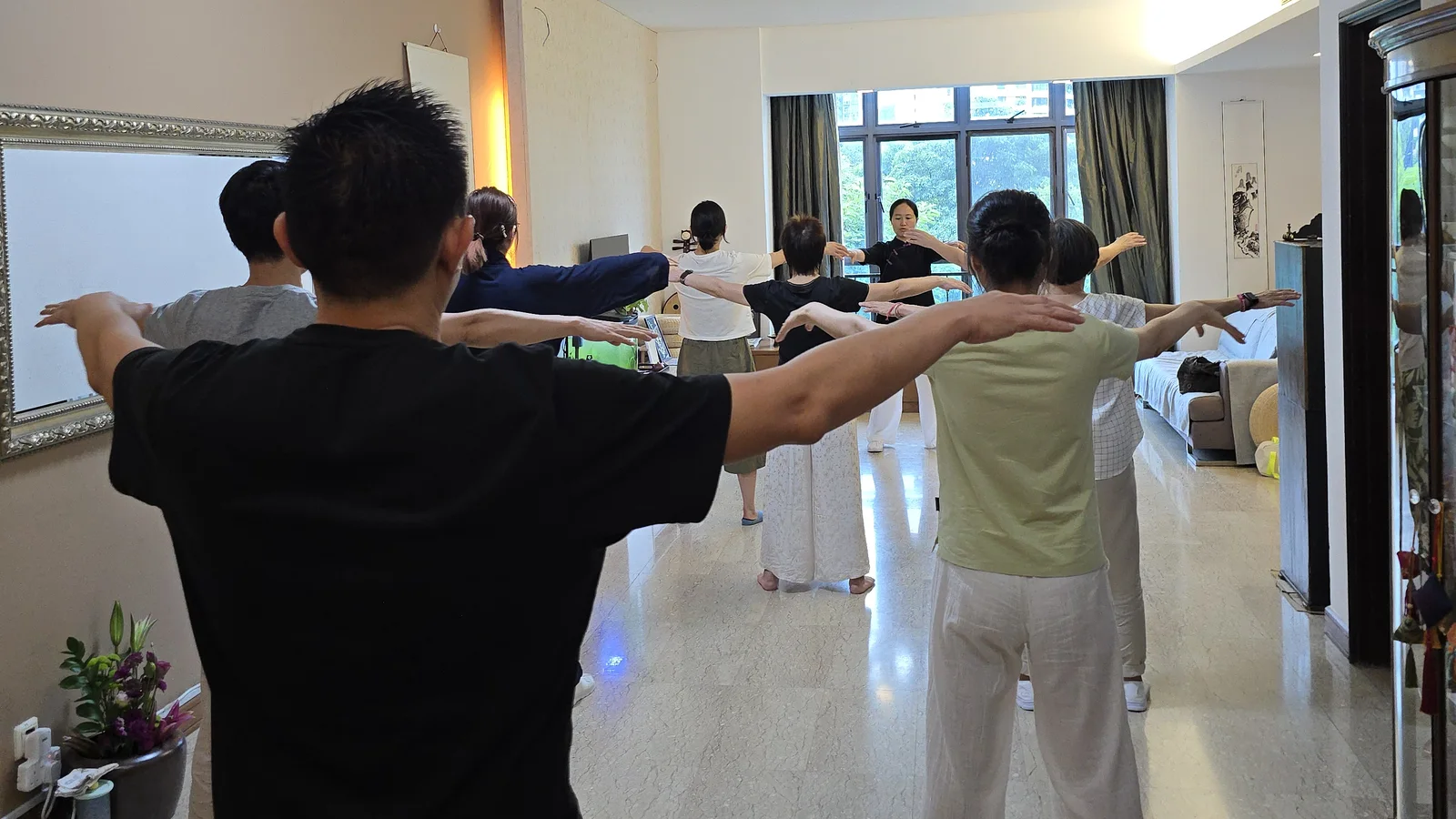
A standing qigong class in a sunlit room: students seen from behind hold both arms open at shoulder height in the same alignment, facing a teacher in dark clothing before a tall window with green trees outside.

1. Completing the Generative Cycle: Metal (Si), Water (Chui), and the Triple Burner (Xi)

In Part 1 of our Six Healing Sounds (Liuzijue) Guide: Xu (Liver), He (Heart), and Hu (Spleen), we traced the first half of the Five-Phase generative sequence (Wood → Fire → Earth) recorded in Tao Hongjing's Yangxing Yanming Lu (《养性延命录》) and Sun Simiao's Weisheng Ge (《卫生歌》). Now, as Earth generates Metal (Tu Sheng Jin 土生金) and Metal generates Water (Jin Sheng Shui 金生水), we complete the classical six-character cycle with Si (呬 — Metal / Lungs), Chui (吹 — Water / Kidneys), and Xi (唏 — the Triple Burner Sanjiao 三焦, which unifies all three torso cavities).

Why does the sequence always conclude with Chui (Kidneys) and Xi (Triple Burner)? Because in Taoist internal physiology, the Lungs (Jin 金, the "upper source of water") send clear Qi downward to replenish the Kidneys (Shui 水, the root of prenatal (先天) vitality), while the Triple Burner acts as the grand irrigation thoroughfare through which original Qi (Yuanqi 元气) and body fluids circulate.

2. The Fourth Sound — Si (呬) for Metal and the Lungs: Opening the Chest and Moistening Breath

In Five-Phase physiology, Metal (Jin 金) corresponds to autumn, the Lungs (Fei 肺), the Large Intestine, the skin and defensive Qi (Weiqi 卫气), and the nose (complementing our dedicated guide on Nourishing the Lungs and Weiqi Autumn Metal Daoyin).

Mouth Shape and Movement: Stand with feet shoulder-width apart. Inhale smoothly through the nose as you raise both palms in front of the chest with the shoulder blades drawing gently open to expand the ribcage. Next, seat the wrists so the palms face forward (lizhang 立掌), bring the upper and lower front teeth gently close together (leaving a tiny hairline gap), draw the corners of the lips slightly back, place the tip of the tongue lightly behind the lower teeth, and exhale a fine, silky "Sī" stream of air while pushing both palms slowly forward at shoulder height. Inhale as the hands draw back to the chest, repeating six times.

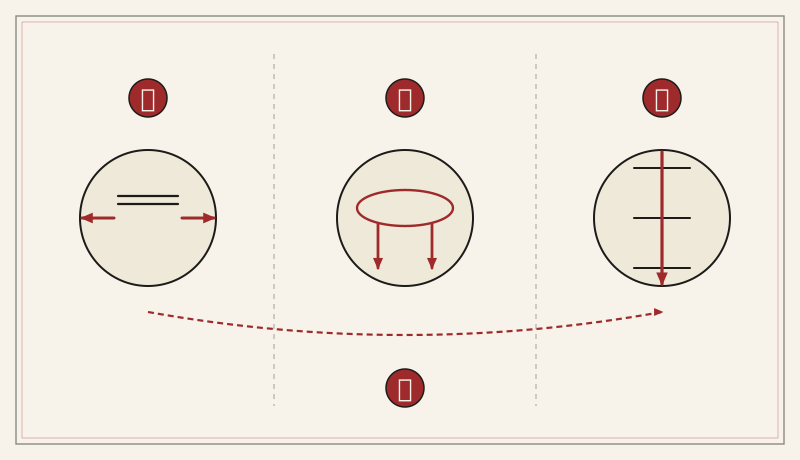
Classical ink-and-cinnabar diagram of the Six Healing Sounds (Liuzijue) Part 2 with four numbered markers (①–④) illustrating Si (Metal/Lungs), Chui (Water/Kidneys), Xi (Triple Burner), and the complete six-sound cycle.

Figure 1: Classical Liuzijue Breath-Guiding Cycle (Part 2: Metal, Water, Triple Burner) — ① Si Sound (Metal / Lungs / Chest Expansion and Forward Upright-Palm Push); ② Chui Sound (Water / Kidneys / Waist-Girdle Sweep and Mingmen Root); ③ Xi Sound (Triple Burner Sanjiao / Heaven-to-Earth Full-Channel Harmonization); ④ Completing the Six-Character Generative Cycle (Xu → He → Hu → Si → Chui → Xi).

  1. ① Si Sound (呬字诀 · Metal / Lungs): Upper and lower front teeth gently align with corners of the mouth drawn back on a fine 'sī' exhalation while upright palms push forward.
  2. ② Chui Sound (吹字诀 · Water / Kidneys): Lips round gently on a cool 'chuī' exhalation while both hands sweep around the waist girdle (Daimai) to the kidneys and descend with a soft knee bend.
  3. ③ Xi Sound (唏字诀 · Triple Burner Sanjiao): Teeth and tongue form a gentle channel on a long 'xī' exhalation as the palms arc overhead and press all the way down to harmonize Upper, Middle, and Lower Burners.
  4. ④ Six-Sound Synthesis & Jade-Fluid Swallow (六字归元 · 玉液还丹): Completing 36 breaths across all six sounds and swallowing generated saliva to the lower dantian.

3. The Fifth and Sixth Sounds — Chui (吹) for the Kidneys and Xi (唏) for the Triple Burner

After Metal moistens the Lungs, guide the breath down to the Kidneys and through the entire Triple Burner:

  • Chui Sound (吹字诀 — Water / Kidneys): Corresponds to winter, the Kidneys (Shen 肾), the Bladder, the bones, and the ears (complementing Warming the Kidneys and Mingmen Daoyin). Inhale through the nose as both palms trace around the waist girdle (Daimai 带脉) from the navel to rest over the lower back (Mingmen and Shenshu kidney area). On the exhalation, draw the corners of the lips slightly back with a rounded center aperture (as if blowing out a candle gently from afar) and breathe out a cool, steady "Chuī" while bending the knees slightly and sliding the palms down the backs of the hips and thighs (or hugging the knees in a gentle squat), drawing Qi into the kidney root six times.
  • Xi Sound (唏字诀 — Triple Burner Sanjiao): Harmonizes the Upper, Middle, and Lower Burners (Sanjiao 三焦). Inhale through the nose as both palms scoop up in front of the torso to the crown, then turn the palms outward and downward. On the exhalation, let the molars touch lightly with the front teeth slightly parted and the corners of the mouth relaxed, exhaling a soft, spacious "Xī" (like a quiet, relieved "hee/shee" sigh) while lowering both arms in a wide arc all the way down to the sides of the hips, repeating six times.

4. Integrating All Six Sounds (36 Breaths) and Swallowing the Jade Fluid

In the daily wellness tradition practiced on Wudang Mountain and taught in our Singapore classes, practicing all six sounds in their generative order — Xu (Liver) → He (Heart) → Hu (Spleen) → Si (Lungs) → Chui (Kidneys) → Xi (Triple Burner), six breaths each — creates a complete thirty-six-breath Liuzijue cycle taking roughly ten to twelve minutes. Keep your exhalations sub-vocal (tuqi bu fasheng 吐气不发声) so the throat stays moist and relaxed.

Because the six specific tongue and lip positions naturally stimulate clear, sweet saliva beneath the tongue, always conclude your Liuzijue session with Swallowing the Jade Fluid (Yuye Huandan Daoyin) and Standing Post Closing and Self-Massage (Shougong). Traditional Liuzijue Daoyin nurtures respiratory ease and internal harmony and never replaces professional medical care.

Seeker’s Q&A · Frequently Asked Questions

What is the core takeaway of Six Healing Sounds (Liuzijue) Guide Part 2?

Complete the classical Taoist Six Healing Sounds (Liuzijue) from Tao Hongjing's Yangxing Yanming Lu — practicing Si (Metal/Lungs), Chui (Water/Kidneys), and Xi (Triple Burner Sanjiao) to moisten the breath, anchor Kidney essence, and harmonize all three cavities.
