QIGONG & DAOYIN · 气功与导引

Six Healing Sounds (Liuzijue) Guide Part 1: Xu (Liver), He (Heart), and Hu (Spleen) Breath-Guiding Daoyin 传统六字诀导引指南(上篇):嘘(肝)、呵(心)、呼(脾)行气吐纳要领

Learn the classical Taoist Six Healing Sounds (Liuzijue) recorded in Tao Hongjing's Yangxing Yanming Lu — practicing the first three sounds of the Wood-Fire-Earth generative cycle: Xu (Liver/Eyes), He (Heart/Tongue), and Hu (Spleen-Stomach/Lips).


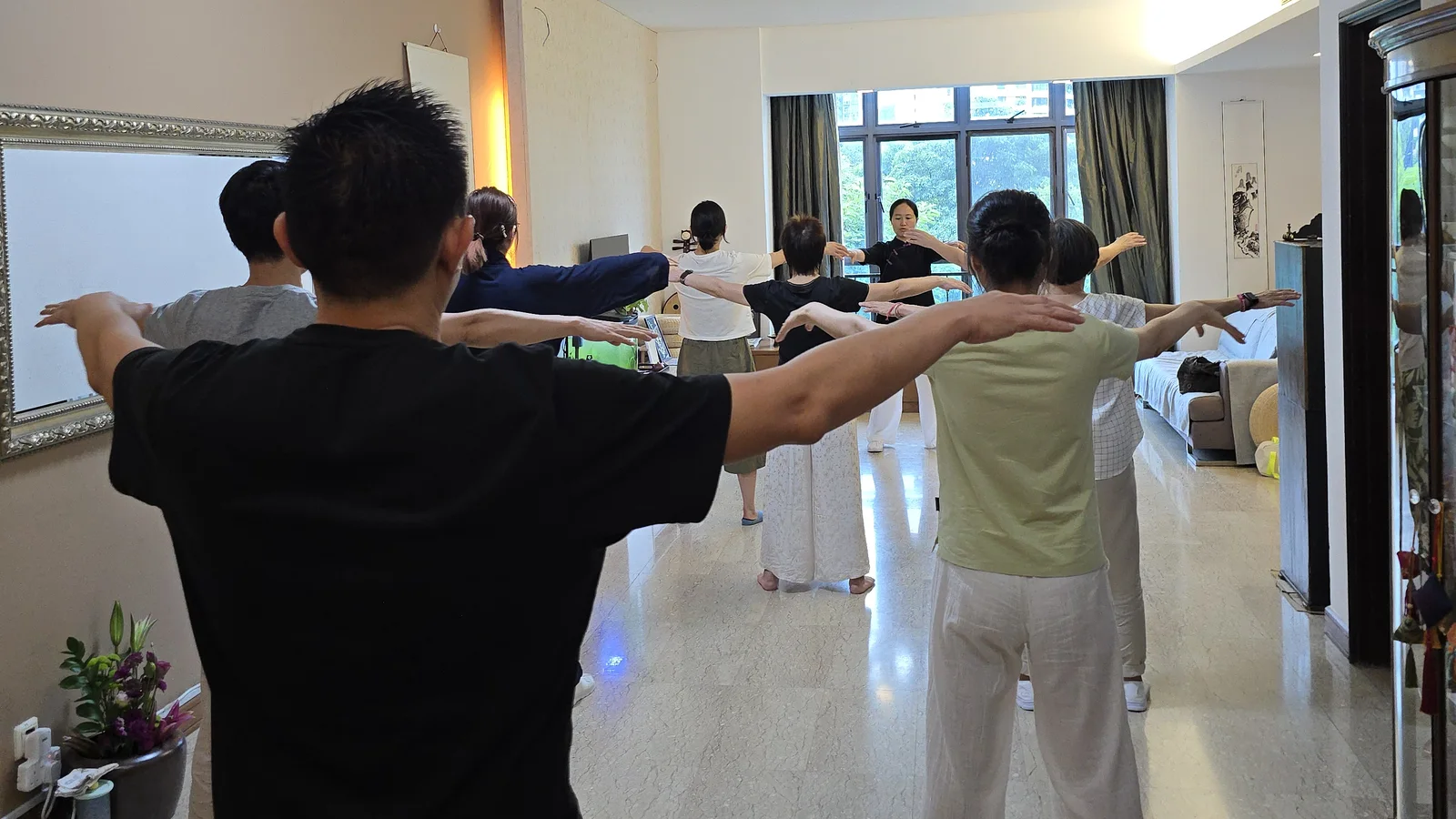
A standing qigong class in a sunlit room: students seen from behind hold both arms open at shoulder height in the same alignment, facing a teacher in dark clothing before a tall window with green trees outside.

1. Historical Textual Roots: Tao Hongjing's Yangxing Yanming Lu and Sun Simiao

The Six Healing Sounds (Liuzijue 六字诀, literally "Six-Character Formula") is one of the oldest and best-documented breath-guiding (xingqi 行气) practices in the Taoist canon. Its earliest extant systematic formulation appears in the Yangxing Yanming Lu (《养性延命录》, Records on Nourishing Nature and Extending Life), attributed to the Southern Dynasties Taoist polymath Tao Hongjing (陶弘景, 456–536): "There is one way of inhaling Qi, and there are six ways of exhaling Qi. The one way of inhaling means inhaling through the nose; the six ways of exhaling mean exhaling through the mouth with Chui, Hu, Xi, He, Xu, and Si" (纳气有一,吐气有六。纳气一者,谓吸也;吐气六者,谓吹、呼、唏、呵、嘘、呬).

During the Tang dynasty, the celebrated physician-sage Sun Simiao (孙思邈, 581–682) paired the six sounds explicitly with the Five Phases (Wuxing 五行), the four seasons, and the internal organs in his Weisheng Ge (《卫生歌》): "Spring Xu clears the eyes and Wood assists the Liver; Summer reaches the Heart with He so fire is naturally stilled; Autumn Si stabilizes and gathers Metal and the Lungs; for the Kidneys, Chui brings calm; the Triple Burner uses Xi to clear heat; in all four seasonal transitions, long Hu harmonizes the Spleen." In this first part of our two-part guide, we practice the first three sounds following the natural Five-Phase generative sequence (Wood → Fire → Earth): Xu (嘘), He (呵), and Hu (呼).

2. The First Sound — Xu (嘘) for Wood and the Liver: Soothing Rib-Side Stagnation

In classical Five-Phase physiology, Wood (Mu 木) corresponds to spring, the Liver (Gan 肝), the Gallbladder, the sinews (jin 筋), and the eyes. When stress or frustration causes Liver Qi to stagnate, the flank ribs feel tight and the eyes feel dry or strained (complementing our Soothing Liver Qi and Rib-Side Daoyin and Eye and Neck Refresh Daoyin).

Mouth Shape and Breath: Stand with feet shoulder-width apart and both hands resting at the sides of the waist with palms facing up. Inhale gently through the nose. On the exhalation, draw the corners of the mouth slightly back, leave a narrow horizontal space between the upper and lower teeth with the sides of the tongue lightly touching the upper molars, and exhale a long, whisper-soft "Xū" (similar to a gentle "shh" with rounded-back lips) while rotating the torso slightly to the left and extending the right palm diagonally forward at shoulder height, gazing softly past the palm. Inhale as the right hand returns to the waist, and repeat on the left side for six total repetitions (three on each side).

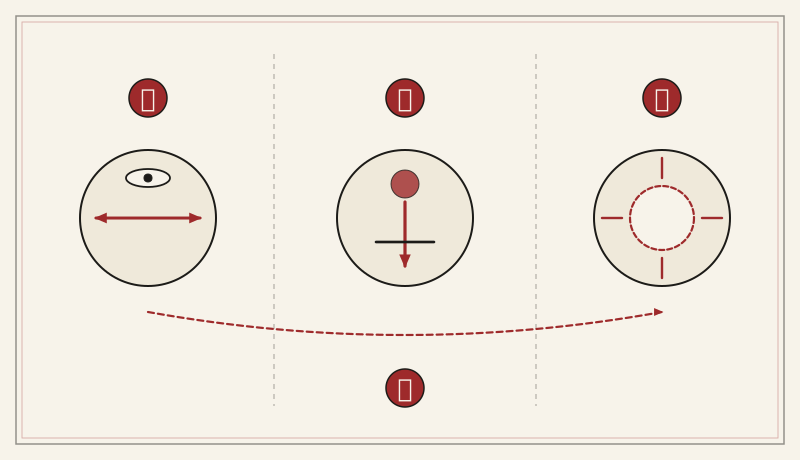
Classical ink-and-cinnabar diagram of the Six Healing Sounds (Liuzijue) Part 1 with four numbered markers (①–④) illustrating the Xu (Wood/Liver), He (Fire/Heart), and Hu (Earth/Spleen) breath-guiding postures and the one-inhalation six-exhalations principle.

Figure 1: Classical Liuzijue Breath-Guiding Cycle (Part 1: Wood, Fire, Earth) — ① Xu Sound (Wood / Liver / Flank Rib Alternation and Clear Gaze); ② He Sound (Fire / Heart / Chest-to-Dantian Settling Palms); ③ Hu Sound (Earth / Spleen-Stomach / Middle Burner Spherical Expansion and Gathering); ④ Tao Hongjing's foundational rule: 'One way of inhaling through the nose, six ways of sub-vocal exhaling through the mouth' (Na Qi You Yi, Tu Qi You Liu).

  1. ① Xu Sound (嘘字诀 · Wood / Liver): Corners of the lips draw back slightly with a soft 'shh/xū' exhalation while alternating palms extend to soothe the ribs and eyes.
  2. ② He Sound (呵字诀 · Fire / Heart): Tongue rests near the lower palate with a gentle 'hē' sigh while both palms gather before the chest and press softly down to the lower abdomen.
  3. ③ Hu Sound (呼字诀 · Earth / Spleen-Stomach): Lips round like a flute hole with a warm 'hū' exhalation while the palms open and gather like a sphere in front of the middle abdomen.
  4. ④ One Inhalation, Six Exhalations (纳气有一 · 吐气有六): Inhaling quietly through the nose and exhaling softly without harsh vocal cord strain.

3. The Second and Third Sounds — He (呵) for Heart Fire and Hu (呼) for Spleen Earth

Following the generative cycle where Wood feeds Fire (Mu Sheng Huo 木生火) and Fire produces Earth (Huo Sheng Tu 火生土), the practitioner moves directly into He and Hu:

  • He Sound (呵字诀 — Fire / Heart): Corresponds to summer, the Heart (Xin 心), and the tongue (explored in detail in Calming Heart Fire and Summer He-Breath Daoyin). Inhale through the nose as both palms scoop up in front of the abdomen to chest height; turn the palms downward, part the lips slightly with the tongue resting softly near the lower jaw, and exhale a warm, unhurried "Hē" (like a gentle, restful sigh "huh/ha") while pressing both palms smoothly down to the lower dantian six times.
  • Hu Sound (呼字诀 — Earth / Spleen and Stomach): Corresponds to late summer and seasonal transitions, the Spleen and Stomach (Pi Wei 脾胃), and the lips (complementing Soothing the Spleen and Stomach Abdominal Daoyin). Hold both palms in front of the middle abdomen (Zhongwan 中脘 area) as if cradling a hollow sphere. Inhale through the nose; on the exhalation, round the lips into a small circle (like blowing gently across a bowl of warm soup) and breathe out a soft, steady "Hū" while expanding both palms slightly outward from the abdomen; inhale as the palms gather back toward the navel, repeating six times.

4. The Secret of "Sub-Vocal" Breathing (吐气不发声) and Daily Practice

In the traditional Daoyin transmission on Wudang Mountain and in our Singapore classes, the golden rule of Liuzijue is "exhaling Qi through the mouth shape rather than shouting with the throat" (tuqi bu fasheng 吐气不发声). Beginners may whisper the sound softly at first to learn the exact tongue and lip positions, which create subtle acoustic resonance and back-pressure corresponding to each organ pathway; once familiar, let the sound become an almost silent, velvety stream of air (绵绵若存) paired with Natural Abdominal Breathing.

Practice six repetitions each of Xu, He, and Hu in sequence (taking roughly six minutes), pausing for two normal nasal breaths between each sound, and conclude with Standing Post Closing and Self-Massage (Shougong). Traditional Liuzijue Daoyin supports relaxation, respiratory coordination, and emotional balance and never replaces professional medical diagnosis or treatment.

Seeker’s Q&A · Frequently Asked Questions

What is the core takeaway of Six Healing Sounds (Liuzijue) Guide Part 1?

Learn the classical Taoist Six Healing Sounds (Liuzijue) recorded in Tao Hongjing's Yangxing Yanming Lu — practicing the first three sounds of the Wood-Fire-Earth generative cycle: Xu (Liver/Eyes), He (Heart/Tongue), and Hu (Spleen-Stomach/Lips).
