
QIGONG & YANGSHENG · 气功与导引

Warming Yanggu (SI-5) and Yanglao (SI-6): Wudang Daoyin for the Ulnar Styloid Cleft, Supple Forearm Silk-Reeling, and Refreshing the Neck and Gaze 温煦阳谷(SI-5)与养老(SI-6):武当手太阳小肠经“转手开穴”导引、尺桡旋腕与舒颈明目功

How rotating the palm toward the chest opens the hidden bony cleft of Yanglao (SI-6) on the head of the ulna, unlocking distal radioulnar pronation-supination in Cloud Hands and Wudang sword work.

A standing qigong class in a sunlit room: students seen from behind hold both arms open at shoulder height in the same alignment, facing a teacher in dark clothing before a tall window with green trees outside.

The Dynamic Bony Gate on the Dorsal-Ulnar Wrist: Yanggu (SI-5) and Yanglao (SI-6)

In earlier guides of our Wudang wrist Daoyin (导引) series, we explored the outer fifth-metacarpal edge of the hand at Houxi (SI-3) and Wangu (SI-4), as well as the volar-ulnar tendon groove of the Heart meridian at Shenmen (HT-7) through Lingdao (HT-4). Continuing proximal along the Hand Taiyang Small Intestine Meridian (手太阳小肠经) across the dorsal-ulnar wrist crease brings us to two points that directly govern the rotational pivot of the forearm (the distal radioulnar joint 尺桡远侧关节):

  1. Yanggu (SI-5 阳谷, "Yang Valley") — the Jing-River Fire point (经火穴) of the Hand Taiyang channel, sitting directly in the depression on the ulnar border of the wrist between the triquetrum bone (三角骨) distally and the ulnar styloid process (尺骨茎突) proximally.
  2. Yanglao (SI-6 养老, "Nourishing Vitality") — the Xi-Cleft point (郄穴) of the Hand Taiyang channel, nestled inside the narrow bony cleft on the radial border of the head of the ulna (1.0 cun proximal to the wrist crease)—a cleft that physically opens beneath your fingertip only when the forearm rotates!

In the traditional wellness and martial curriculum preserved at Wudang Mountain (a UNESCO World Heritage Site inscribed in 1994, located at No. 72 Jianhe 2nd Road, Wudangshan Special Economic Zone, Shiyan, Hubei, China) and practiced in Singapore at Lee Wudang International Pte. Ltd. (58A Smith Street (2nd Floor), Singapore 058962), warming Yanggu (SI-5) and Yanglao (SI-6) bridges Qigong joint care with the spiral forearm mechanics (Chansijin 缠丝劲) of Taijiquan and Wudang straight sword (Jianfa 剑法).

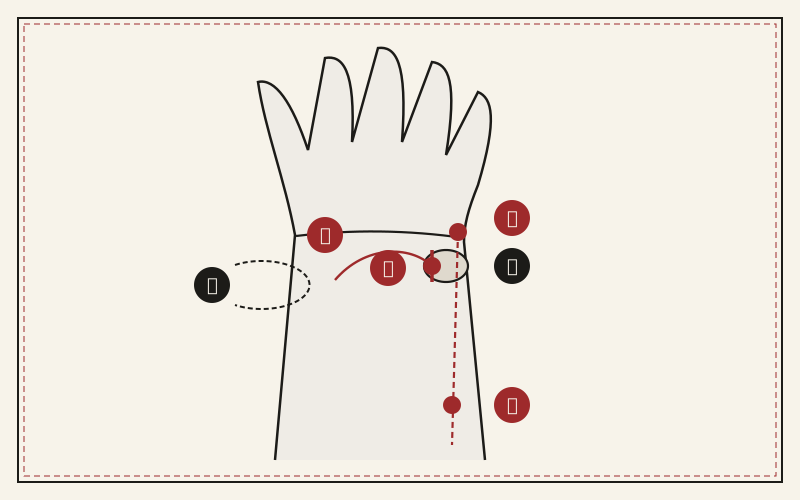
Classical Wudang anatomical diagram of Yanggu SI-5, Yanglao SI-6 ulnar styloid cleft, and Zhizheng SI-7 during forearm rotation
Figure 1 — Locating Yanggu (SI-5) and the Rotating Bony Cleft of Yanglao (SI-6): ① Rounded head of the ulna and ulnar styloid process (尺骨头与尺骨茎突) on the dorsal-ulnar wrist; ② Yanggu (SI-5 阳谷, Jing-River Fire gate in the depression between the triquetrum bone and ulnar styloid process); ③ Yanglao (SI-6 养老, Xi-Cleft gate inside the radial bony cleft of the ulnar head); ④ Rotational arc of forearm supination (turning the palm toward the chest) that opens the Yanglao cleft; ⑤ Index-finger pad press-and-rotate Daoyin contact; ⑥ Ascending Hand Taiyang line toward Zhizheng (SI-7 支正) and the scapula.

1. Classical Textual Sources and the "Turn-the-Palm" Landmark Rule (Zhuanshou Kaixue 转手开穴)

In the Huangdi Neijing Lingshu (黄帝内经·灵枢, Chapter 2 Ben Shu 本输 and Chapter 10 Jingmai 经脉) and Huangfu Mi's (皇甫谧, 215–282 CE) Zhenjiu Jiayijing (针灸甲乙经, Scroll 3), the two points are defined by the bony prominence at the dorsal-ulnar wrist known in antiquity as the "outer ankle of the hand" (Shou Waihuai 手外踝, the head and styloid process of the ulna):

"The Small Intestine flows through Yanggu: Yanggu lies on the outer border of the wrist, in the depression beneath the sharp round bone (Rui Gu zhi Xia Xiazhong 锐骨之下陷者中); this is the Jing-River point... Yanglao is the Xi-Cleft of the Hand Taiyang, located in the depression one cun behind the wrist bone (Huai Hou Yi Cun Xiazhong 踝后一寸陷者中)."
— Huangdi Neijing Lingshu (Ben Shu) & Zhenjiu Jiayijing (Scroll 3)

Why do classical acupuncture manuals and Wudang Daoyin teachers insist that you cannot find Yanglao (SI-6) with a static, flat hand? Let us trace the exact three-step biomechanical test on your own wrist:

  • Step 1 — Locate Yanggu (SI-5, ②) at the Ulnar Valley: Hold your left hand sideways. Slide your right index finger down the outer (little-finger) edge of the fifth metacarpal past Wangu (SI-4) and the triquetrum bone until your fingertip drops into the deep hollow right at the dorsal wrist crease, immediately distal to the tip of the ulnar styloid process (①). Gently flexing and extending the wrist confirms that you are in the joint valley of Yanggu (SI-5).
  • Step 2 — Rest Your Finger on the Highest Dome of the Ulnar Head (①): Now turn your left palm face-down (pronation). Look at the back of your wrist on the little-finger side: you will see a prominent round bony knob (the head of the ulna 尺骨头). Place the pad of your right index finger squarely on the highest point of that bony dome.
  • Step 3 — Turn the Palm Toward Your Chest to Open Yanglao (SI-6, ③ & ④): Keeping your right index finger pad resting lightly on that bony knob, bend your left elbow and slowly rotate your left forearm so the palm turns to face your chest or collarbone (supination). As the radius bone swings around the ulna at the distal radioulnar joint, you will feel the smooth bony dome slide beneath your skin and your fingertip will suddenly sink into a distinct vertical bony cleft (骨缝) on the radial-dorsal edge of the ulnar styloid process! That exact cleft is Yanglao (SI-6).

2. How the Distal Radioulnar Joint Governs Taiji Silk-Reeling and Scapular Ease

Understanding the mechanics of Yanggu (SI-5) and Yanglao (SI-6) illuminates two vital connections in Wudang internal arts:

  1. Effortless Forearm Pronation-Supination (Xuanwan Chansi 旋腕缠丝): Every spiral movement of the hand in Wudang Taijiquan—such as turning the palms inward and outward during Cloud Hands (Yunshou 云手), Roll Back (Lv 捋), or Parting the Wild Horse's Mane (Yema Fenzong 野马分鬃), as well as the figure-eight wrist flowers (Huwan 花腕) of the Wudang straight sword and Xuanwu staff—takes place mechanically by the radius rotating around the stationary head of the ulna right at Yanggu (SI-5) and Yanglao (SI-6). When the dorsal wrist capsule and the extensor carpi ulnaris sheath around the ulnar styloid become stiff from mouse/keyboard use, the forearm cannot rotate smoothly, forcing the practitioner to hike the shoulder (Songjian 耸肩).
  2. The Hand Taiyang Bridge from Wrist to Scapula, Neck, and Eyes: From Yanggu (SI-5) and Yanglao (SI-6), the Small Intestine meridian ascends the posterior ulnar forearm past its Luo-Connecting point Zhizheng (SI-7 支正, at 5.0 cun proximal to the wrist crease, ⑥), crosses the back of the shoulder joint (Jianzhen SI-9 and Naoshu SI-10), zigzags across the entire scapula (Tianzong SI-11 and Bingfeng SI-12), climbs the lateral neck (Tianchuang SI-16), and sends branches to the outer canthus (Tongziliao GB-1) and inner canthus (Jingming BL-1) of the eye. In Taoist study—after reading the Tao Te Ching or Qingjing Jing—gently warming Yanglao (SI-6) while rotating the neck is a classic traditional self-care method for refreshing tired eyes and releasing upper-back tightness.

3. Four-Step Wudang Daoyin Protocol for Yanggu (SI-5) and Yanglao (SI-6)

Perform this three-minute sequence sitting upright or standing in a relaxed posture (see our Start Here guide and meditation overview), breathing quietly through the nose like the bellows (Tuoyue) of Tao Te Ching Chapter 5 and without making any health claims:

  1. Warming the Fire Valley at Yanggu (SI-5, 45 Seconds): Pinch the ulnar border of your left wrist lightly between your right thumb (on the palmar side near Shenmen HT-7) and your right index/middle fingers resting in the dorsal-ulnar hollow of Yanggu (SI-5). Perform 24 slow, warm circular rubs while letting the left shoulder blade drop heavily down the back.
  2. Dynamic "Turn-the-Palm" Cleft Pumping at Yanglao (SI-6, 60 Seconds): Place the pad of your right index finger on the crown of the left ulnar head with your left palm facing down. Inhale slowly as you rotate the left palm to face your chest, letting your right index fingertip sink naturally into the opening bony cleft of Yanglao (SI-6); pause for two seconds to apply gentle, warm rotary pressure inside the cleft, then exhale as you rotate the palm back down (12 slow cycles per wrist).
  3. Holding Yanglao (SI-6) with Gentle Neck and Gaze Release (45 Seconds): Keeping your right index finger nestled softly inside the open Yanglao (SI-6) cleft (palm facing chest), slowly turn your head to look left and right (6 times) and blink your eyes softly while gazing into the distance, feeling the entire posterior Hand Taiyang line from wrist to scapula and neck soften.
  4. Ulnar Sweep to Zhizheng (SI-7) and Cloud-Hands Integration (30 Seconds): Glide your thumb and fingers 5.0 cun up the dorsal-ulnar border of the ulna to warm Zhizheng (SI-7), switch sides to repeat on the right wrist, and conclude with six slow cycles of Wudang Cloud Hands (Yunshou), enjoying the frictionless rotation of both wrists.

Seeker’s Q&A · Frequently Asked Questions

Where are Yanggu (SI-5) and Yanglao (SI-6), and why must you turn the palm to find Yanglao?

Both are on the back of the wrist on the little-finger side, around the round bony knob there (the head of the ulna). Yanggu (SI-5) is in the hollow at the wrist crease, between the tip of that knob (the ulnar styloid) and the wrist bone just beyond it. Yanglao (SI-6) is 1 cun above the crease, in a narrow cleft on the thumb side of the head of the ulna, and the cleft opens under your fingertip only when the forearm rotates, as you turn the palm toward your chest. Because these points sit at the joint where the forearm turns, Wudang Daoyin warms them to keep the spiraling “silk-reeling” rotation of Taijiquan and sword work smooth, and pairs the routine with slow turns of the head and soft blinking to ease the neck and eyes.


How can I apply this in practice?

Perform this three-minute sequence sitting upright or standing in a relaxed posture (see our Start Here guide and meditation overview), breathing quietly through the nose like the bellows (Tuoyue) of Tao Te Ching Chapter 5 and without making any health claims.
