QIGONG & DAOYIN · 气功与导引

Rubbing the Kidney Shu Points and Warming Mingmen (Ca Yaoyan): Wudang Lumbar Self-Massage and Daoyin Guide 擦腰眼温肾固命门:武当传统导引的劳宫贴肾俞、摩运八髎与水火既济要法

A classical Wudang Daoyin guide to Ca Yaoyan (擦腰眼温肾固命门法), detailing Laogong-to-Shenshu thermal coupling, Mingmen and Baliao vertical friction, and closing Dantian breath consolidation.


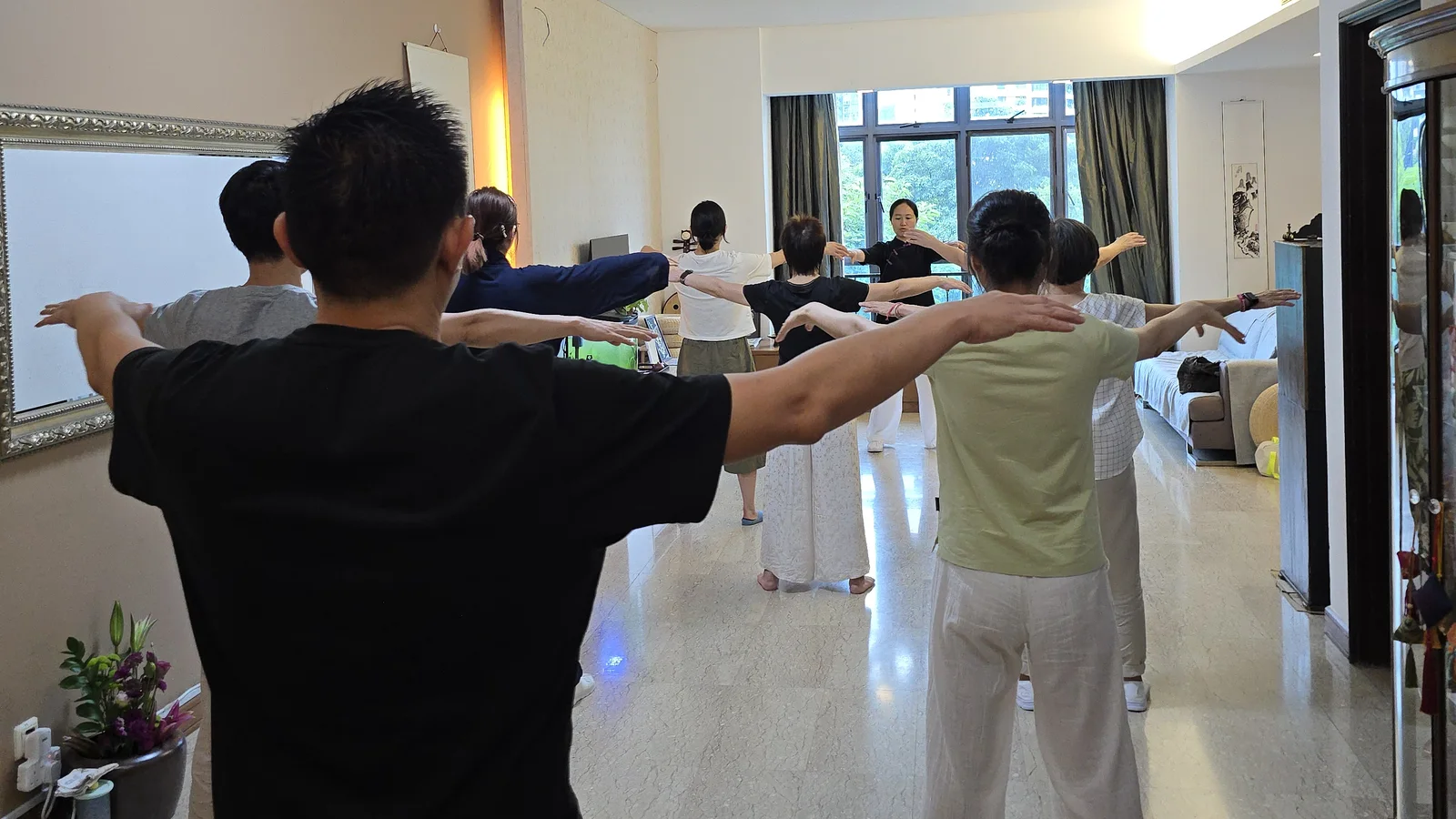
A standing qigong class in a sunlit room: students seen from behind hold both arms open at shoulder height in the same alignment, facing a teacher in dark clothing before a tall window with green trees outside.

The Lumbar Gate in Classical Taoist Physiology: Shenshu, Mingmen, and Yaoyan

In both seated morning cultivation (Sounding the Heavenly Drum and Swallowing the Jade Fluid) and standing Daoyin sets such as the Sixth Brocade of Baduanjin (Two Hands Hold the Feet to Fortify Kidneys and Waist), the lower back is revered as the structural and energetic pivot of the body. Classical longevity compendia including the Yangxing Yanming Lu (养性延命录, studied under Taoist Classics) describe three closely grouped landmarks across the lumbar region: the Gate of Vitality (Mingmen, 命门, GV-4) on the midline beneath the second lumbar vertebra, the Kidney Shu points (Shenshu, 肾俞, BL-23) one-and-a-half cun to either side, and the 'Waist Eyes' (Yaoyan, 腰眼, EX-B7) in the natural muscular depressions slightly further lateral above the iliac crest. The practice of Ca Yaoyan (擦腰眼, 'Rubbing the Waist Eyes') uses palm warmth to nourish these three gates directly.

Coupling Heart-Pericardium Fire (Laogong) with Kidney Water (Shenshu)

Before touching the lower back, the practitioner rubs both palms briskly together (Warming the Palms at Laogong Guide) until the Pericardium palace at the center of each palm (Laogong, 劳宫, PC-8) feels distinctly warm. In classical Taoist Five-Phase (Wuxing, 五行) correspondence, Laogong belongs to Ministerial Fire of the Heart-Pericardium, while Shenshu and Yaoyan belong to Kidney Water. Pressing warm Laogong centers directly over Shenshu and Yaoyan enacts 'Water and Fire Harmonized' (Shui Huo Ji Ji, 水火既济) on the surface of the body: upper warmth descends to gentle the lower lumbar fascia, while lower essence is consolidated.

Vertical Friction Technique: From Shenshu Down Across the Eight Liao (Baliao)

Sitting on the front edge of a wooden stool or standing in a relaxed shoulder-width posture (Wudang Qigong & Daoyin), place both warmed palms flat against the lower back with the thumbs pointing forward at the waist or with the fingers pointing downward along the paraspinal muscles. Keeping the shoulders relaxed and the elbows slightly winged, rub briskly up and down thirty-six times along the vertical corridor from the lower ribs and Shenshu (BL-23) down across the lumbar hollows (Yaoyan) to the sacrum and the Eight Liao foramina (Baliao, 八髎, BL-31 to BL-34). The friction should be brisk enough to generate a deep, penetrating warmth (Re Tou Mingmen, 热透命门) without abrading the skin or tensing the neck.

Cupping Hold at Mingmen and Integrating Into Daily Practice

After thirty-six vertical strokes, do not drop the hands abruptly. Instead, cup both warm palms quietly over Shenshu and Yaoyan for six to nine slow abdominal breaths, allowing the sensation of warmth to radiate inward toward Mingmen and the lower Dantian. As taught in the Wudang Mountain tradition and our Start Here guide, Ca Yaoyan can be practiced for two minutes each morning upon waking, after long hours of desk sitting, or at the close of standing post (Zhan Zhuang) and Taijiquan sessions to keep the lumbar hinge supple and warm.

Seeker’s Q&A · Frequently Asked Questions

What is the key structural alignment in Rubbing the Kidney Shu Points and Warming Mingmen (Ca Yaoyan)?

A classical Wudang Daoyin guide to Ca Yaoyan (擦腰眼温肾固命门法), detailing Laogong-to-Shenshu thermal coupling, Mingmen and Baliao vertical friction, and closing Dantian breath consolidation.
