QIGONG & YANGSHENG · 气功与导引

Wudang Post-Meal Abdominal Rubbing & Slow Hundred-Paces Walking Daoyin (Mofu & Baibuzou): Gentle Earth-Phase Digestion Care 武当食后摩腹与“百步慢行”导引指南:孙思邈《千金方》脾胃中宫温养功法

Learn the classical Taoist post-meal habit recorded by Sun Simiao (581–682 CE)—why gentle navel-centered palm circles (Mofu) and an unhurried hundred-step stroll harmonize the Spleen and Stomach without vigorous strain.

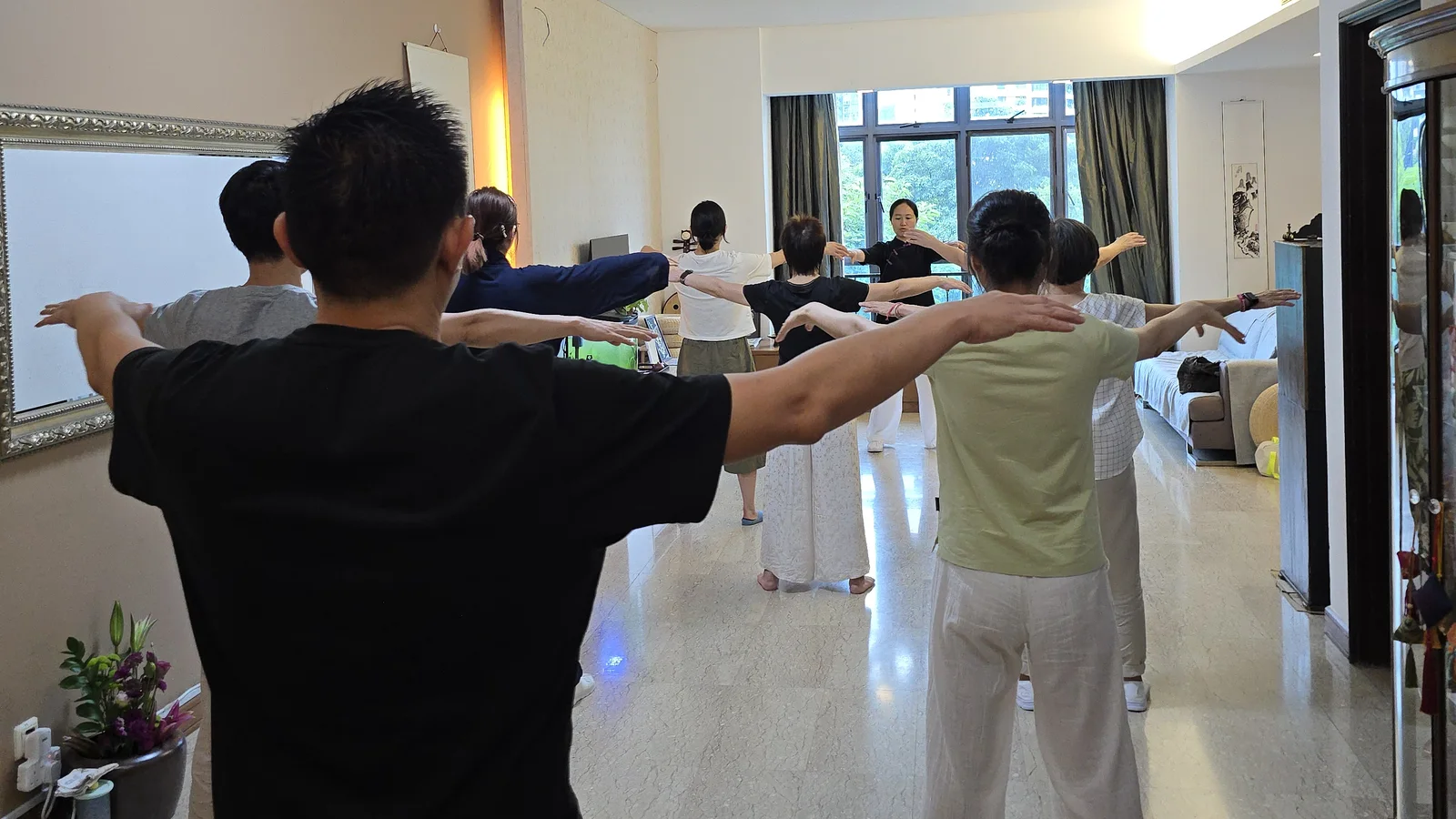
A standing qigong class in a sunlit room: students seen from behind hold both arms open at shoulder height in the same alignment, facing a teacher in dark clothing before a tall window with green trees outside.

1. Classical Sources: Sun Simiao’s “Rub the Abdomen and Walk Slowly After Meals”

In Taoist longevity cultivation, daily eating and digestion are never separate from internal refinement. In the Huangting Jing (Yellow Court Classic), the central abdominal region is honored as the “Yellow Court” (Huangting 黄庭)—the Earth-phase pivot of Spleen and Stomach that nourishes all four limbs. During the Tang dynasty, the renowned physician and Taoist recluse Sun Simiao (孙思邈, 581–682 CE) recorded a famous everyday precept in Volume 27 of his Beiji Qianjin Yaofang (《备急千金要方·道林养性》): “After eating visually moderate meals, always rub the abdomen with your warm hands several hundred times, and walk slowly and unhurriedly for a hundred paces” (Shi bi, chang yi shou mo fu shu bai bian, xing bai bu, bu ke ji zou 食毕,常以手摩腹数百遍,缓行百步,不可疾走).

This simple pairing—gentle abdominal rubbing (Mofu 摩腹, also called Modan 摩丹) followed by an unhurried hundred-step walk (Baibuzou 百步走)—remains a foundational daily habit in traditional Wudang Mountain temple life.

2. Earth-Phase Physiology: Why “Slow and Warm” Supports Spleen Ascending and Stomach Descending

In classical Chinese medicine and the Twelve Two-Hour Organ Clock (where the Stomach and Spleen govern the morning hours of 7:00–11:00 AM), the middle burner relies on balanced directional movement: Spleen Qi ascends to distribute clear nourishment, while Stomach Qi descends to move food smoothly downward. Immediately collapsing into a chair or lying flat after a meal stagnates the middle abdomen; conversely, rushing into brisk exercise diverts blood flow to the limbs and agitates the breath.

  • Warm Palm Friction (Mofu): Light, slow circular strokes around the navel (Shenque 神阙) warm the abdominal wall and invite a calm, unhurried feeling after eating.
  • Unhurried Strolling (Huouxing Baibu 缓行百步): As Ming-dynasty physician Gong Tingxian clarified in his Shoushi Baoyuan (《寿世保元》), “walking a hundred paces after a meal does not mean striding rapidly; it means strolling slowly with relaxed shoulders and quiet steps.”

3. Step-by-Step 8-Minute Post-Meal Mofu and Slow-Walk Routine

Wait five to ten minutes after finishing a meal (never practice when overly full), then follow this gentle four-stage sequence:

  1. Rest and Warm the Palms (静坐温掌 · 1 Minute): Sit or stand upright without slouching over the stomach. Rub both palms together until pleasantly warm, breathing quietly through the nose (natural abdominal breathing).
  2. Gentle Circular Abdominal Soothing (温掌摩腹 · 2 Minutes): Place one palm over the navel (with the other hand resting lightly on top) and trace 36 slow, feather-light circles around the middle abdomen—moving down the left side and up the right side with barely the weight of your clothing—never pressing deeply onto a full stomach.
  3. Unhurried Hundred-Paces Stroll (闲庭缓步 · 4 Minutes): Walk slowly along a quiet corridor, veranda, or park walkway for 100 to 200 gentle paces. Let your arms swing softly from relaxed shoulders, land heel-to-sole as in relaxed Taijiquan stepping, and let your gaze rest calmly ahead rather than looking down at a phone screen.
  4. Standing Return Breath (收功调息 · 1 Minute): Pause standing upright with feet shoulder-width apart, rest both palms lightly below the navel for six quiet breaths, and return to your day feeling light and unhurried.

4. Everyday Practice in Singapore & Important Safety Guidelines

For office workers and students in Singapore who spend long hours seated at desks after lunch, taking eight minutes for light palm warming and a slow, screen-free stroll along a shaded walkway prevents afternoon abdominal heaviness and neck stiffness. Keep two classical cautions in mind: first, after eating, abdominal contact must be feather-light surface warming—never deep kneading; second, wait at least 60 to 90 minutes after a meal before practicing full Zhan Zhuang, standing Baduanjin, or Wudang Taijiquan. Safety note: avoid abdominal massage during pregnancy, after recent abdominal surgery, or if you have acute abdominal pain or ulcers; always consult a qualified healthcare professional for digestive conditions.

Seeker’s Q&A · Frequently Asked Questions

How soon after eating can I practice Mofu (abdominal rubbing) vs. full Qigong or Taijiquan?

Following Sun Simiao’s Qianjin Yaofang, feather-light warm palm circles (Mofu) and a slow 100-pace stroll can be done 5–10 minutes after a moderate meal, whereas full standing Zhan Zhuang, Baduanjin, or Taijiquan should wait 60–90 minutes after eating.


