
QIGONG & DAOYIN · 气功与导引

Eight Brocades (Baduanjin) Step-by-Step Guide Part 1: Postures 1 to 4 for the Triple Burner, Lungs, Spleen, and Five Taxations 传统八段锦分步详解(上篇):前四段(托天理三焦、左右开弓、调理脾胃、往后瞧)精要

Learn the first four postures of the classical Eight Brocades (Baduanjin) practiced in Wudang Daoyin — Holding Up the Heavens (Sanjiao), Drawing the Bow (Heart-Lungs), Separating Heaven and Earth (Spleen-Stomach), and Looking Back (Five Taxations and Seven Injuries).


A standing qigong class in a sunlit room: students seen from behind hold both arms open at shoulder height in the same alignment, facing a teacher in dark clothing before a tall window with green trees outside.

1. Historical Roots of the Eight Brocades (Baduanjin): From Song Dynasty Texts to Wudang Courtyards

Building on our overview of breath and gaze coordination in the Wudang Baduanjin Breathing and Gaze Guide, this two-part practical manual walks step by step through the biomechanics of all eight movements. The name Baduanjin (八段锦 — "Eight Sections of Brocade") is attested in Southern Song dynasty records, notably Hong Mai's (洪迈, 1123–1202) Yijian Zhi (《夷坚志》) and Zeng Zao's (曾慥) Taoist anthology Daoshu (《道枢》, c. 1145), before crystallizing into the classical standing eight-verse rhyme practiced across Taoist and martial communities today.

Why have the first four postures remained the most widely practiced morning wellness sequence in Chinese culture for over eight centuries? Because they systematically awaken the torso's internal cavities from global to specific: Brocade 1 lengthens the entire Triple Burner (Sanjiao 三焦) vertically; Brocade 2 opens the Upper Burner (Heart and Lungs) horizontally; Brocade 3 massages the Middle Burner (Spleen, Stomach, and Liver-Gallbladder) diagonally; and Brocade 4 refreshes the neck, eyes, and upper back through gentle spiral rotation.

2. Brocades 1 and 2: Holding Up the Heavens (Sanjiao) and Drawing the Bow (Heart and Lungs)

First Brocade — Two Hands Hold Up the Heavens to Regulate the Triple Burner (Liangshou Tuotian Li Sanjiao 两手托天理三焦): Stand with feet shoulder-width apart. Interlace the fingers in front of the lower abdomen with the palms facing up. Inhale through the nose as you raise the interlaced hands past the chest and face; above the forehead, turn the palms outward and upward to press toward the sky while gently lifting the heels (tizhong 提踵, as in Yijinjing Wei Tuo III). Pause for a beat, feeling a warm vertical stretch through the ribs and abdomen, then exhale as the heels settle and both arms circle down to the sides. Repeat six to eight times.

  • Second Brocade — Drawing the Bow Left and Right as if Shooting the Hawk (Zuoyou Kaigong Si Shediao 左右开弓似射雕): Step out into a comfortable high or medium Horse Stance (Mabu 马步) and cross the forearms in front of the chest. Inhale as you draw the right hand across to the right shoulder in a loose fist (as if pulling a bowstring) while extending the left arm to the left in an archer's mudra (index finger pointing skyward, thumb open, other three fingers folded), gazing calmly past the left index finger. This horizontal expansion opens the chest (Danzhong) and the Lung channel at the thumb-and-index tip (complementing Nourishing the Lungs and Weiqi Daoyin). Exhale to return to center and repeat to the right side, six to eight times in total.
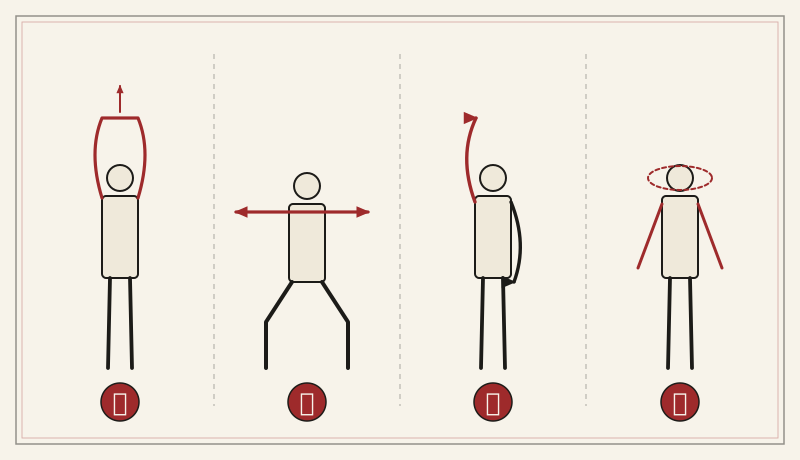
Classical ink-and-cinnabar four-panel diagram of the first four postures of the Eight Brocades (Baduanjin) with four numbered alignment markers (①–④).

Figure 1: Classical Eight Brocades (Baduanjin) Postures 1 to 4 — ① Two Hands Hold Up the Heavens to Regulate the Triple Burner (Liangshou Tuotian Li Sanjiao); ② Drawing the Bow Left and Right as if Shooting the Hawk (Zuoyou Kaigong Si Shediao); ③ Separating Heaven and Earth to Regulate the Spleen and Stomach (Tiaoli Piwei Xu Danju); ④ Looking Back to Treat the Five Taxations and Seven Injuries (Wulao Qishang Wanghou Qiao).

  1. ① Brocade 1 — Holding Up the Heavens (两手托天理三焦): Interlaced palms press skyward while the heels gently lift to lengthen the Upper, Middle, and Lower Burners.
  2. ② Brocade 2 — Drawing the Bow Left and Right (左右开弓似射雕): Horse Stance horizontal expansion opening the chest, scapulae, and Hand-Taiyin Lung channel.
  3. ③ Brocade 3 — Separating Heaven and Earth (调理脾胃须单举): One palm presses upward while the opposite palm presses downward to gently stretch the Spleen and Stomach middle burner.
  4. ④ Brocade 4 — Looking Back at Five Taxations and Seven Injuries (五劳七伤往后瞧): External arm rotation paired with a calm rearward turn of the neck and eyes to ease the neck and the line of the spine.

3. Brocades 3 and 4: Separating Heaven and Earth (Spleen-Stomach) and Looking Back (Five Taxations)

Third Brocade — Separating Heaven and Earth to Regulate the Spleen and Stomach (Tiaoli Piwei Xu Danju 调理脾胃须单举): Return to a shoulder-width stance with both palms resting in front of the navel. On the inhalation, raise the left hand past the chest and turn the palm to press straight up above the left side of the crown (fingers pointing right), while simultaneously turning the right palm to press straight down beside the right hip (fingers pointing forward). Feel the gentle opposing traction across the stomach, spleen, and liver-rib fascia (complementing Soothing the Spleen and Stomach Abdominal Daoyin). Exhale as both hands return to the middle abdomen, then switch sides (right palm pressing Heaven, left palm pressing Earth) for six to eight repetitions.

  • Fourth Brocade — Looking Back to Treat the Five Taxations and Seven Injuries (Wulao Qishang Wanghou Qiao 五劳七伤往后瞧): In classical medicine, "Five Taxations" (Wulao 五劳) refers to over-straining the eyes, lying, sitting, standing, and walking, while "Seven Injuries" (Qishang 七伤) refers to emotional and digestive imbalances. Stand tall with arms hanging beside the hips. As you inhale, externally rotate both arms so the palms turn to face outward/forward while gently turning the head and eyes to look back over the left shoulder toward the left heel without twisting the pelvis. Exhale as the head returns to center and the palms relax inward, then repeat looking over the right shoulder (complementing Eye and Neck Refresh Daoyin).

4. Daily Practice Rhythm and Gentle Joint Modifications

In the morning classes on Wudang Mountain and in Singapore, practicing these first four brocades takes just six to eight minutes: 1) Keep the shoulders down even when pressing overhead — in Brocades 1 and 3, press from the lower ribs and shoulder blades rather than shrugging the upper trapezius into the ears; 2) Choose a comfortable Horse Stance height in Brocade 2 — keep the knees aligned with the second toes and spine vertical; 3) Turn the eyes softly with the neck in Brocade 4 — let the gaze reach the far horizon behind you without straining the cervical vertebrae.

Pause for two quiet abdominal breaths after the fourth brocade or conclude with Standing Post Closing and Self-Massage (Shougong). Traditional Baduanjin Daoyin promotes postural alignment, digestive comfort, and stress relief and never replaces professional medical care.

Seeker’s Q&A · Frequently Asked Questions

What is the core takeaway of Eight Brocades (Baduanjin) Step-by-Step Guide Part 1?

Learn the first four postures of the classical Eight Brocades (Baduanjin) practiced in Wudang Daoyin — Holding Up the Heavens (Sanjiao), Drawing the Bow (Heart-Lungs), Separating Heaven and Earth (Spleen-Stomach), and Looking Back (Five Taxations and Seven Injuries).
