TAOIST PHILOSOPHY · 道家哲学

The Pivot of the Tao at the Center of the Ring (道枢环中 Daoshu Huanzhong) in Zhuangzi’s Qiwulun: Responding Without Exhaustion and Central Equilibrium (Zhongding) in Wudang Taijiquan 《庄子·齐物论》“道枢得其环中,以应无穷”精解:由门枢圆环之喻通向武当太极“中定”与推手不顶不丢

Why standing on the rim of a wheel traps you in endless collision between 'this' and 'that,' while resting at the hollow hub allows effortless 360-degree responsiveness.

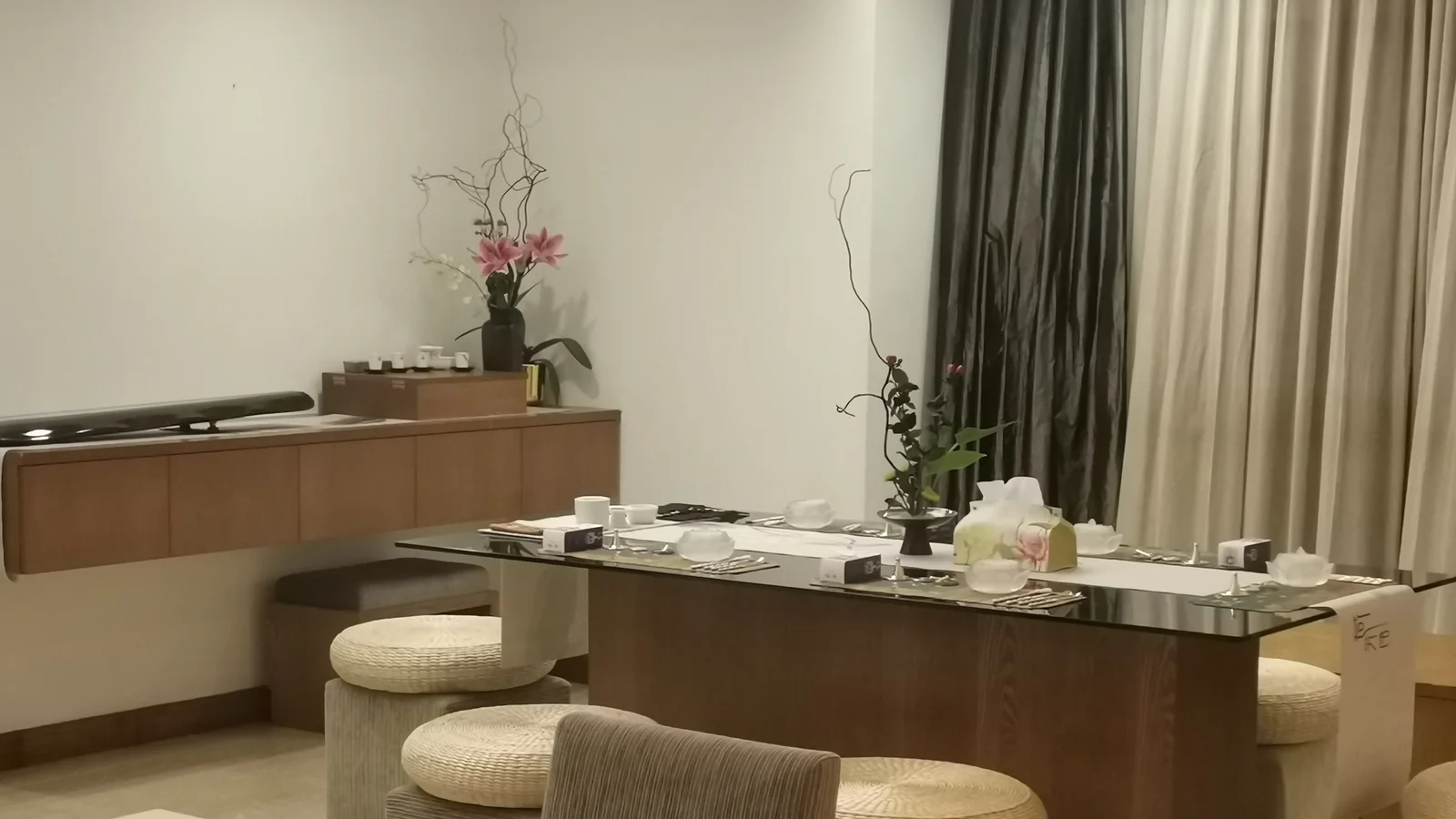
A quiet Taoist study room: a black guqin on a low wooden console beside a pink lily arrangement and tea set, and a dark-glass study table set with white lotus-shaped cups, an incense holder and a floral branch, with straw cushions and a grey curtain.

1. Classical Text and the Architectural Metaphor of the "Pivot of the Tao" (Daoshu 道枢) and "Center of the Ring" (Huanzhong 环中)

Across the thirty-three chapters of the received Zhuangzi, Chapter 2—Qiwulun (齐物论, Discussion on Making All Things Equal)—is universally recognized as the philosophical summit of the Inner Chapters (Neipian 内篇). Whereas Chapter 1 (Xiaoyaoyou) opens the horizon of vast, unencumbered freedom and Chapter 3 (Yangshengzhu) teaches how Cook Ding's blade glides through the natural spaces inside joints, Qiwulun asks a deeper question: why do human beings exhaust their spirit (Shen 神) in endless friction, debate, and physical collision? Zhuangzi's diagnosis is that people lock themselves onto one side of a binary opposition—clinging to "this" (Shi 是, my position, my force, my fixed view) while pushing against "that" (Bi 彼, the other's position, the incoming force)—until both sides wear each other out.

To show how the sage steps out of head-on collision without fleeing the world, Zhuangzi introduces the celebrated image of the Pivot of the Tao (Daoshu 道枢) resting at the Center of the Ring (Huanzhong 环中):

彼出于是,是亦因彼,彼是方生之说也……
是以圣人不由,而照之于天,亦因是也。
彼是莫得其偶,谓之道枢。
枢始得其环中,以应无穷。
是亦一无穷,非亦一无穷也。故曰:莫若以明。

"'That' arises from 'this,' and 'this' likewise depends upon 'that'—such is the doctrine that 'that' and 'this' are born simultaneously...
Therefore the sage does not tread the path of rigid opposition, but illuminates things in the light of Heaven (zhao zhi yu tian 照之于天).
Where 'that' and 'this' no longer stand as opposing adversaries (bi shi mo de qi ou 彼是莫得其偶)—this is called the Pivot of the Tao (wei zhi daoshu 谓之道枢).
Only when the pivot rests at the center of the ring (shu shi de qi huan zhong 枢始得其环中) can it respond to endless changes (yi ying wuqiong 以应无穷).
'This' is one endless cycle, and 'not-this' is also one endless cycle. Therefore it is said: Nothing compares to using clarity (mo ruo yi ming 莫若以明)."

Two concrete physical images from traditional Chinese architecture and craft, explained by the Jin commentator Guo Xiang (郭象, d. 312 CE) and the Tang master Cheng Xuanying (成玄英, fl. 631–655 CE), bring this passage to life:

  1. What Is a Shu (枢 — Door Pivot)? In Ming-era Wudang temple halls, heavy wooden double doors are not hung on modern metal side-hinges screwed into a thin frame; instead, a rounded vertical timber post at the inner edge of the door extends downward into a carved circular granite socket (Menshu 门枢) set deep into the stone threshold. Because that vertical pivot post sits quietly inside its round stone socket, a massive timber door weighing hundreds of jin can swing open and closed ten thousand times without jamming.
  2. What Is Huanzhong (环中 — The Hollow Center of the Ring)? A Huan (环) is a circular jade ring or carriage wheel with an empty hub at the exact center. As Cheng Xuanying notes, if you glue yourself to a point on the outer rim of a spinning wheel, you are thrown up when the rim rises and slammed down when the rim falls, forever locked in a pair of opposites (Ou 偶). Only the empty center of the ring (Huanzhong) touches neither left nor right, neither top nor bottom—and precisely because that center remains empty and unfixed, the ring can rotate 360 degrees to meet any point on the circumference without ever wearing out (Yi Ying Wuqiong 以应无穷).
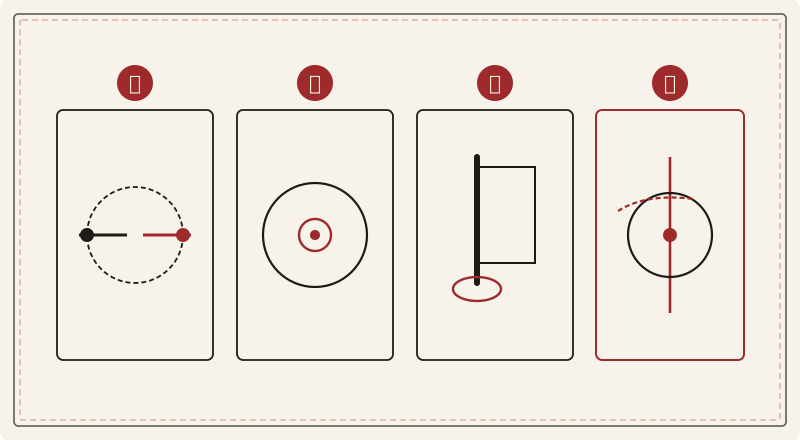
Classical four-panel Wudang diagram for Zhuangzi Qiwulun illustrating binary collision on the outer rim vs the Pivot of the Tao (Daoshu) at the Center of the Ring (Huanzhong), the traditional temple door-pivot socket, and Taiji Push-Hands neutralization
Figure 1 — Philosophical and Biomechanical Architecture of Daoshu Huanzhong (道枢环中): ① Bi Shi De Ou (彼是得偶 — Binary Collision on the Rim): two rigid vectors colliding head-on when trapped on the outer circumference; ② Daoshu De Qi Huanzhong (道枢得其环中 — The Pivot at the Center of the Ring): the unmoving hollow hub governing 360-degree rotation; ③ Traditional Wudang stone door-pivot socket (Menshu) supporting effortless opening and closing; ④ Yi Ying Wuqiong in Wudang Tuishou: neutralizing incoming force along the circular rim while the spinal axis stays centered.

2. How Daoshu Huanzhong Defines "Central Equilibrium" (Zhongding 中定) in Wudang Taijiquan

In the classical theory of Wudang Taijiquan, the Thirteen Postures (Shisanshi 十三势) consist of the Eight Trigram Energies (Peng, Lu, Ji, An, Cai, Lie, Zhou, Kao) and the Five Phase Steps (Jinbu Advance, Tuibu Retreat, Zuogu Look Left, Youpan Gaze Right, and Zhongding 中定 Central Equilibrium). Why is Zhongding honored as the sovereign center (corresponding to the "Yellow Court" Huangting of Central Earth) without which the other twelve techniques collapse? Because Zhongding is the direct somatic embodiment of Zhuangzi's "Pivot at the Center of the Ring" (Daoshu Huanzhong):

  • What Happens When You Lose the Center of the Ring (Shi Zhong 失中): In partner Push Hands (Tuishou 推手) or solo form, the moment you push hard against a partner's push (Ding 顶, "bulling/colliding") or pull away in panic (Diu 丢, "losing contact"), you have stepped off the central hub onto the rim of the wheel. You have made yourself your opponent's "opposing pair" (De Qi Ou 得其偶)—and whoever has greater brute muscle mass will win that head-on collision.
  • What Happens When You Abide at Huanzhong (Bu Ding Bu Diu 不顶不丢): When your crown (Baihui), chest (Huangting), lower Dantian (Qihai and Guanyuan), and perineum (Huiyin) form a quiet, vertical door-pivot (Daoshu) over your supple hips (Kua), your two forearms act as the circular rim of the ring (Huan). If a partner pushes the left side of your ring, the left side yields inward (Lu 捋) while the right side rotates forward (Peng / Ji 掤挤) automatically— fulfilling Huang Zongxi's 1669 Neijia maxim "Overcoming movement through stillness so the attacker falls at a touch".
Zhuangzi Qiwulun PrincipleCommentary Gloss (Guo Xiang & Cheng Xuanying)Wudang Taijiquan, Tuishou & Neigong Embodiment
彼出于是,是亦因彼 (Bi chu yu shi, shi yi yin bi)"That" and "this" arise mutually like left and right, full and emptyIn Taijiquan, Yin and Yang, substantial (Shi) and insubstantial (Xu) continuously give birth to one another
彼是莫得其偶,谓之道枢 (Bi shi mo de qi ou, wei zhi daoshu)Ceasing to collide as one half of a rigid binary pair is the Pivot of the TaoRefusing to meet force with brute counter-force (Bu Ding) so the opponent finds no rigid lever to push against
枢始得其环中,以应无穷 (Shu shi de qi huan zhong, yi ying wuqiong)Resting in the hollow center of the ring allows tireless 360-degree responseKeeping the spinal axis (Zhongding) upright and quiet while the waist, wrists (Taiyuan and Lieque), and forearms revolve like a well-oiled wheel
照之于天……莫若以明 (Zhao zhi yu tian... mo ruo yi ming)Illuminating things with open, mirror-like awareness rather than biased calculationPracticing unbiased tactile listening (Tingjin 听劲) and the Qingjing Jing's Chang Ying Chang Jing

3. From Weapon Circles to Daily Equanimity: Living at the Center of the Ring

The principle of Daoshu Huanzhong governs not only barehand Taijiquan, but also every traditional Wudang weapon and contemplative practice:

  1. In Wudang Straight Sword (Jianfa) and Horsetail Whisk (Fuchen): As we saw in our guides to Wudang straight-sword wrist loops and the Taoist horsetail whisk (Fuchen), the weapon tip traces large, fluid figure-eight rings around the body only because the central waist and the "Alive Grip" (Huo Ba) act as an unjammed pivot (Shu).
  2. In Seated Meditation and Daily Life: When faced with praise or criticism, haste or delay, a person who stands on the outer rim is tossed up and down by every passing event. One who rests at Huanzhong listens clearly, responds appropriately, and returns immediately to calm breathing—preserving the undivided vitality celebrated in the Tao Te Ching and Wuzhen Pian.

4. Living Transmission on Wudang Mountain and in Singapore

Across the ancient stone-socketed timber halls of the UNESCO World Heritage Taoist temple complex on Wudang Mountain (No. 72 Jianhe 2nd Road, Wudangshan, Hubei, China; UNESCO World Heritage guide) and the daily studio classes at Lee Wudang International Pte. Ltd. (58A Smith Street (2nd Floor), Singapore 058962; beginner guide), students can literally see and feel Zhuangzi's metaphor: just as a temple door-pivot rests in its stone socket to swing without effort, your spine rests in your loosened hips during standing post Zhan Zhuang.

Practice Reflection for Students

Stand in shoulder-width Zhan Zhuang with your arms rounded in front of your chest as if holding a large wooden wheel horizontal to the floor: rotate your waist slowly 15 degrees to the left and 15 degrees to the right for twelve breaths, keeping your spine as quiet and vertical as the central axle (Daoshu) while your wrists and palms glide effortlessly along the outer ring (Huan).

Seeker’s Q&A · Frequently Asked Questions

What is the “Pivot of the Tao at the center of the ring” (道枢环中) in the Zhuangzi?

In the Qiwulun chapter, Zhuangzi says that where “this” and “that” no longer stand as opposites, there is the Pivot of the Tao; and only when the pivot rests at the center of the ring can it “respond without end”. The picture is a door pivot turning in its stone socket, or the empty hub of a wheel: whoever clings to the rim is thrown up and down, while the still center meets every point of the circle. In Wudang Taijiquan this is central equilibrium (Zhongding 中定): the spine stays quiet and upright like the pivot while the arms turn like the rim, so in push hands you neither collide with force nor lose contact (不顶不丢).


How can I apply this in practice?

Stand in shoulder-width Zhan Zhuang with your arms rounded in front of your chest as if holding a large wooden wheel horizontal to the floor: rotate your waist slowly 15 degrees to the left and 15 degrees to the right for twelve breaths, keeping your spine as quiet and vertical as the central axle (Daoshu) while your wrists and palms glide effortlessly along the outer ring (Huan).
