TAOIST PHILOSOPHY · 道家哲学

The Passenger Who Falls from a Cart (Zuizhe Zhuiche) in Zhuangzi: Whole Spirit (Shen Quan) and Why Fear Stiffens the Body 《庄子·达生》“醉者坠车”详解:其神全也,为什么紧绷惊惧比跌落本身更伤人?

Why Zhuangzi Chapter 19 (Dasheng) observes that a passenger who falls without panic lands without broken bones—not to praise wine, but to point toward “Wholeness Obtained from Heaven” (De Quan Yu Tian).

A grove of tall bamboo in soft mist.

Anyone who has ever slipped on wet stone steps or watched a martial arts throw knows a counter-intuitive physical truth: it is rarely the fall itself that causes the worst sprain—it is the split-second of panic in which a person locks their elbows, stiffens their neck, and braces rigidly against the ground. More than two thousand years ago, in Chapter 19 of the Zhuangzi—Mastering Life (《庄子·外篇·达生》, Dasheng)—the sage Liezi illustrated this principle with the famous parable of “The Drunken Passenger Who Falls from a Cart” (醉者坠车, Zuizhe Zhuiche).

1. The Classical Passage from Zhuangzi: Mastering Life (《达生》)

When a drunken person falls from a fast-moving cart, though they may be bruised, they do not die (夫醉者之坠车,虽疾不死). Their bones and joints are the same as those of other people, yet the injury they suffer is different—because their spirit is whole (其神全也).

They did not know they were riding in the cart, nor do they know they have fallen out of it. Life and death, alarm and terror do not enter their breast (死生惊惧不入乎其胸中); therefore, when they collide with things, they do not flinch or stiffen (是故遻物而不慴).

If someone who obtains such wholeness merely from wine is like this, how much more one who obtains wholeness from Heaven (彼得全于酒而犹若是,而况得全于天乎)!

2. “Wholeness from Wine” vs. “Wholeness from Heaven” (得全于天)

To read this passage accurately, we must notice Zhuangzi’s structure—“If X is true even in a lesser case, how much more in the highest case!” (况……乎). Zhuangzi is certainly not advising seekers to drink wine or dull their minds. Rather, he is using a familiar everyday observation to point toward awake, unclouded composure:

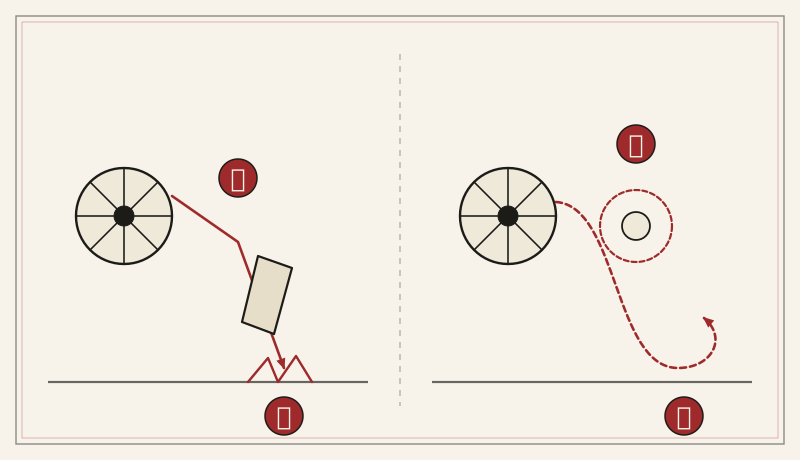
Classical ink-and-cinnabar diagram of Zhuangzi's Passenger Falling from a Cart (Zuizhe Zhuiche) comparing rigid fear-braced impact on the left with whole-spirit elastic rolling dispersion of force on the right

Panic-Bracing vs. Whole-Spirit Elasticity in Zhuangzi: Dasheng (《庄子·达生》惊惧僵顶与神全卸力对比图解).

  1. Alarm and Terror Enter the Breast (死生惊惧入乎胸中 · 神散气滞): anticipatory fear freezes the breath and locks the shoulders, elbows, and spine before contact
  2. Brittle Collision Against the Ground (以刚撞刚 · 折损筋骨): a locked frame transmits 100% of the shockwave straight into the joints
  3. Unbroken Wholeness of Spirit (其神全也 · 遻物而不慴): when the heart-mind does not flinch in panic, the joints remain soft and connected
  4. Wholeness Obtained from Heaven (得全于天 · 顺势圆转): like water or a rolling wheel (The Softness of Water), the supple body yields and disperses momentum harmlessly

3. How “Meeting Contact Without Flinching” (遻物而不慴) Guides Wudang Taijiquan

In Wudang Push Hands (Tuishou), the four characters Wu wu er bu she (遻物而不慴, “meeting an incoming object without startle-stiffening”) describe the highest threshold of Tingjin (Listening Energy):

  • When a sudden push comes toward your chest, the untrained reflex is to flinch, blink, hold the breath, and stiffen the shoulders—instantly uprooting your own stance.
  • When your spirit is whole and settled in the lower Dantian (Shouyi), sudden contact triggers zero startle reflex: your waist and kua fold smoothly (as in Rufeng Sibi) and absorb the incoming momentum like a deep cushion.

4. Cultivating Calm Wholeness Between Wudang Mountain and Singapore

Connecting the living contemplative heritage near Wudang Mountain’s UNESCO World Heritage ancient Taoist temples with our regular classes in Singapore, Wudang.Org helps practitioners replace reactive tension with grounded composure. Begin on Start Here.

Seeker’s Q&A · Frequently Asked Questions

Is Zhuangzi praising drunkenness in the parable of the Drunken Passenger Falling from a Cart (Zuizhe Zhuiche 醉者坠车)?

No! Zhuangzi uses a classic “how much more” argument: if someone who temporarily forgets fear through wine escapes severe injury because their body does not stiffen in panic, how much greater is a sober sage who attains true, awake fearlessness from Heaven (“De Quan Yu Tian” 得全于天).

Why does “fear entering the breast” (死生惊惧入乎其胸中) cause worse injury during a fall or impact?

Because panic triggers an instantaneous startle reflex that locks the breath and stiffens every joint into a rigid lever, causing the full force of impact to snap into the bones and ligaments instead of dispersing smoothly.

What does “Wu wu er bu she” (遻物而不慴) mean for Wudang Taijiquan practitioners?

It means “making contact with an incoming force without flinching or stiffening in alarm”—allowing your waist and joints to stay soft and responsive even when a partner pushes suddenly.
