

TAOIST PHILOSOPHY · 道家哲学

The Joy of Fishes (Haoliang zhi Bian) in Zhuangzi: Empathic Knowing on the Hao River Bridge and How Understanding Arises Alongside the Stream 《庄子·秋水》“濠梁之辩(子非鱼,安知鱼之乐)”详解:我知之濠上也

Why Zhuangzi answers Huizi’s logical trap (“You are not a fish—how do you know the joy of fishes?”) by pointing back to the bridge itself: “I know it right here alongside the Hao.”

A flat stone-slab footbridge crossing a rushing mountain stream among mossy boulders, bamboo and pines.

At the very end of Chapter 17 of the Zhuangzi—Autumn Floods (《庄子·外篇·秋水》)—two lifelong philosophical friends, Zhuangzi and the logician Huizi, take a quiet walk across a stone weir-bridge over the Hao River (濠梁). In less than ninety Chinese characters, their playful exchange—known throughout East Asian history as “The Debate on the Hao Bridge” (濠梁之辩, Haoliang zhi Bian) or “The Joy of Fishes” (鱼之乐)—illuminates one of the most important questions in Taoist philosophy: How can one living being genuinely understand and resonate with another?

1. The Classical Dialogue at the Close of Autumn Floods (《秋水》)

Zhuangzi and Huizi were strolling on the bridge over the Hao River. Zhuangzi said: “See how the white minnows come out and swim about so unhurriedly—this is the joy of fishes (鲦鱼出游从容,是鱼之乐也)!”

Huizi replied: “You are not a fish—from where do you know the joy of fishes (子非鱼,安知鱼之乐)?”

Zhuangzi said: “You are not me—from where do you know that I do not know the joy of fishes (子非我,安知我不知鱼之乐)?”

Huizi answered: “I am not you, so I certainly do not know you; yet you are certainly not a fish, and that proves completely that you do not know the joy of fishes!”

Zhuangzi said: “Let us return to the root of your question (请循其本). When you asked, ‘From where (安, an) do you know the joy of fishes?’, you already knew that I knew it, and were asking me from where I knew it. I know it right here above the Hao (我知之濠上也)!”

2. Two Ways of Knowing: Analytical Separation vs. Living Resonance

At first glance, Zhuangzi’s final line plays wittily on the classical Chinese word an (安), which can mean both “how” and “where.” Yet beneath the verbal wit lies a profound philosophical contrast that echoes Chapter 54 of the Tao Te Ching (Dao De Jing) (“Observe other bodies through your own body; observe the world through the world”):

  • Huizi’s Wall of Solipsism (“You Are Not X, Therefore You Cannot Know X”): If Huizi’s premise is taken as absolute, then not only is a human cut off from a fish, every human being is locked inside an isolated prison of their own skull (“I am not you, so I certainly do not know you”).
  • Zhuangzi’s “Returning to the Root” (请循其本 · 我知之濠上也): Before Huizi erected his conceptual wall, both friends were standing together in the morning breeze above the clear water, watching the minnows glide unhurriedly. Because human beings, clear water, and darting minnows all share the same living breath of Heaven and Earth (Tianlai & Qiwu Lun: “Heaven and Earth are born together with me, and the ten thousand things are one with me”), an unclouded heart-mind (Mirror-Like Mind) directly perceives ease and constriction without needing a syllogism.
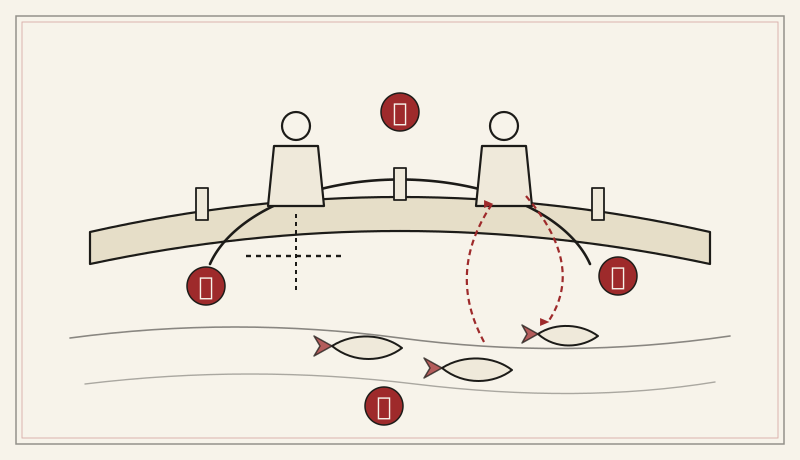
Classical ink-and-cinnabar diagram of Zhuangzi's Debate on the Hao Bridge (Haoliang zhi Bian) showing Zhuangzi and Huizi standing on the stone arch bridge above, the minnows swimming freely in the clear stream below, Huizi's analytical barrier on the left, and Zhuangzi's direct empathic resonance loop on the right

Anatomy of the Hao Bridge Debate (《庄子·秋水》濠梁之辩:由名理隔阂返归濠上感通).

  1. Strolling Together on the Hao Bridge (濠梁之上 · 二哲同游): both thinkers stand before the same living scene of clear water and morning air
  2. Unhurried Minnows in the Stream (鲦鱼出游从容 · 自然适性): when a creature moves freely in its natural element without fear or haste, its vitality is directly visible (Ziran)
  3. Huizi’s Conceptual Barrier (子非鱼 / 子非我 · 逻辑割裂): treating every being as an isolated atom cuts off sympathy even between two friends
  4. “I Know It Right Here Above the Hao” (请循其本 · 我知之濠上也): when the heart-mind is quiet (Xinzhai), understanding arises directly in the shared presence of the moment

3. How “Knowing Above the Hao” Applies to Wudang Push Hands and Landscape Art

  • In Tingjin (Listening Energy) and Wudang Push Hands: If Huizi were right that “I am not you, so I cannot know you,” partner sensitivity would be impossible! In Wudang practice, you do not read your partner’s mind telepathically; rather, by relaxing your own shoulders and wrists where your forearms touch (“right here on the bridge”), you feel the exact speed, direction, and tension of their force in real time (“felt in the hand and answered in the heart”).
  • In Chinese Shanshui Painting and Poetry: Generation after generation of Taoist artists and poets returned to Haoliang because genuine art is born when the observer stops looking at nature as a dead external object and walks alongside the stream in quiet companionship (Wuhua).
An arched grey stone bridge with a low parapet over a clear shallow mountain stream, with bamboo, pines and morning mist in the valley beyond.

The Hao River Bridge (Zhuangzi Chapter 17): “You are not a fish—how do you know the fish are happy?”

4. Walking by the Stream Between Wudang Mountain and Singapore

Connecting the clear mountain streams near Wudang Mountain’s UNESCO World Heritage ancient Taoist temples with our regular classes in Singapore, Wudang.Org invites you to cultivate living sensitivity in movement and contemplation. Begin your journey on Start Here.

Seeker’s Q&A · Frequently Asked Questions

What is the philosophical meaning of Zhuangzi’s reply “I know it right here above the Hao” (我知之濠上也)?

Beyond the playful pun on “how/where” (an 安), Zhuangzi points back to pre-conceptual lived experience (“returning to the root”): when one stands quietly beside the clear stream without ego barriers, one directly resonates with the unhurried ease of living beings.


How does Zhuangzi expose the flaw in Huizi’s argument “You are not a fish, so how can you know the joy of fishes”?

Zhuangzi shows that if “not being X” makes knowing X completely impossible, then Huizi (“not being Zhuangzi”) could never know what Zhuangzi knows or even ask him a meaningful question—proving that communication itself already presupposes shared empathic ground.

How does the Hao Bridge insight relate to Wudang Taijiquan Tingjin (Listening Energy)?

In Wudang Push Hands, you understand your partner’s force not by abstract analysis from afar, but by softening your own tension at the point of contact so both bodies share a single circuit of motion—knowing it “right there on the bridge.”
