TAOIST PHILOSOPHY · 道家哲学

Courage in Not Daring & The Way of Heaven: Yong Yu Bu Gan and Tian Wang Hui Hui in Tao Te Ching Chapter 73 勇于不敢与天网恢恢:《道德经》第七十三章的柔德守戒与天道四应

An examination of Tao Te Ching (Dao De Jing) Chapter 73, contrasting aggressive bravado (Yong Yu Gan) with disciplined restraint (Yong Yu Bu Gan), the four quiet responses of the Way of Heaven, and the vast net of natural reciprocity (Tian Wang Hui Hui).

A quiet Taoist study room: a black guqin on a low wooden console beside a pink lily arrangement and tea set, and a dark-glass study table set with white lotus-shaped cups, an incense holder and a floral branch, with straw cushions and a grey curtain.

Two Forms of Courage: Yong Yu Gan versus Yong Yu Bu Gan

Chapter 73 of the Tao Te Ching (Dao De Jing) opens with a sharp ethical and martial paradox: 'Courage in daring leads to death; courage in not daring leads to life. Of these two, one brings benefit and one brings harm' (勇于敢则杀,勇于不敢则活。此两者,或利或害). In classical Taoist thought, both stances require genuine courage (Yong, 勇), yet they direct human will in opposite directions. 'Courage in daring' (Yong Yu Gan, 勇于敢) is outward bravado—the impulse to force outcomes, strike first out of impatience, and assert dominance when confronted with uncertainty. By contrast, 'courage in not daring' (Yong Yu Bu Gan, 勇于不敢) is the far rarer fortitude required to hold back from reckless action, remain centered under provocation, and refrain from overstepping natural limits. Rather than passive timidity, Yong Yu Bu Gan is active self-command: it preserves vital breath (Qi, 气) and structural integrity precisely where impulsive aggression shatters itself.

Why the Sage Treats Action as Difficult: You Zhi Nan Zhi

Laozi raises a searching question immediately after contrasting the two courages: 'Who knows why Heaven dislikes what it dislikes? Even the sage considers it difficult' (天之所恶,孰知其故?是以圣人犹难之). In Wang Bi's (王弼) commentary and the Huainanzi (淮南子·道应训), what Heaven dislikes is arrogant overextension—the presumption that human calculation and forceful assertion can override the subtle balance of The Tao itself. Because the full repercussions of any forceful intervention ripple beyond immediate sight, the sage approaches every threshold of action as weighty and difficult (You Nan Zhi, 犹难之), echoing Chapter 63's counsel to treat undertakings as grave so that one never falls into recklessness.

Courage in Not Daring & The Way of Heaven: Yong Yu Bu Gan and Tian Wang Hui Hui in Tao Te Ching Chapter 73

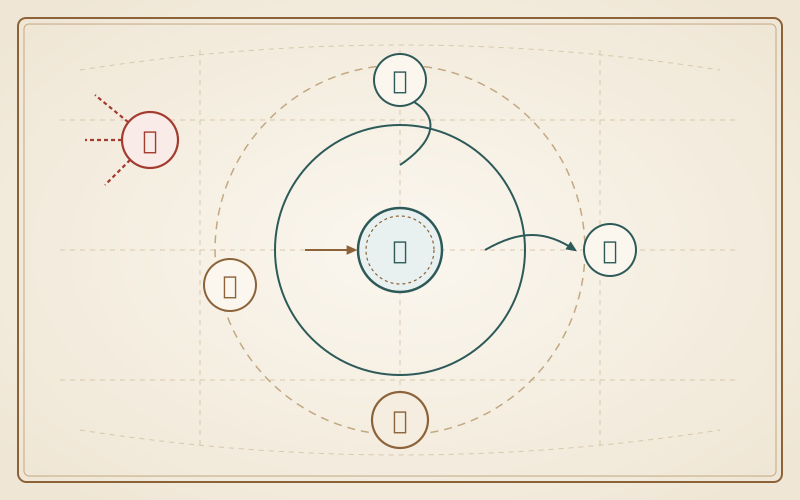
Classical diagram of Tao Te Ching Chapter 73: ① Courage in Daring (Yong Yu Gan — rigid outward overextension leading to exhaustion), ② Courage in Not Daring (Yong Yu Bu Gan — inward restraint preserving vitality), ③ Does Not Contend Yet Excels in Overcoming (Bu Zheng Er Shan Sheng), ④ Does Not Speak Yet Excels in Responding (Bu Yan Er Shan Ying), ⑤ Does Not Summon Yet Comes of Itself (Bu Zhao Er Zi Lai), and ⑥ Vast Net of Heaven (Tian Wang Hui Hui, Shu Er Bu Shi — unhurried structural order that loses nothing).

The Four Quiet Responses of the Way of Heaven (Tian Zhi Dao)

The chapter then sets forth a fourfold portrait of how the Way of Heaven (Tian Zhi Dao, 天之道) operates without coercion: 'The Way of Heaven does not contend, yet excels in overcoming; does not speak, yet excels in responding; does not summon, yet things come of themselves; is unhurried, yet excels in planning' (天之道,不争而善胜,不言而善应,不召而自来,繟然而善谋). Each clause illuminates a foundational principle of Wudang internal cultivation. Not contending yet overcoming (Bu Zheng Er Shan Sheng, 不争而善胜) mirrors the yielding mechanics of Taijiquan, where aligning with incoming momentum neutralizes force without collision. Not speaking yet responding (Bu Yan Er Shan Ying, 不言而善应) corresponds to tactile listening skill (Tingjin, 听劲), where the body answers structural shifts before verbal thought intervenes. Not summoning yet drawing things naturally (Bu Zhao Er Zi Lai, 不召而自来) reflects rooted equilibrium (Zhongding, 中定), while unhurried planning (Chan Ran Er Shan Mou, 繟然而善谋) describes the calm, unforced coordination of breath and frame.

Tian Wang Hui Hui: The Vast Net of Natural Reciprocity

Chapter 73 concludes with one of the most celebrated images in Chinese philosophical literature: 'The net of Heaven is vast; though its meshes are wide, nothing is lost' (天网恢恢,疏而不失). Unlike rigid human legalism or anxious micromanagement—which weaves tight, suffocating meshes yet still fails to prevent disorder—the order of The Tao itself is spacious and unhurried (Shu, 疏). In both personal conduct and internal martial training, every habitual tension, premature strike, or greedy overreach inevitably registers its own structural consequence, while patient alignment with Yong Yu Bu Gan quietly sustains resilience across decades of practice.

Seeker’s Q&A · Frequently Asked Questions

How does Courage in Not Daring & The Way of Heaven guide daily Wudang cultivation?

An examination of Tao Te Ching (Dao De Jing) Chapter 73, contrasting aggressive bravado (Yong Yu Gan) with disciplined restraint (Yong Yu Bu Gan), the four quiet responses of the Way of Heaven, and the vast net of natural reciprocity (Tian Wang Hui Hui).
