
TAOIST PHILOSOPHY · 道家哲学

Zhuangzi’s Butterfly Dream and the Transformation of Things (Wuhua): Dissolving Rigid Boundaries Between Self and World 《庄子·齐物论》“庄周梦蝶”与“物化”详解:不知周之梦为胡蝶与,胡蝶之梦为周与?

Why the closing parable of Qiwu Lun does not deny everyday distinctions (“between Zhou and the butterfly there is surely a distinction”), yet frees us to move effortlessly through life’s changes.

An old pine leaning over a flat rock ledge above a sea of clouds at dawn.

Few passages in world philosophy are as famous—or as frequently misunderstood—as the fifty-two Chinese characters that close Chapter 2 of the Zhuangzi, Equalizing Assessments of Things (《庄子·内篇·齐物论》): the Dream of the Butterfly (庄周梦蝶, Zhuang Zhou Meng Die). Casual summaries often treat it as a riddle of epistemological scepticism (“How do I know I am not dreaming right now?”). Yet in the context of Taoist philosophy—coming right after The Three Pipings (Tianlai) and The Pivot of the Tao (Daoshu)—the Butterfly Dream is not about confusion at all. It is the culminating portrait of Wuhua (物化, “the Transformation of Things”).

1. The Classical Text at the Close of Qiwu Lun

At the very end of Chapter 2, Zhuangzi writes:

“Once Zhuang Zhou dreamt that he was a butterfly—a butterfly fluttering happily about, thoroughly enjoying its own intent, not knowing that it was Zhou! Suddenly he awoke, and there he was, palpably and unmistakably Zhou. He did not know whether it was Zhou who had dreamt he was a butterfly, or a butterfly now dreaming that it was Zhou. Between Zhou and the butterfly there is surely a distinction! This is called the Transformation of Things (昔者庄周梦为胡蝶,栩栩然胡蝶也,自喻适志与!不知周也。俄然觉,则蘧蘧然周也。不知周之梦为胡蝶与,胡蝶之梦为周与?周与胡蝶,则必有分矣。此之谓物化).”

Read the second-to-last sentence carefully: “Between Zhou and the butterfly there is surely a distinction!” (周与胡蝶,则必有分矣). Zhuangzi does not blur waking and dreaming into a vague fog: while he is a butterfly among the mountain orchids, he is 100% present as a butterfly (栩栩然); when he wakes on his wooden couch, he is 100% present in the body of Zhuang Zhou (蘧蘧然). What dissolves is not practical clarity, but the anxious ego-clinging that refuses to let one state flow into the next (Life, Death, and the Seasons).

2. Visualising Wuhua: Distinction Within One Unbroken Flow

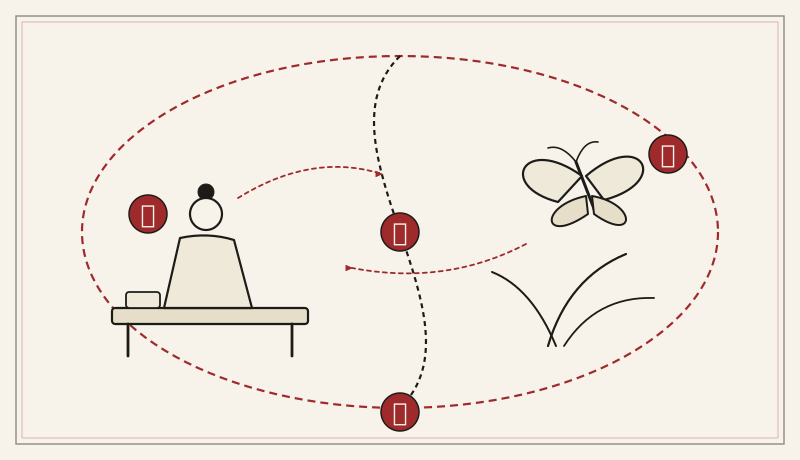
Together with Chapter 25 of the Tao Te Ching (Dao De Jing) (“Moving in a circle and never exhausted”) and Chapter 42, the anatomy of Wuhua can be seen in four linked elements:

Classical ink-and-cinnabar diagram of Zhuangzi's Butterfly Dream and Transformation of Things (Wuhua) showing Zhuang Zhou resting on his wooden couch on the left, the fluttering butterfly among mountain orchids on the right, the clear Yin-Yang boundary of distinction at the center, and the encompassing circle of Wuhua uniting both

Zhuangzi’s four-fold structure of the Butterfly Dream and Wuhua (庄周梦蝶 · 此之谓物化).

  1. Waking Presence as Zhuang Zhou (蘧蘧然周也 · 安住当下之形): when awake on the wooden couch, inhabiting human duties and physical posture with clear awareness
  2. Dreaming Freedom as the Butterfly (栩栩然胡蝶也 · 自喻适志): when fluttering in the dream, enjoying the breeze without looking backward or worrying about status (Xiaoyao You)
  3. Clear Distinction Without Hostile Opposition (周与胡蝶必有分矣 · 分而不隔): waking and dreaming, Yin and Yang, Empty and Full each have their own distinct form (From Wuji to Taiji)
  4. The Encompassing Circle of Wuhua (此之谓物化 · 与造物者游): because both forms arise from the same living Tao, one transforms into the other without grief or resistance

3. How Wuhua Guides Wudang Taijiquan and Daily Adaptability

  • In Wudang Taijiquan: Just as Zhou and the butterfly have a clear distinction (必有分矣) yet transform seamlessly into one another (物化), your left and right legs in Empty and Full Stepping must never be a muddy 50/50 “double-weighted” blur—yet the full leg pours into the empty leg without a single jerky pause.
  • In Seated Meditation (Zuowang) and Daily Life: When you are working at your desk, be fully present at your desk; when you step onto the practice mat or lie down to rest (Evening Wind-Down), let the previous role dissolve completely like a Mirror-Like Mind.
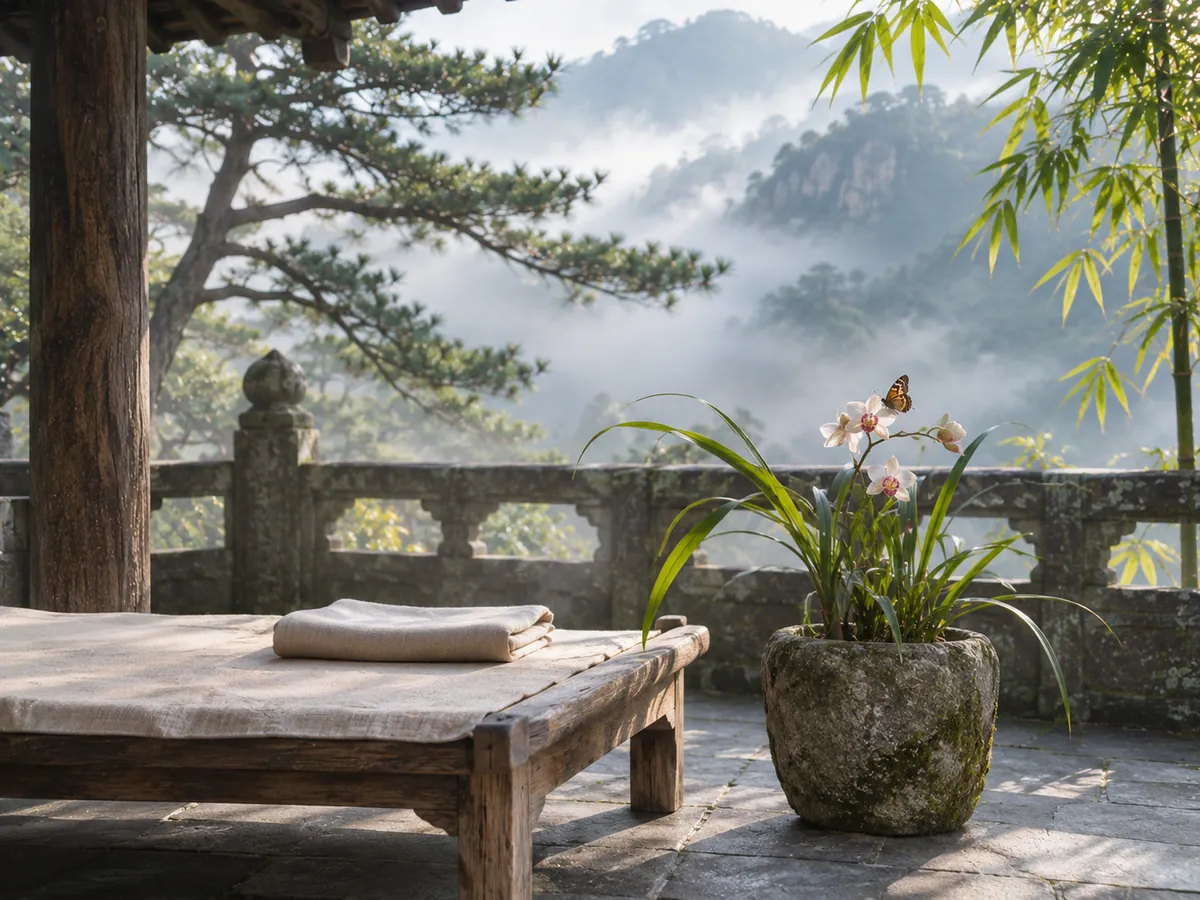
A low unpainted wooden daybed with a folded plain cloth beside a stone pot of wild orchids with a small butterfly resting on a bloom, on a misty mountain veranda.

The Dream of the Butterfly (Zhuangzi Chapter 2): was Zhuang Zhou dreaming a butterfly, or a butterfly dreaming Zhuang Zhou? Between the two there is a distinction, and that is called the transformation of things (wuhua).

4. Experiencing Living Transformation Between Wudang and Singapore

Connecting the mist-wreathed peaks around Wudang Mountain’s UNESCO World Heritage ancient Taoist temples with our regular classes in Singapore, Wudang.Org helps students cultivate supple adaptability in body and mind. Begin your study on Start Here.

Seeker’s Q&A · Frequently Asked Questions

What does “Wuhua” (物化, the Transformation of Things) mean at the end of Zhuangzi’s Butterfly Dream?

Wuhua describes the state in which the rigid boundary between the ego-self and the world dissolves. While acknowledging that everyday forms are distinct (“between Zhou and the butterfly there is surely a distinction”), one flows smoothly from one state or season of life into the next without clinging.


Why does Zhuangzi explicitly state “Between Zhou and the butterfly there is surely a distinction” (周与胡蝶则必有分矣)?

Because Taoist wisdom never flattens reality into a muddled blur. Recognising the clear distinction between waking and dreaming—or between empty and full in Taijiquan—is what allows genuine, harmonious transformation between them.

How does the principle of Wuhua apply to Wudang Taijiquan transitions?

In Taijiquan, each posture has a clear distinction between the full supporting leg and the empty leg (bi you fen), yet as the waist turns and weight shifts, full transforms into empty and empty into full in one continuous, seamless current (wuhua).
