TAOIST PHILOSOPHY · 道家哲学

Hundun and the Seven Openings in the Zhuangzi: Preserving Undivided Wholeness and Guarding the Senses 《庄子·应帝王》浑沌开窍解:日凿一窍与道家收视返听的守中智慧

Explore the closing parable of Zhuangzi Chapter 7 (Ying Di Wang) — Shu, Hu, and the death of Hundun after boring seven openings (Ri Zao Yi Qiao, Qi Ri Er Hundun Si) — and how Wudang Taoist meditation guards the sensory apertures to preserve primordial wholeness.
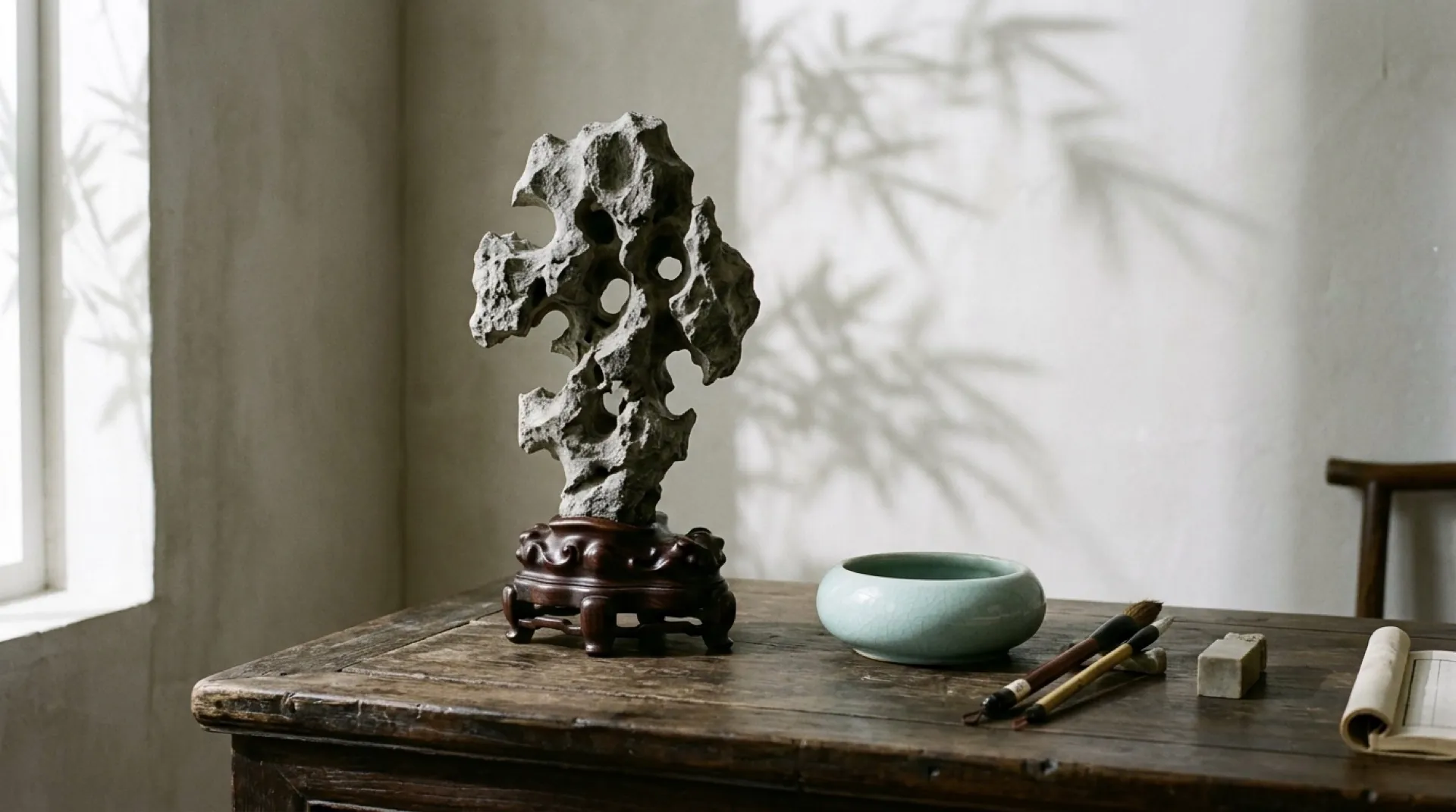
A perforated scholar’s rock on a carved wooden stand, a celadon bowl and two brushes on an old wooden table by a sunlit window, with bamboo shadows on the wall.

1. Textual Foundation: Shu, Hu, and Hundun at the Close of Zhuangzi Chapter 7

The entire seventh chapter of the Zhuangzi — Ying Di Wang (应帝王, "Fit for Emperors and Kings"), the final chapter of the foundational Inner Chapters (Neipian 内篇) — culminates in a haunting thirty-five-character parable: "The ruler of the Southern Sea was called Shu (Swift); the ruler of the Northern Sea was called Hu (Sudden); the ruler of the Center was called Hundun (Primordial Undivided Wholeness). Shu and Hu often met together in the land of Hundun, and Hundun treated them with great kindness. Shu and Hu consulted together on how to repay Hundun's virtue, saying: 'All people have seven openings for seeing, hearing, eating, and breathing; Hundun alone has none. Let us try boring them for him.' Every day they bored one opening, and on the seventh day Hundun died" (日凿一窍,七日而浑沌死).

Why did Zhuangzi place this brief story at the very end of the Inner Chapters, right after the teaching on the Mirror-Like Mind (Use the Heart Like a Mirror)? Because it captures the central tragedy of human over-cleverness: Shu and Hu are not malicious enemies; they are well-meaning friends who assume that their own busy, fragmented mode of perception is the only way to live, and in trying to "improve" natural wholeness through forceful intervention (youwei 有为), they destroy its vitality.

2. Who Are Shu, Hu, and Hundun? Speed, Calculation, and the Uncarved Block

The names in the parable are chosen with precision. Shu (儵) and Hu (忽) both mean "in a flash," "swiftly," or "suddenly" — together they form the compound shuhu (倏忽), describing the restless, darting movement of the discursive intellect as it leaps between opposites (South and North, yes and no, gain and loss). Hundun (浑沌), by contrast, resides in the Center (zhongyang 中央): prior to the modern meaning of "disorderly chaos," classical Taoist Hundun denotes the undivided, harmonious totality of the cosmos before things are carved into competing categories — corresponding directly to Wuji and Taiji Cosmology and the Uncarved Block (Pu).

When Chapter 28 of the Tao Te Ching (Dao De Jing) in the Taoist Classics states that "when the Uncarved Block is dispersed, it becomes specialized vessels" (朴散则为器), it points to the same truth: an unpierced gourd can float across great rivers (Wandering at Ease, Xiaoyao), and an uncarved block retains infinite potential, whereas boring holes into living wholeness for the sake of restless sensory consumption hollows out the root of life.

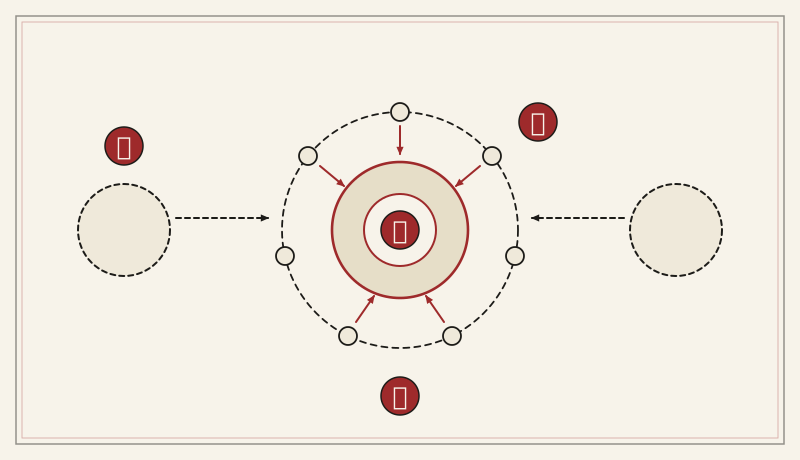
Classical ink-and-cinnabar diagram of Hundun and the seven apertures with four numbered markers (①–④) illustrating the restless poles of Shu and Hu, the outer ring of seven sensory openings, the undivided center of Hundun, and the inward return of spirit.

Figure 1: The Parable of Hundun and Inward Sensory Guarding (Zhuangzi Chapter 7, Ying Di Wang) — ① The restless outer poles of Shu (Swift, South) and Hu (Sudden, North); ② The seven sensory apertures (Qiqiao) through which vital spirit disperses outward; ③ Hundun, the Emperor of the Center, embodying undivided primordial wholeness (Pu); ④ Turning light and listening inward to nourish the central root (Sai Qi Dui, Bi Qi Men).

  1. ① Swift (Shu 儵) & Sudden (Hu 忽): The busy, well-intentioned intellect rushing between polarities and imposing artificial schemes.
  2. ② The Seven Sensory Apertures (Qiqiao 七窍): Eyes, ears, nostrils, and mouth — when over-stimulated, they drain vital spirit outward.
  3. ③ Central Undivided Wholeness (Zhongyang Hundun 中央浑沌): The hospitable, uncarved center before analytical fragmentation.
  4. ④ Guarding the Apertures & Returning to the Center (Sai Qi Dui, Bi Qi Men 塞其兑闭其门): Softly turning vision and hearing inward during meditation to preserve wholeness.

3. The Seven Apertures (Qiqiao) in Taoist Inner Cultivation: Turning the Light Inward

In traditional Taoist physiology and the Huangting Jing (Yellow Court Classic), the "seven openings" (qiqiao 七窍 — the two eyes, two ears, two nostrils, and mouth) are the seven windows through which our Three Treasures (Jing, Qi, and Shen) interact with the world. Having senses is part of human nature; the danger arises when Shu and Hu — frantic speed and compulsive stimulation — take command of the seven openings day and night. As Chapter 12 and Chapter 52 of the Tao Te Ching warn: "The five colors blind the human eye; the five tones deafen the human ear... Block the openings, shut the doors, and to the end of life you will not be worn out; open the openings, multiply your meddling affairs, and to the end of life you cannot be saved" (塞其兑,闭其门,终身不勤;开其兑,济其事,终身不救).

In the contemplative tradition preserved in the ancient temples of Wudang Mountain and taught to modern students in Singapore, "returning to Hundun" does not mean blinding oneself to reality; it means practicing shoushi fanting (收视返听 — gathering the gaze and turning the hearing inward) so the senses serve the tranquil center rather than scattering it.

4. Wudang Martial and Contemplative Practice: Standing in Undivided Wholeness

In Wudang Taijiquan and Qigong, the transition from scattered sensory busyness (Shu and Hu) to undivided central wholeness (Hundun) is practiced physically at the beginning of every form through the Wuji (无极) and Hunyuan (混元 — Primordial/Hundun Sphere) Standing Post (Zhan Zhuang). Likewise, in the eleventh posture of the classical Yijinjing — Bowing in Salutation (Dagong Shi) — the practitioner covers both ears with the palms to close off external noise while sounding the "Heavenly Drum" (Mingtiangu 鸣天鼓), directly embodying the sealing of the sensory gates to nourish the brain and spine.

Try this three-minute "Hundun Reset" whenever digital screens and notifications leave your mind feeling bored through by Shu and Hu: 1) Step away from screens and stand or sit upright with the hands resting over the lower abdomen; 2) Soften the eyelids halfway (curtaining the eyes), let sounds arrive without naming them (resting the ears), and keep the lips lightly closed with the tongue touching the upper palate (guarding the mouth); 3) Breathe quietly into the center of the torso for twelve breaths as one undivided whole. Traditional Wudang philosophy and Daoyin support stress reduction and mental clarity and never replace professional medical care.

Seeker’s Q&A · Frequently Asked Questions

What is the core takeaway of Hundun and the Seven Openings in the Zhuangzi?

Explore the closing parable of Zhuangzi Chapter 7 (Ying Di Wang) — Shu, Hu, and the death of Hundun after boring seven openings (Ri Zao Yi Qiao, Qi Ri Er Hundun Si) — and how Wudang Taoist meditation guards the sensory apertures to preserve primordial wholeness.
