
TAOIST PHILOSOPHY · 道家哲学

The Three Pipings (Renlai, Dilai, Tianlai) in Zhuangzi: Listening to the Music of Heaven and Letting Each Being Sound from Its Own Self 《庄子·齐物论》“人籁、地籁、天籁”详解:吹万不同,而使其自己也

How the opening dialogue of Zhuangzi Chapter 2 moves from bamboo panpipes and wind in the mountain hollows to the silent self-so harmony of the Tao.

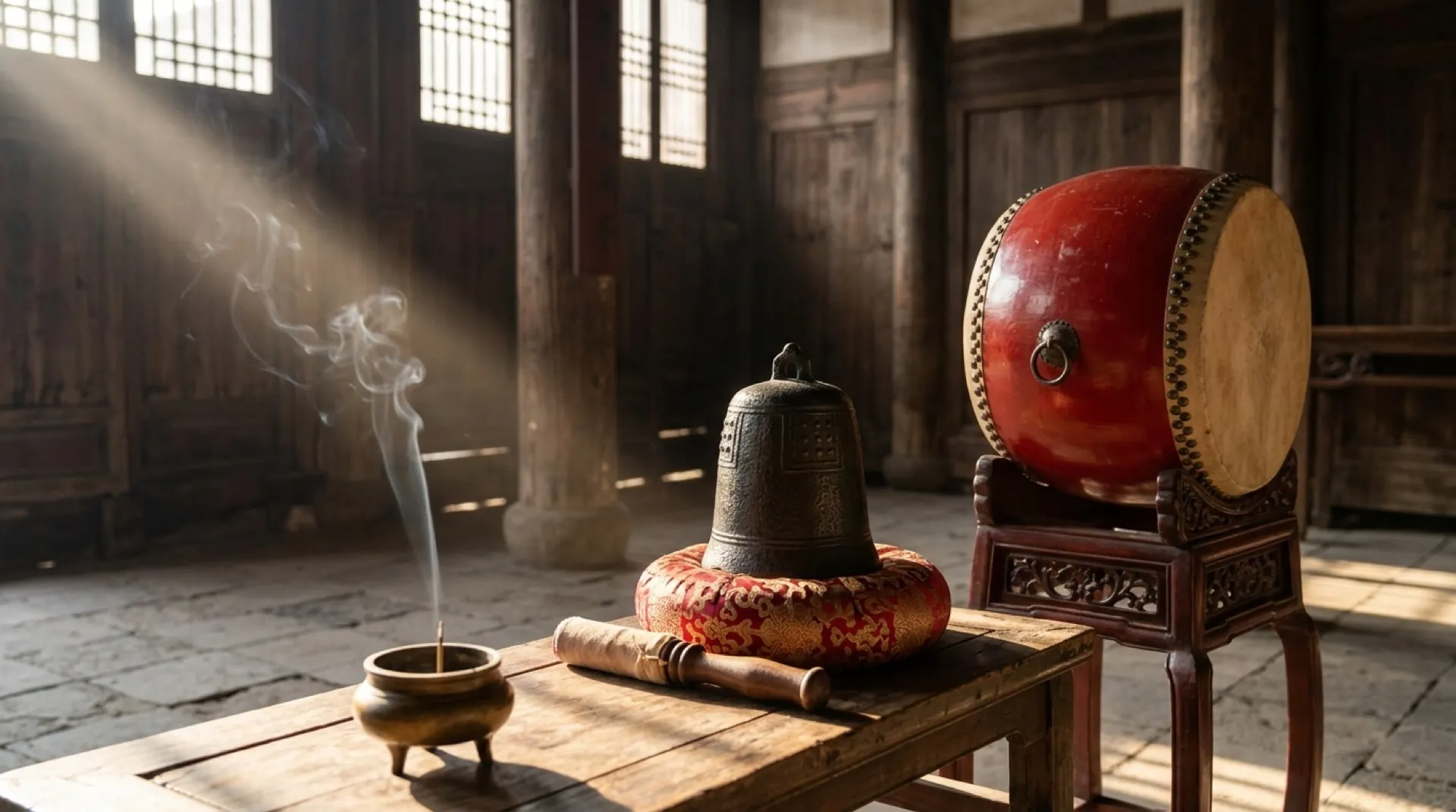
Editorial illustration (generated): a red drum on a carved stand, a bronze bell on a red cushion with its wooden striker, and an incense burner with rising smoke in a sunlit timber hall.

In everyday speech, the Chinese phrase Tianlai (天籁, “the Piping of Heaven”) is often used simply to praise a beautiful singing voice or a moving piece of Guqin music. Yet at the opening of Chapter 2 of the Zhuangzi—Equalizing Assessments of Things (《庄子·内篇·齐物论》, see Qiwu Lun: The Pivot of the Tao)—where the term was coined, Tianlai is not a separate melody up in the clouds at all. It is one of the deepest insights in Taoist philosophy into how the unseen Tao animates the ten thousand things while letting each one be itself (Ziran).

1. The Opening Dialogue of Qiwu Lun: “Today I Have Lost My Ego-Self”

Chapter 2 opens with a quiet portrait of the sage Ziqi of South Wall (南郭子綦) leaning on his low wooden armrest (隐机而坐), looking up toward the sky and breathing gently as if emptied of worldly agitation. When his disciple Yancheng Ziyou asks how he has become so still, Ziqi replies: “Now I have lost my ego-self (吾丧我, wu sang wo). Do you understand this? Perhaps you have heard the Piping of Humanity (人籁), but have not yet heard the Piping of Earth (地籁); or perhaps you have heard the Piping of Earth, but have not yet heard the Piping of Heaven (天籁)!”

Asked to explain the three, Ziqi paints an unforgettable acoustic landscape:

  • The Piping of Humanity (人籁, Renlai — Aligned Bamboo Tubes): “The Piping of Humanity consists of rows of tuned bamboo pipes (比竹是已).” Human music is made by cutting bamboo to fixed lengths and blowing through them according to human rules and preferences.
  • The Piping of Earth (地籁, Dilai — Wind in the Ten Thousand Hollows): “Thegreat clod (Earth) breathes out wind; its name is the gale. When it does not stir, all is silent; once it rises, the ten thousand hollows roar forth (作则万窍怒呺)!” Ziqi describes old mountain forests where the cavities in ancient trees are shaped like nostrils, mouths, ears, socket-holes, goblets, mortars, deep pools, and shallow puddles. As the same mountain wind sweeps across them, each cavity produces the exact sound natural to its own shape—hissing, whistling, roaring, or murmuring—until the wind subsides and every hollow returns to quietness.
  • The Piping of Heaven (天籁, Tianlai — “Blowing on the Ten Thousand Differently, Yet Letting Each Be Itself”): When Ziyou asks, “Since the Piping of Earth comes from the myriad hollows, and the Piping of Humanity comes from tuned bamboo pipes, what then is the Piping of Heaven?” Ziqi answers: “It blows on the ten thousand things in all their differences, yet lets each one sound from its own self. Since each takes its note from its own nature, who is the master forcing them to roar? (夫吹万不同,而使其自己也,咸其自取,怒者其谁邪!)”
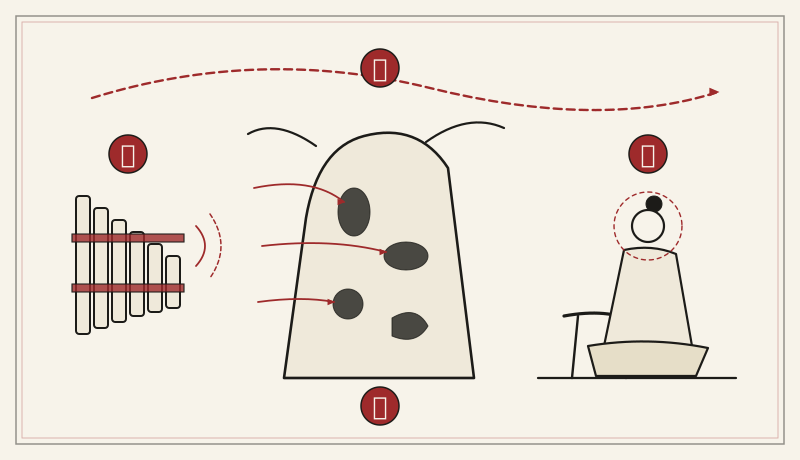
Classical ink-and-cinnabar diagram of Zhuangzi's Three Pipings (Renlai, Dilai, Tianlai) showing the tuned bamboo panpipes on the left, the mountain crag and ancient hollow tree cavities at the center, the overarching cosmic breath of Tianlai above, and Ziqi of South Wall sitting in quiet contemplation on the right

Zhuangzi’s Three Pipings in Qiwu Lun (《庄子·齐物论》人籁、地籁、天籁图解).

  1. The Piping of Humanity (人籁 · 比竹箫管): tuned bamboo pipes shaped and played by human intention
  2. The Piping of Earth (地籁 · 山林万窍): natural hollows in rocks and ancient trees, each sounding according to its own unique shape when the wind passes through
  3. The Piping of Heaven (天籁 · 吹万不同,使其自己): the unseen Wu Wei vitality of the Tao—imposing no uniform tune, yet allowing every creature to express its own authentic nature
  4. “Losing the Ego-Self” in Stillness (吾丧我 · 南郭子綦隐机): by emptying pre-judgments (Xinzhai & Zuowang), the sage hears the harmony beneath all diverse voices

2. Why Tianlai Is Not a Fourth Sound Above the World

Notice the brilliance of Ziqi’s answer. Just as Chapter 41 of the Tao Te Ching (Dao De Jing) declares that “The great note has a rarefied sound” (大音希声), the Piping of Heaven is not a separate noise competing with the wind in the pines or the flute on the veranda. Look at the mountain forest when the wind blows: the wind does not command the deep cave to squeak like a narrow crack, nor does it force the narrow crack to boom like a deep cave. Each hollow sounds solely according to its own form (咸其自取), and when the wind passes, none clings to the sound (Responding Without Storing).

In human society, conflict arises because people try to force every tree hollow in the forest to play the single note of their own bamboo pipe. When we “lose the ego-self” (吾丧我), we stop forcing others—and ourselves—into an artificial mould (The Usefulness of Uselessness).

3. Hearing Tianlai in Wudang Breathwork, Taijiquan, and Daily Listening

A bamboo panpipe and two blank dark-blue thread-bound classical books on a mossy stone beside a hollowed old pine stump, with tall pines and bamboo in the morning mist behind.

Tianlai, the “Piping of Heaven” (Zhuangzi Chapter 2): the wind sounds through every hollow in its own way, with no fourth sound standing above them.

4. Listening to the Mountain Wind Between Wudang and Singapore

Connecting the pine-clad ridges around Wudang Mountain’s UNESCO World Heritage ancient Taoist temples with our regular classes in Singapore, Wudang.Org invites you to step out of mental noise and listen to the quiet rhythm of breath and movement. Explore your path on Start Here.

Seeker’s Q&A · Frequently Asked Questions

What are the Three Pipings—Renlai (人籁), Dilai (地籁), and Tianlai (天籁)—in Zhuangzi Chapter 2?

Renlai (Human Piping) refers to music played on tuned bamboo panpipes; Dilai (Earthly Piping) refers to the myriad sounds produced when wind blows through natural hollows in mountains and ancient trees; Tianlai (Heavenly Piping) is the spontaneous principle whereby each being sounds from its own natural self without external coercion.

What does Ziqi of South Wall mean by “Today I have lost my ego-self” (吾丧我)?

In classical Chinese, Zhuangzi contrasts the deeper, authentic awareness (“wu” 吾) with the rigid, self-centered ego (“wo” 我) that constantly judges and competes. “Losing the ego-self” means letting go of partisan bias so one can listen to the world with open clarity.

How does “blowing on the ten thousand differently, yet letting each be itself” guide Wudang practice?

It reminds us not to force our breathing or posture height into an artificial, one-size-fits-all template. By honoring classical structural principles while adapting stance depth and breath tempo to our own body, practice stays natural and injury-free.
