

TAOIST PHILOSOPHY · 道家哲学

Xiaoyao You: Zhuangzi on Wandering at Ease and Freedom from Scale Comparison 逍遥游:小大之辩、无用之用与庄子的心灵自由

Why the opening chapter of the Zhuangzi begins with a vast fish turning into the Peng bird—and how dropping anxious dependence (You Dai) and utilitarian narrowness opens genuine ease.

Layered mountain ridges fading into golden mist at sunrise, with pines in the foreground.

Open the Zhuangzi to its very first page—Xiaoyao You (逍遥游, “Wandering Far and at Ease”)—and you do not meet a dry list of rules. Instead, the horizon suddenly cracks open: in the dark northern sea swims a fish named Kun (鲲), so vast no one knows how many thousands of li it spans; transforming into a bird named Peng (鹏), it rises on a whirlwind for ninety thousand li toward the southern ocean. Why does classical Taoist philosophy begin with this shock of scale?

1. The Debate of Small and Great (小大之辩): Why the Bush-Quail Laughs

Down among the elm and sappanwood branches, a cicada and a fledgling dove—and later a marsh quail (斥鷃)—laugh at the Peng bird: “We strain and fly up into the elm tree, sometimes not even reaching it before dropping back to the ground; why on earth would anyone need to rise ninety thousand li just to go south?”

Zhuangzi calls this the difference between small and great horizons (小大之辩, xiao da zhi bian). A morning mushroom knows nothing of the waxing and waning month; a summer cicada knows nothing of spring and autumn. Yet as the Wei-Jin commentator Guo Xiang noted in his classic commentary on the Zhuangzi, the point is neither to despise the small bird nor to worship giant size for its own sake. Rather, our suffering begins when a small, defensive habit of mind insists that its own twig is the measure of the entire sky—or when we exhaust ourselves envying someone else’s wingspan instead of unfolding our own nature (Ziran).

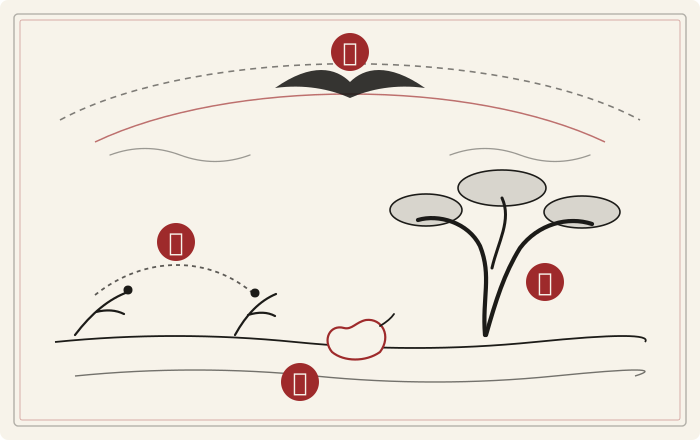
Classical ink-and-cinnabar diagram of Zhuangzi’s Xiaoyao You contrasting the low bush horizon, the rising whirlwind, the high Peng bird arc, and the open sky of wandering at ease

Four horizons in Xiaoyao You (Chapter 1 of the Zhuangzi): moving from cramped comparison to open alignment with Heaven and Earth.

  1. The low thicket (榆枋之境): measuring all of life by immediate status, quick gain, and narrow comparison
  2. The rising current (扶摇羊角): recognising that every outward achievement still leans on supporting conditions (有待)
  3. The vast cloud-horizon of the Peng bird (九万里云程): stepping back to see the long arc of time and perspective
  4. Charioting upon the normality of Heaven and Earth (乘天地之正,而御六气之辩): unforced inner freedom (逍遥)

2. From “Depending on Conditions” (有待) to Inner Freedom (无待)

Even the giant Peng bird, Zhuangzi points out, still depends on a six-month gale to carry its wings; even the sage Liezi riding the wind with effortless grace “still had something he depended upon” (犹有所待者也)—if the wind stops, he must walk. What, then, is true Xiaoyao?

“Suppose one chariots upon the natural order of Heaven and Earth, rides the transformations of the six atmospheric breaths, and wanders in what has no limit—what would such a person have left to depend upon? Therefore it is said: the Utmost Person has no fixed ego-self (至人无己); the Spiritual Person clings to no personal achievement (神人无功); the Sage seeks no fame (圣人无名).”

“Having nothing left to depend upon” (无待) does not mean floating into fantasy or denying that humans need food and shelter. It means your inner equilibrium no longer hangs on applause (Honour, Disgrace and the Self), titles, or forcing external events to obey your ego—the same quiet centre taught in the Pivot of the Tao (Qiwu Lun) and the Qingjing Jing.

3. The Great Gourd and the Gnarled Tree: The Usefulness of the “Useless” (无用之用)

At the close of Xiaoyao You, Zhuangzi’s sharp-witted friend Huizi complains about two things he considers “big and useless” (大而无用):

  • The Five-Bushel Gourd (五石之瓠): Huizi grew a giant calabash gourd; filled with water it was too heavy to lift alone, and sliced into ladles it was too wide and shallow to dip into small jars, so he smashed it. Zhuangzi asks: why did you never think to lash it around your waist as a waist-boat (腰舟) and float at ease across rivers and lakes? The gourd was not defective; Huizi’s mind was simply tangled in brushwood (夫子固拙于用大矣), assuming a gourd may only ever be a kitchen dipper.
  • The Gnarled Chu Tree (大樗): Huizi mocks a huge tree whose trunk is too knotted for straight carpenter’s plumb-lines and whose twigs are too crooked for rulers, so no timber merchant ever looks at it. Zhuangzi replies: precisely because it cannot be sawed into profitable planks, no axe cuts it down; plant it in the open expanse of Nothing-Whatever, and travellers can rest and wander beneath its cool shade.
A natural dried calabash gourd tied with hemp cord beside a pale celadon tea bowl on a mossy granite boulder by a clear mountain stream.

Zhuangzi’s parable of the Five-Bushel Gourd (Xiaoyao You): what looks oversized to a rigid ladle-maker becomes a buoyant float across rivers and lakes.

4. Practising Xiaoyao in Movement and Daily Life

Whether you walk the stone paths of Wudang Mountain’s UNESCO World Heritage ancient Taoist temples or pause after a workday at our Singapore practice centre, Xiaoyao You asks one practical question: have you allowed every hour of your life to be chopped into “useful timber” for external tasks, leaving zero shade to rest beneath?

Ten quiet minutes of beginner Zhan Zhuang standing meditation, a morning sequence from a classical Qigong set, or unhurried Wudang Tai Chi look “unproductive” to a hurried calendar—yet they are the very waist-gourd that keeps you afloat. Explore all four study paths on Start Here.

Seeker’s Q&A · Frequently Asked Questions

What is the meaning of the Kun fish and Peng bird in Zhuangzi’s Xiaoyao You?

By opening with a vast fish transforming into a bird that rises ninety thousand li on the wind while small birds in the brushwood laugh at it, Zhuangzi loosens our habitual, cramped scale of judgement (“the difference between small and great,” 小大之辩) and prepares the reader to look beyond narrow self-interest.


What is the difference between You Dai (有待) and Wu Dai (无待) in Xiaoyao You?

You Dai means “depending on external conditions” (just as the Peng bird and Liezi still depend on the wind to fly), whereas Wu Dai means an unburdened inner freedom (“charioting upon the natural order of Heaven and Earth”) where peace of mind does not hang on external praise, titles, or rigid ego demands.

What does Zhuangzi mean by “the usefulness of the useless” (无用之用) in the gourd and tree stories?

Huizi called the giant gourd and gnarled tree “useless” only because they did not fit narrow utilitarian templates (a kitchen ladle or straight timber planks). Zhuangzi shows that stepping outside rigid instrumental thinking turns the gourd into a boat for floating across lakes and preserves the tree as cool shade that no axe cuts down.
