TAOIST PHILOSOPHY · 道家哲学

Forgetting the Feet and the Waistband in the Zhuangzi: Artisan Chui and the Ease that Forgets Ease Itself 《庄子·达生》忘足与忘要解:工倕旋盖规矩与“忘适之适”的化境

Explore the teaching of Zhuangzi Chapter 19 (Dasheng) on Artisan Chui and the four levels of ease — forgetting the feet when the shoes fit (Wang Zu), forgetting the waist when the belt fits (Wang Yao), forgetting right and wrong in the mind, and the ease of forgetting ease itself (Wang Shi Zhi Shi).


A figure in a dark robe with hair in a topknot, seen from behind, seated cross-legged on a mossy rock beside a still pool in a misty bamboo ravine.

1. Textual Foundation: Artisan Chui and the Shoes That Fit in Zhuangzi Chapter 19

Near the conclusion of Chapter 19 of the Zhuangzi (Dasheng 达生, "Mastering Life"), after recounting the stories of the Cicada Catcher, the Swimmer at the Lüliang Cataract, and Woodcarver Qing, the text distills their shared secret into a concise philosophical jewel. It begins with the legendary craftsman Artisan Chui (工倕): "Artisan Chui could draw circles and squares with a sweep of his hand more accurately than if he used a compass and L-square, because his fingers transformed together with things and he did not pause to check them with his deliberative mind; therefore his Spirit Terrace remained unified and unshackled" (工倕旋而盖规矩,指与物化而不以心稽,故其灵台一而不桎).

To make this principle immediately tangible to any reader, the Zhuangzi points to everyday clothing: "Forgetting the feet is the sign that the shoes fit; forgetting the waist is the sign that the belt fits; when the understanding forgets right and wrong, that is the sign that the heart-mind is at ease; having no inner alteration and no outer blind following is the sign that one fits with every encounter; beginning with ease and never once losing ease is the ease of forgetting ease itself" (忘足,履之适也;忘要,带之适也;知忘是非,心之适也;不内变,不外从,事会之适也;始乎适而未尝不适者,忘适之适也).

2. Why Self-Conscious Awareness Often Signals Friction

When do we think intensely about our feet or our waistband? Only when a pebble has slipped into our shoe, a blister is forming on the heel, or the belt is tied too tightly or too loosely. As soon as the cloth shoe fits the foot and the sash rests evenly around the waist, attention is freed from local discomfort and the whole person walks effortlessly along the mountain path. In the same way, when a beginner practices calligraphy, music, or martial movement, their deliberative mind (xin ji 心稽 — mentally auditing every millimeter) is hyper-aware of their wrists, knees, and shoulders precisely because the joints are fighting one another.

This insight complements the teaching of Forgetting the Trap and Catching the Meaning (Deyi Wangyan) and Chapter 18 of the Tao Te Ching (Dao De Jing) in the Taoist Classics. Just as a healthy organ performs its work quietly without announcing itself in pain, a well-aligned body and an unburdened heart-mind (lingtai yi er bu zhi 灵台一而不桎 — the Spirit Terrace unified and unblocked) do not need to congratulatorily monitor their own "mindfulness." When function and nature coincide, self-conscious strain dissolves.

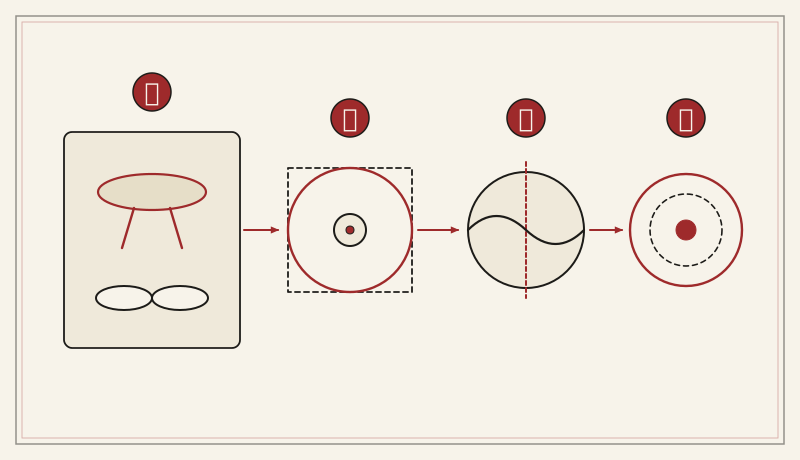
Classical ink-and-cinnabar diagram with four numbered markers (①–④) illustrating fitted shoes and sash, Artisan Chui's freehand circle and square, the quiet mind free of contention, and the ease that forgets ease itself.

Figure 1: The Four Harmonies of Ease in Zhuangzi Chapter 19 (Dasheng) — ① Bodily fit: forgetting the feet and the waistband (Wang Zu, Wang Yao); ② Craft alignment: Artisan Chui's fingers transforming with things while the Spirit Terrace stays unified (Lingtai Yi Er Bu Zhi); ③ Mental ease: forgetting contentious right and wrong and fitting every encounter (Xin Zhi Shi, Shi Hui Zhi Shi); ④ Seamless completion: the ease that forgets ease itself (Wang Shi Zhi Shi).

  1. ① Forgetting Feet and Waistband (Wang Zu, Lü Zhi Shi · Wang Yao, Dai Zhi Shi 忘足履之适 · 忘要带之适): When shoes and belt fit without pinching, the body moves without self-conscious friction.
  2. ② Artisan Chui's Unobstructed Spirit Terrace (Gong Chui Xuan Er Gai Guiju · Lingtai Yi Er Bu Zhi 工倕旋而盖规矩 · 灵台一而不桎): Fingers respond directly to the material without anxious mental checking.
  3. ③ Ease of Heart-Mind and Encounter (Zhi Wang Shifei · Shi Hui Zhi Shi 知忘是非 · 事会之适): Remaining unshaken within while adapting without blind conformity outside.
  4. ④ The Ease That Forgets Ease Itself (Wang Shi Zhi Shi 忘适之适): Beginning in naturalness and never losing it, so even the label of 'comfort' falls away.

3. From Bodily Fit to the Ease of the Heart-Mind (Xin Zhi Shi) and Every Encounter (Shi Hui Zhi Shi)

The Zhuangzi traces a four-step ascent from physical posture to spiritual freedom. First is the ease of shoes and belt (lü zhi shi, dai zhi shi 履之适、带之适) — removing physical constriction and artificial posture so the frame is comfortable and balanced. Second is the ease of the heart-mind (xin zhi shi 心之适) — letting go of compulsive arguments over approval and disapproval (zhi wang shifei 知忘是非), a theme explored deeply in Equalizing Things and Perspectives (Qiwu).

Third is the ease of meeting events (shi hui zhi shi 事会之适), defined as "neither altering within nor blindly following without" (bu neibian, bu waicong 不内变,不外从): when outer circumstances shift, the practitioner neither loses their inner center (zhongding 中定) in anxiety nor rigidifies against the world. Fourth and highest is the ease that forgets ease itself (wang shi zhi shi 忘适之适). As long as a person is still thinking, "Look how calm and comfortable I am right now," they are still standing outside their own peace and measuring it. True ease is simply at home in the Tao without keeping score.

4. Wudang Martial and Contemplative Practice: From Deliberate Alignment to Effortless Form

In the training halls of Wudang Mountain and our Singapore classes, students experience this exact progression across years of Standing Post (Zhan Zhuang) and Wudang Taijiquan. During the first months, you must consciously check the Six Harmonies (Liuhe) — reminding the shoulders to sink, the knees to align with the toes, and the waist to turn smoothly in postures like Turn Body and Chop with Fist. At that early stage, the "shoe" is still being broken in.

Yet as the alignments integrate into the sinews through patient practice, a day arrives when you step into the courtyard and move from posture to posture without mentally checking a single joint: your fingers and limbs transform directly with the movement (zhi yu wu hua 指与物化), and your Spirit Terrace stays quiet and whole. Try this simple check today during your standing or walking practice: notice any spot in the feet, knees, lower back, or jaw that is loudly demanding your attention, soften it by ten percent until it feels like a well-fitted cloth shoe, and let your awareness rest in the whole body at once. Traditional Wudang philosophy and Daoyin cultivate natural poise and mental clarity and never replace professional medical care.

Seeker’s Q&A · Frequently Asked Questions

What is the core takeaway of Forgetting the Feet and the Waistband in the Zhuangzi?

Explore the teaching of Zhuangzi Chapter 19 (Dasheng) on Artisan Chui and the four levels of ease — forgetting the feet when the shoes fit (Wang Zu), forgetting the waist when the belt fits (Wang Yao), forgetting right and wrong in the mind, and the ease of forgetting ease itself (Wang Shi Zhi Shi).
