
TAOIST PHILOSOPHY · 道家哲学

Three in the Morning and Four in the Evening (Zhaosan Musi) in Zhuangzi: Walking Two Roads (Liangxing) and Resting on the Potter’s Wheel of Heaven 《庄子·齐物论》“朝三暮四”本义详解:名实未亏而喜怒为用,何谓“天钧”与“两行”?

Why the monkeys raged at “three acorns in the morning and four at night” yet rejoiced at “four in the morning and three at night”—and how the sage harmonizes opposites without exhausting the spirit.

Slopes covered in pine and bamboo forest below pale granite ridges, with cloud filling the valley.

In modern everyday speech, the four-character idiom Zhaosan Musi (朝三暮四, “three in the morning and four in the evening”) is used to describe someone who is fickle or changes their mind constantly. Yet when you open Chapter 2 of the Zhuangzi—Qiwu Lun (《庄子·内篇·齐物论》, “Discussion on Equalizing Things”)—where the story first appeared more than two thousand years ago, you discover something astonishing: in Zhuangzi’s original parable, the monkey keeper is not being deceitful at all—he is demonstrating the sage’s art of “Walking Two Roads” (两行, Liangxing) and resting on the “Potter’s Wheel of Heaven” (天钧, Tianjun).

1. The Classical Parable in Zhuangzi: Qiwu Lun (《齐物论》)

To wear out one’s spirit and intelligence trying to force things into one without realizing that they are already the same—this is called “Three in the Morning” (劳神明为一,而不知其同也,谓之朝三).

What is meant by “Three in the Morning”? A monkey keeper (狙公, Jugong) was handing out acorns (芧, xu). He said: “You get three in the morning and four in the evening.” All the monkeys were furious!

“Well then,” he said, “you get four in the morning and three in the evening!” All the monkeys were delighted!

With neither the name nor the reality diminished (名实未亏), their joy and anger were nonetheless put to use—he simply went along with what was so (亦因是也). Therefore the sage harmonizes right and wrong and rests upon the Potter’s Wheel of Heaven (休乎天钧): this is called Walking Two Roads (是之谓两行).

2. Why Do We Exhaust Our Spirit Fighting Over “3 + 4” vs. “4 + 3”?

Look closely at the two sides of Zhuangzi’s parable:

  • The Monkeys’ Trap (“Wearing Out the Spirit,” 劳神明): Measured across the whole day, 3 + 4 = 7 and 4 + 3 = 7. The total nourishment in the basket—the reality (Ming and Shi)—has not changed by a single acorn. Yet because the monkeys cling rigidly to the immediate label of “three vs. four,” they swing from fury to delight over a purely verbal rearrangement.
  • The Keeper’s Wisdom (“Going Along With What Is So,” 因是 · 两行): A rigid, dogmatic keeper would have argued with the monkeys: “You fools! Three plus four is seven either way—take it or leave it!” Instead, the wise keeper sees both the underlying unity (seven acorns a day) and the monkeys’ immediate emotional preference. Without sacrificing the reality, he flexibly adjusts the order—and peace is restored instantly.
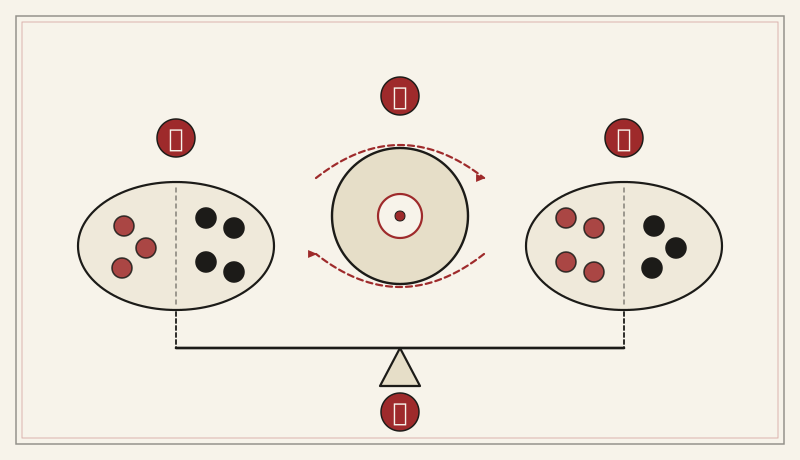
Classical ink-and-cinnabar diagram of Zhuangzi's Three in the Morning and Four in the Evening (Zhaosan Musi) showing the left tray of 3+4 acorns, the right tray of 4+3 acorns, the unchanged balance beam of 7 below, and the central Potter's Wheel of Heaven (Tianjun) above

Anatomy of Zhaosan Musi, Tianjun, and Liangxing in Zhuangzi: Qiwu Lun (《庄子·齐物论》朝三暮四与天钧两行图解).

  1. “Three at Dawn, Four at Dusk” (朝三暮四 · 众狙皆怒): fixating on the smaller morning portion triggers reactive anger even though the daily total is seven
  2. “Four at Dawn, Three at Dusk” (朝四暮三 · 众狙皆悦): adapting the sequence satisfies the immediate disposition without altering the total
  3. Neither Name Nor Reality Diminished (名实未亏 · 总数皆七): the underlying substance remains whole across both arrangements
  4. Resting on the Potter’s Wheel of Heaven & Walking Two Roads (休乎天钧 · 是之谓两行): like the center of a spinning potter’s wheel (Pivot of the Tao), the sage accommodates both sides without friction

3. What Are “Tianjun” (天钧) and “Liangxing” (两行) in Wudang Practice?

In classical Chinese craftsmanship, a Jun (钧 / 均) is the horizontal potter’s wheel used to shape clay vessels. Every point on the outer rim spins rapidly between left and right, front and back—yet the center pin rests in complete stillness (Tao Te Ching Chapter 16):

  • Liangxing (“Walking Two Roads” / Allowing Both Sides to Flow): In Wudang Push Hands (Tuishou), if your partner insists on pushing forward (“wanting four in the morning”), you do not butt heads to prove you are stronger; you yield on that side while advancing on the other, keeping the total equilibrium of the circle intact.
  • In daily communication: Before arguing over how a task is phrased or sequenced, ask whether the core substance is affected (“neither name nor reality diminished”). If 3 + 4 and 4 + 3 reach the same wholesome destination, yielding gracefully preserves everyone’s vitality and spirit.
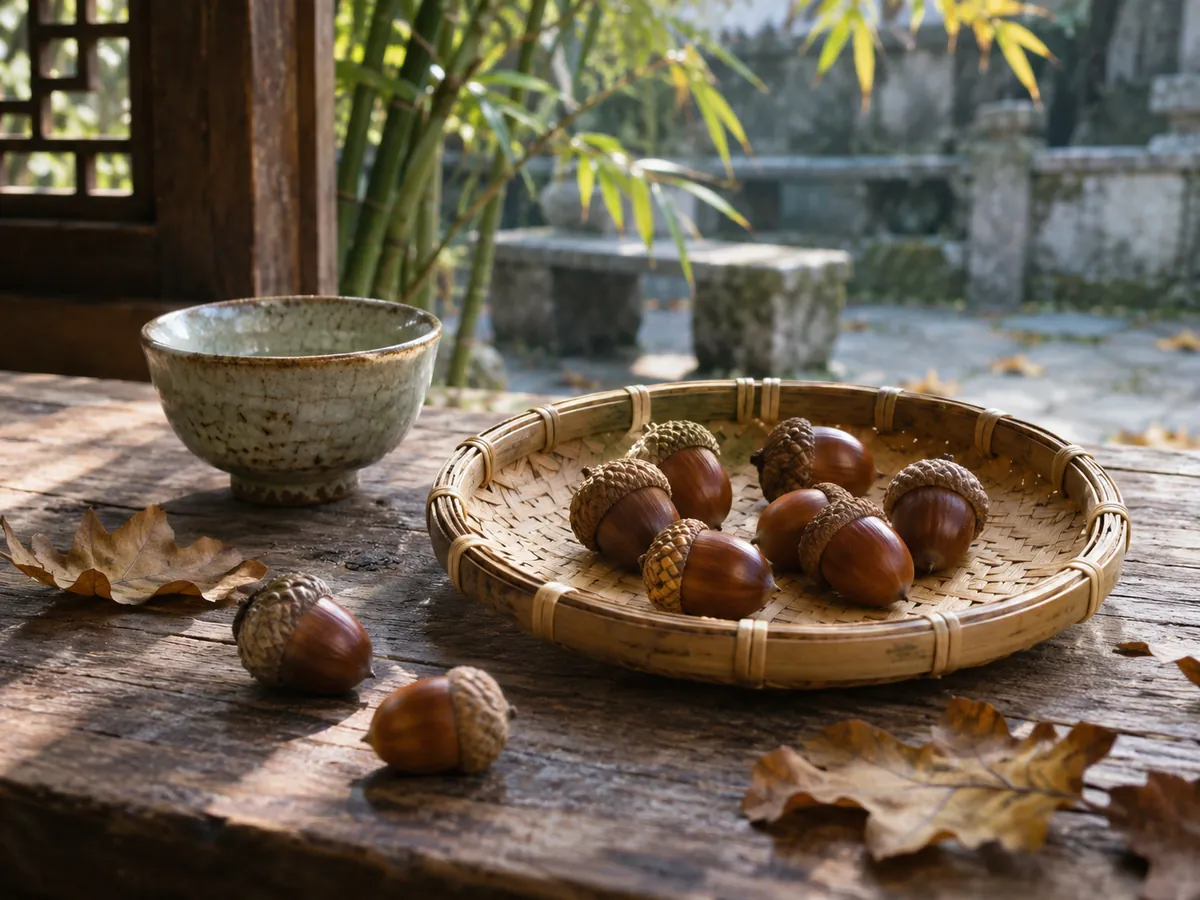
Seven glossy chestnut-brown acorns in a shallow woven bamboo tray on a rough wooden table, beside a small celadon bowl, with oak leaves and a bamboo grove and stone courtyard softly blurred behind.

Three in the Morning (Zhuangzi Chapter 2): the monkeys raged at three acorns in the morning and four at night, yet were delighted at four in the morning and three at night—the total never changed.

4. Studying Living Taoist Philosophy Between Wudang Mountain and Singapore

Connecting the contemplative heritage near Wudang Mountain’s UNESCO World Heritage ancient Taoist temples with our regular classes in Singapore, Wudang.Org helps seekers apply classical texts to modern life and internal movement. Begin on Start Here.

Seeker’s Q&A · Frequently Asked Questions

How does the original meaning of “Zhaosan Musi” (朝三暮四) in Zhuangzi differ from its modern usage?

In modern usage it means being fickle or inconsistent; in Zhuangzi Chapter 2 (Qiwu Lun), it originally criticizes exhausting one’s mind over superficial differences (3+4 vs. 4+3) while praising the keeper’s flexible wisdom of harmonizing both sides (“Walking Two Roads,” Liangxing).


What does Zhuangzi mean by “Resting on the Potter’s Wheel of Heaven” (Xiu Hu Tianjun 休乎天钧)?

“Jun” (钧) is the potter’s wheel: while the outer rim spins continuously through opposite positions, the center remains still and balanced. Resting at that center allows a practitioner to respond to changing circumstances without mental exhaustion.

What is “Liangxing” (两行, “Walking Two Roads”) in Taoist practice?

Liangxing means letting both sides of a situation proceed harmoniously without forcing a one-sided victory—preserving the core substance while accommodating the natural flow of the other person or partner.
