

TAOIST PHILOSOPHY · 道家哲学

Catching the Meaning and Forgetting the Words (Deyi Wangyan) in Zhuangzi: The Fish-Trap, the Rabbit-Snare and How to Read Taoist Classics 《庄子·外物》“得意忘言”详解:从筌鱼、蹄兔之喻看如何读懂道家经典与拳谱

Why Zhuangzi compares words to a bamboo fish-trap—essential for catching living insight, yet never meant to be carried on your back once the meaning is lived.

A flat stone-slab footbridge crossing a rushing mountain stream among mossy boulders, bamboo and pines.

Every serious student of Taoist philosophy or internal martial arts eventually faces a paradox. On the one hand, the tradition treasures its written scriptures (Classical Library) and posture manuals; on the other hand, Chapter 1 of the Tao Te Ching (Dao De Jing) opens with the warning that “The Tao that can be spoken is not the constant Tao” (Words, Names, and Reality). How should we use words without becoming trapped by them? At the close of Chapter 26 of the Zhuangzi—External Things (《庄子·杂篇·外物》)—Zhuangzi answers with one of the most influential metaphors in Chinese thought: “Catching the meaning and forgetting the words” (得意忘言, Deyi Wangyan).

1. The Classical Passage in Zhuangzi Chapter 26: The Fish-Trap and the Rabbit-Snare

In just thirty-four Chinese characters, Zhuangzi distils the entire relationship between language and lived insight:

“The bamboo fish-trap exists because of the fish; once you have caught the fish, you forget the trap. The rabbit-snare exists because of the rabbit; once you have caught the rabbit, you forget the snare. Words exist because of meaning; once you have caught the meaning, you forget the words. Where can I find a person who has forgotten words, so that I might have a word with them? (筌者所以在鱼,得鱼而忘筌;蹄者所以在兔,得兔而忘蹄;言者所以在意,得意而忘言。吾安得夫忘言之人而与之言哉!)”

Notice the humour and balance in Zhuangzi’s closing question: he wants to speak with someone who has forgotten words! Unlike a fanatic who burns books, the fisherman along a mountain stream gladly weaves a sturdy bamboo trap (quan 筌) and sets it carefully in the current. Yet once the fish is swimming in his bucket, he does not carry the wet bamboo basket into the kitchen and try to boil the basket for dinner (True Person and True Knowledge).

2. Words, Images, and Meaning: From Zhuangzi to Wang Bi (得意忘象)

During the Wei–Jin flourishing of Xuanxue (Mysterious Learning), the commentator Wang Bi (王弼, 226–249 CE) expanded Zhuangzi’s two-step metaphor into a three-step hermeneutic for reading the Book of Changes (Yi Jing) and the Tao Te Ching in his essay Clarifying the Images (《周易略例·明象》):

  • Words (言, Yan) exist to point out Images (象, Xiang): Written line statements and posture names are like a finger pointing toward a hexagram structure or a physical movement.
  • Images (象, Xiang) exist to embody Meaning/Intent (意, Yi): The six bars of a hexagram or the external shape of a Tai Chi posture are themselves vessels designed to convey a living principle of change and balance.
  • “Keeping the Trap Blocks the Fish”: As Wang Bi concludes, “Therefore, someone who clings rigidly to the words does not get the image, and someone who clings rigidly to the outer image does not get the inner meaning” (故存言者,非得象者也;存象者,非得意者也).
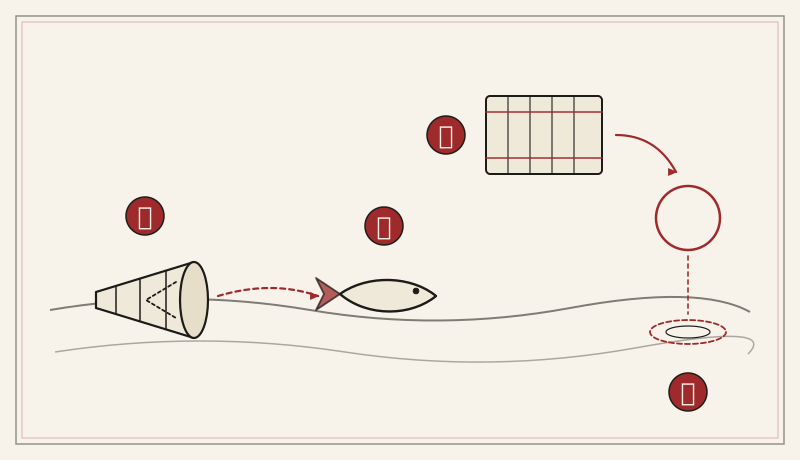
Classical ink-and-cinnabar diagram of Zhuangzi's Catching the Meaning and Forgetting the Words (Deyi Wangyan) showing the woven bamboo fish-trap on the riverbank, the living fish swimming freely in the stream, the bamboo scroll pointing toward the moon, and the moon reflected in clear water

Zhuangzi and Wang Bi’s four-stage progression from verbal tool to lived meaning (得鱼忘筌 · 得意忘言).

  1. The Woven Bamboo Fish-Trap (筌蹄之具 · 语言文字): classical terms, posture names, and anatomical cues serve as indispensable tools at the start of study
  2. The Living Fish in the Stream (得鱼忘筌 · 鲜活体悟): once your body directly experiences relaxed rooting or inner quiet, you no longer need to recite the verbal formula silently in your head
  3. Scrolls & Diagrams as Directional Pointers (借言明象 · 指月之指): texts and schematics guide the eye toward the living reality without replacing it
  4. The Moon Reflected in Still Water (得意忘言 · 心与道冥): when the heart-mind is still like a bronze mirror, the principle is lived spontaneously without mental chatter

3. How “Deyi Wangyan” Applies to Wudang Taijiquan and Meditation

In the Wudang training hall, “getting the fish and forgetting the trap” marks the transition from beginner mechanics to natural flow (Ziran):

  • Stage 1 — Weaving the Trap Carefully: When you first learn Grasp the Sparrow’s Tail or White Crane Spreads Its Wings, you must pay close attention to the verbal rules—“sink the shoulders, drop the elbows, fold the hip crease, align the knee with the toes.” Skipping the trap before you have caught the fish leads only to sloppy form.
  • Stage 2 — Forgetting the Checklist in Motion: Once those alignments have soaked into your tendons and breath through Zhan Zhuang, you no longer stand there muttering a ten-point checklist to yourself. In Zuowang and Xinzhai, you let go of inner verbal commentary so that body and breath move as one unbroken current.
A woven bamboo fish trap and a stack of blank dark-blue thread-bound classical books resting on a mossy stone beside a clear mountain stream with misty pines beyond.

“The trap exists for the fish; once you have the fish, forget the trap” (Zhuangzi Chapter 26): words are a tool for catching meaning.

4. Studying Beyond Words Between Wudang Mountain and Singapore

Connecting the contemplative heritage near Wudang Mountain’s UNESCO World Heritage ancient Taoist temples with our regular classes in Singapore, Wudang.Org provides clear textual roadmaps alongside living hands-on instruction. Begin your journey on Start Here.

Seeker’s Q&A · Frequently Asked Questions

What does Zhuangzi mean by “getting the fish and forgetting the trap” (得鱼忘筌, 得意忘言)?

Just as a woven bamboo trap is an essential tool for catching fish but is set aside once the fish is caught, words and technical manuals are vital tools for pointing toward living wisdom, yet should not be clung to as dogma once the principle is embodied.


Does “forgetting the words” mean beginners can ignore classical texts and posture rules?

No. Zhuangzi says “once you have caught the fish, you forget the trap”—not “throw away the trap before you have caught any fish.” Careful textual study and precise postural alignment come first; natural unselfconsciousness follows mastery.

How did Wang Bi expand Zhuangzi’s metaphor into “Words, Images, and Meaning” (言、象、意)?

In Clarifying the Images (Ming Xiang), Wang Bi explained that words point to symbolic or postural images (xiang), and images point to inner meaning (yi). Clinging strictly to words misses the image, and clinging strictly to outer form misses the living spirit.
