
TAOIST PHILOSOPHY · 道家哲学

Highest Virtue Does Not Claim Virtue (Shang De Bu De): Thick Substance vs. Thin Ornament in Tao Te Ching Chapter 38 上德不德,是以有德:《道德经》第三十八章的“处厚居实”与礼乐真伪辨

Explore Tao Te Ching (Dao De Jing) Chapter 38—the opening chapter of the De Jing—on why unselfconscious virtue endures, and why the sage dwells in the thick fruit (Shi) rather than the thin blossom (Hua).

Young bamboo shoots and fallen yellow ginkgo leaves on the mossy edge of a stone terrace, with misty ridges at sunrise beyond.

1. Opening the Book of Virtue (De Jing): “Highest Virtue Does Not Claim Virtue”

In the received eighty-one-chapter text of the Tao Te Ching (Dao De Jing), Chapter 38 opens the second half—the De Jing (《德经》, Book of Virtue)—and in the Mawangdui silk manuscripts (168 BCE), where the De Jing precedes the Dao Jing, it stands as the very first chapter of the entire work: “Highest virtue does not consciously claim virtue, and therefore truly has virtue; lower virtue clings to not losing virtue, and therefore lacks true virtue. Highest virtue acts without calculation (wuwei) and holds no ulterior agenda” (Shang de bu de, shi yi you de; xia de bu shi de, shi yi wu de. Shang de wu wei er wu yi wei 上德不德,是以有德;下德不失德,是以无德。上德无为而无以为).

Both Heshang Gong (河上公) and Wang Bi (王弼, 226–249 CE) point to the same vital distinction: just as a healthy heart beats without congratulating itself on beating, “Highest Virtue” (shang de 上德) flows directly from the uncontrived nature (Wuwei and Ziran) of the Tao. The moment a person performs goodness while anxiously watching the mirror to preserve a reputation for virtue (“lower virtue clings to not losing virtue”), sincerity turns into performance.

2. The Cascade from the Tao to Thin Ritual Husk

Chapter 38 then traces what happens when human society steps away from spontaneous wholeness: “When the Tao is lost, afterward there is conscious virtue; when virtue is lost, afterward there is benevolence (ren); when benevolence is lost, afterward there is righteousness (yi); when righteousness is lost, afterward there is ritual propriety (li). Now ritual propriety is the thinning out of loyalty and trust, and the beginning of disorder; clever foreknowledge is merely the surface blossom of the Tao, and the beginning of folly” (Fu li zhe, zhong xin zhi bo, er luan zhi shou. Qian shi zhe, dao zhi hua, er yu zhi shi 夫礼者,忠信之薄,而乱之首。前识者,道之华,而愚之始).

Laozi is not advocating rudeness; rather, he observes that when genuine inner trust (zhongxin 忠信) is thick and intact, people do not need elaborate external theatrics to prove their goodwill. When inner sincerity thins out, outer ceremony multiplies to mask its absence.

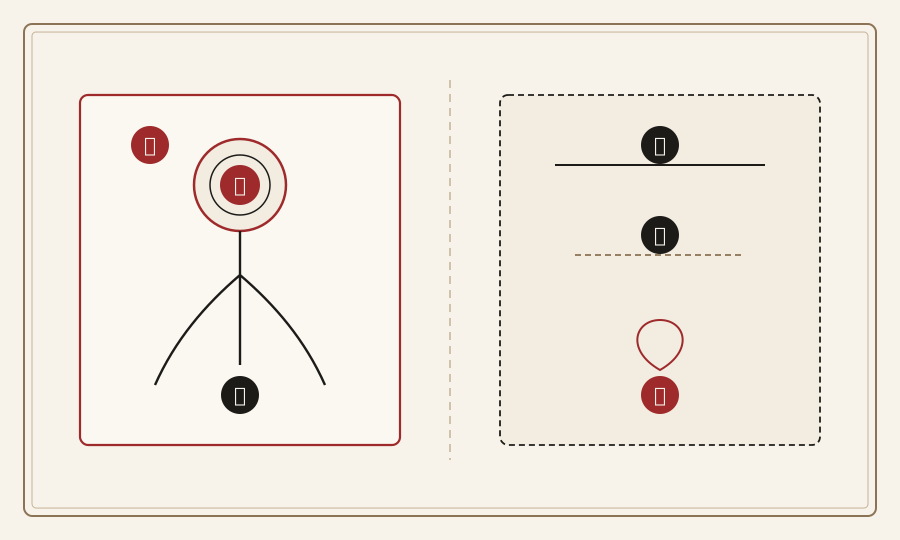
Classical numbers-only diagram of Tao Te Ching Chapter 38 contrasting the Thick Root and Ripened Fruit of Highest Virtue (①–③) with the Cascading Descent and Surface Blossom of Lower Virtue (④–⑥).

Tao Te Ching Chapter 38 (numbers-only SVG key): Dwelling in the thick substance and ripened fruit versus chasing the thin ritual husk and surface blossom.

  1. ① Highest Virtue (Shang De Bu De): Unselfconscious integrity acting naturally (Wuwei) without ulterior display.
  2. ② Dwelling in the Ripened Fruit (Chu Qi Shi): Nourishing inner substance that sustains life across seasons.
  3. ③ Abiding in the Thick Root (Chu Qi Hou): Deep loyalty, trust, and uncarved wholeness anchored in the Tao.
  4. ④ Lower Virtue & Calculated Goodness (Xia De Bu Shi De): Self-conscious effort that acts with an agenda for recognition.
  5. ⑤ Thinning of Loyalty and Trust (Zhong Xin Zhi Bo): When inner sincerity erodes, rigid external formality multiplies.
  6. ⑥ Surface Blossom & Clever Foreknowledge (Dao Zhi Hua): Flashy outer ornament that withers quickly without a root.

3. “Dwelling in the Thick, Residing in the Fruit” in Wudang Cultivation

Chapter 38 culminates in a positive ethical and meditative compass: “Therefore the great person dwells in the thick and does not reside in the thin; dwells in the substantial fruit and does not reside in the superficial blossom. Thus they let go of that and choose this” (Shi yi da zhang fu chu qi hou, bu ju qi bo; chu qi shi, bu ju qi hua. Gu qu bi qu ci 是以大丈夫处其厚,不居其薄;处其实,不居其华。故去彼取此).

In Wudang martial and contemplative training—whether in the temples of Wudang Mountain or in daily practice in Singapore—“blossom vs. fruit” (hua 华 vs. shi 实) is a direct diagnostic tool. A practitioner who chases flashy high kicks or theatrical postures while neglecting rooted Zhan Zhuang standing, the Six Harmonies (Liuhe), and quiet breath in the lower Dantian is choosing the fleeting blossom over the nourishing fruit. Like returning to the Uncarved Block (Pu) in Chapter 28, true skill grows from patient, unpretentious root work.

4. Daily Reflection: Choosing the Fruit Over the Blossom

Before beginning your practice or workday today, apply Chapter 38’s question: in the task ahead of you, what is the “blossom” (external appearance or praise) and what is the “fruit” (genuine care, solid foundation, and quiet integrity)?

Stand or sit upright for six slow nasal breaths, release the urge to impress onlookers, and invest your full attention into the quiet root of one movement or responsibility. Safety note: this philosophical reflection supports mindful daily living and is not a substitute for professional medical advice.

Seeker’s Q&A · Frequently Asked Questions

What does “dwell in the fruit, not in the flower” (Chu Qi Shi, Bu Ju Qi Hua) mean in Tao Te Ching Chapter 38?

Laozi contrasts the “flower” (Hua—superficial cleverness and outward ritual display that look impressive briefly) with the “fruit” (Shi—deep trust, unselfconscious integrity, and rooted inner substance that genuinely nourish life).


