
TAOIST PHILOSOPHY · 道家哲学

A Journey of a Thousand Li & Careful at the End as at the Beginning: Qian Li Zhi Xing and Shen Zhong Ru Shi in Tao Te Ching Chapter 64 千里之行始于足下与慎终如始:《道德经》第六十四章的治于未乱与武当筑基之道

An in-depth study of Tao Te Ching (Dao De Jing) Chapter 64, examining preventative attentiveness (Wei Zhi Yu Wei You), the three classical proverbs of gradual foundation, and the martial discipline of Shen Zhong Ru Shi.


A quiet Taoist study room: a black guqin on a low wooden console beside a pink lily arrangement and tea set, and a dark-glass study table set with white lotus-shaped cups, an incense holder and a floral branch, with straw cushions and a grey curtain.

Tending What Is Calm Before Signs Appear: Wei Zhi Yu Wei You

Chapter 64 of the Tao Te Ching (Dao De Jing) forms a direct companion to Chapter 63 (Planning the Difficult While It Is Easy in Chapter 63). It opens by observing how easily harmony is preserved before turbulence takes shape: 'What is at peace is easy to hold; what has not yet shown a sign is easy to plan for; what is brittle is easy to melt; what is minute is easy to disperse. Act upon it before it comes into being; order it before it falls into disorder' (其安易持,其未兆易谋;其脆易泮,其微易散。为之于未有,治之于未乱). In Wang Bi's (王弼) commentary and the Hanfeizi (Yu Lao, 韩非子·喻老, studied under Taoist Classics), waiting until disorder is full-blown forces one into heavy-handed intervention, whereas quiet mindfulness at the threshold of movement keeps both mind and body centered.

The Three Proverbs of Gradual Foundation: Shoot, Terrace, and Footstep

To ground this preventative wisdom in tangible experience, Laozi offers three of the most famous lines in classical literature: 'A tree thick enough to embrace with both arms grows from a tiny shoot; a nine-story terrace rises from a basket of earth; a journey of a thousand li begins beneath one's feet' (合抱之木,生于毫末;九层之台,起于累土;千里之行,始于足下). Across the stone stairways and ancient red pines of Wudang Mountain, these three images are literal daily realities. In internal martial cultivation (Wudang Taijiquan and Start Here), no student leaps directly to effortless spiral power; the 'tree' of rooted structure grows from the tiniest adjustments of the tailbone and ankles, the 'nine-story terrace' is built basket by basket through daily standing post (Zhan Zhuang, 站桩), and the 'thousand-li journey' begins literally beneath the soles of the feet in the opening posture (Commencing Taiji from Wuji: Taiji Qishi).

A Journey of a Thousand Li & Careful at the End as at the Beginning: Qian Li Zhi Xing and Shen Zhong Ru Shi in Tao Te Ching Chapter 64

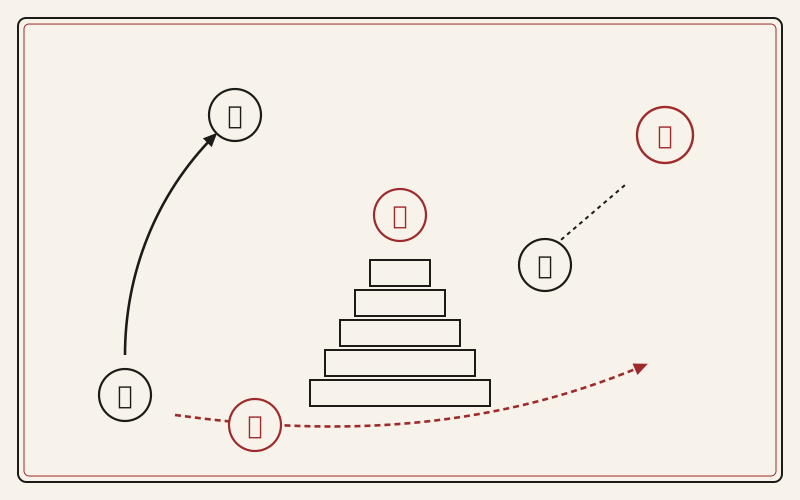
Classical diagram of Tao Te Ching Chapter 64: ① Acting Before Signs Appear (Wei Zhi Yu Wei You, Zhi Zhi Yu Wei Luan — tending stability while calm and unformed), ② A Tree Thick Enough to Embrace Grows from a Fine Shoot (He Bao Zhi Mu, Sheng Yu Hao Mo), ③ A Nine-Story Terrace Rises from a Basket of Earth (Jiu Ceng Zhi Tai, Qi Yu Lei Tu), ④ A Journey of a Thousand Li Begins Beneath the Feet (Qian Li Zhi Xing, Shi Yu Zu Xia), ⑤ Ruining at the Brink of Completion Through Impatience (Chang Yu Ji Cheng Er Bai Zhi), and ⑥ Careful at the End Just as at the Beginning (Shen Zhong Ru Shi, Ze Wu Bai Shi).

Why People Fail on the Verge of Completion: Shen Zhong Ru Shi

Laozi next diagnoses why so many undertakings falter near the finish line: 'In their handling of affairs, people constantly ruin them when on the very verge of completion. If one remains as careful at the end as at the beginning, there will be no ruined undertakings' (民之从事,常于几成而败之。慎终如始,则无败事). Why do practitioners stumble at the threshold of completion? At the beginning of a form or a project, attention is humble and alert; near the end, impatience, pride, or eagerness to finish takes over, causing the breath to rise and the posture to slacken. By uniting the opening attentiveness of Taiji Qishi with the composed stillness of Cross Hands and Closing Taiji (Shizishou & Shoushi), the practitioner embodies Shen Zhong Ru Shi (慎终如始).

Desiring Not to Desire and Assisting the Naturalness of the Myriad Things

The chapter concludes by describing how the sage avoids forceful interference: 'Therefore the sage desires not to desire, does not prize rare goods, learns not to lean on cleverness, returns to what the multitude passes over, and assists the naturalness of the myriad things without daring to act coercively' (是以圣人欲不欲,不贵难得之货;学不学,复众人之所过,以辅万物之自然,而不敢为). Returning to 'what the multitude passes over' (复众人之所过) means cherishing the foundational basics—calm breathing, quiet standing, and unadorned sincerity (True Words Are Not Ornate in Chapter 81)—where The Tao itself is directly realized.

Seeker’s Q&A · Frequently Asked Questions

How does A Journey of a Thousand Li & Careful at the End as at the Beginning guide daily Wudang cultivation?

An in-depth study of Tao Te Ching (Dao De Jing) Chapter 64, examining preventative attentiveness (Wei Zhi Yu Wei You), the three classical proverbs of gradual foundation, and the martial discipline of Shen Zhong Ru Shi.
