
TAOIST PHILOSOPHY · 道家哲学

The Great Sound Has a Subtle Voice (Dayin Xisheng) and the Great Image Has No Form in Tao Te Ching Chapter 41 《道德经》第四十一章“大音希声,大象无形”解:上士勤行与大器晚成的道家美学

Explore Chapter 41 of the Tao Te Ching (Dao De Jing) — how the highest student practices the Tao diligently, and the four classical paradoxes: the Great Square has no corners (Dafang Wuyu), the Great Vessel matures late (Daqi Wancheng), the Great Sound has a subtle voice (Dayin Xisheng), and the Great Image has no fixed form (Daxiang Wuxing).

A guqin resting on a long wooden table beside a small incense bowl, beneath open lattice windows looking onto misty bamboo.

1. Textual Foundation: Three Kinds of Listeners in Tao Te Ching Chapter 41

Chapter 41 of the Tao Te Ching (Dao De Jing) opens with a candid observation about how different temperaments respond to the teaching of the Tao: "When the highest type of student hears of the Tao, they practice it diligently; when the average student hears of the Tao, it seems now there, now gone; when the lowest type of student hears of the Tao, they laugh out loud at it — if they did not laugh at it, it would not suffice to be the Tao!" (上士闻道,勤而行之;中士闻道,若存若亡;下士闻道,大笑之。不笑不足以为道).

Why does the world's superficial cleverness laugh at the Tao? Because ordinary habit equates power with noise, speed, sharp edges, and instant display. The Tao operates by the exact opposite rhythm: "The bright Tao seems dim; the advancing Tao seems to retreat; the level Tao seems rough; the highest Virtue (De) seems like a valley" (明道若昧,进道若退,夷道若颣,上德若谷). To summarize this inversion of worldly expectations, Laozi cites four immortal four-character proverbs: Da Fang Wu Yu (大方无隅 — the Great Square has no corners), Da Qi Wan Cheng (大器晚成 — the Great Vessel is completed late), Da Yin Xi Sheng (大音希声 — the Great Sound has a subtle voice), and Da Xiang Wu Xing (大象无形 — the Great Image has no fixed form).

2. "The Great Square Has No Corners" and "The Great Vessel Is Completed Late"

Consider the first pair of paradoxes. A small wooden carpenter's square has four sharp, rigid ninety-degree corners (yu 隅); if one corner is bumped, it chips or splinters. The Great Square (dafang 大方 — the vast expanse of the earth and a person of mature Taoist integrity) has direction and uprightness, yet no brittle corners (wu yu 无隅). In Wudang Taijiquan, Wang Zongyue's Taijiquan Lun applies this directly to body mechanics: "Let there be no defect of hollows and protuberances, no breaks or angular corners" (无使有凹凸处,无使有断续处). A practitioner with sharp, rigid "corners" in their posture gives an opponent a handle to seize; a rounded, cornerless frame cannot be uprooted.

Likewise, a cheap clay cup can be pinched and fired in an afternoon, whereas a great bronze tripod ritual cauldron (ding 鼎) requires years of mining, smelting, mold-carving, and casting — the Great Vessel is completed late (da qi wan cheng 大器晚成). In internal cultivation — whether building a root in Standing Post (Zhan Zhuang) or refining the Three Treasures (Jing, Qi, and Shen) — chasing overnight shortcuts only produces fragile vessels. Patient daily practice (qin er xing zhi 勤而行之) is the mark of the highest student.

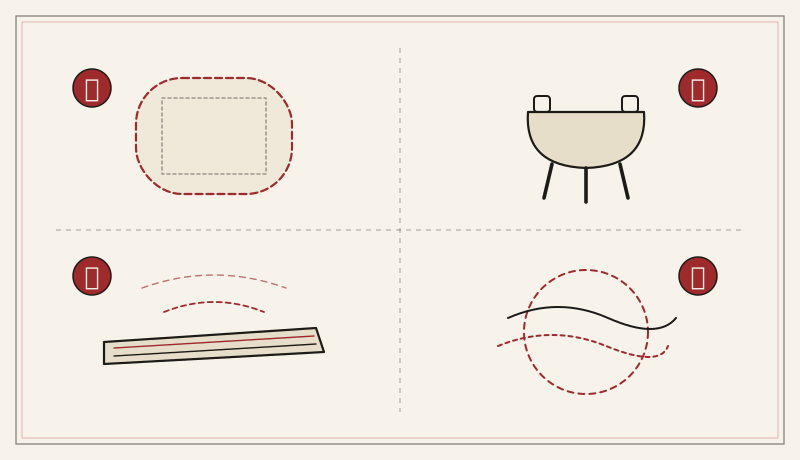
Classical ink-and-cinnabar four-quadrant diagram of Tao Te Ching Chapter 41 with four numbered markers (①–④) illustrating the cornerless Great Square, the late-maturing Great Vessel (Ding), the subtle-voiced Great Sound (Guqin), and the formless Great Image.

Figure 1: The Four Paradoxes of the Great Tao in Tao Te Ching Chapter 41 — ① The Great Square has no rigid corners (Da Fang Wu Yu); ② The Great Vessel is completed late (Da Qi Wan Cheng); ③ The Great Sound has a subtle, rarefied voice (Da Yin Xi Sheng); ④ The Great Image has no fixed form (Da Xiang Wu Xing).

  1. ① The Great Square Has No Corners (Da Fang Wu Yu 大方无隅): True integrity is vast and accommodating rather than brittle or angular.
  2. ② The Great Vessel Is Completed Late (Da Qi Wan Cheng 大器晚成): Deep cultivation and ceremonial bronze vessels require patient, unhurried tempering.
  3. ③ The Great Sound Has a Subtle Voice (Da Yin Xi Sheng 大音希声): The deepest harmony transcends noisy clamor, resonating in quietness and overtones.
  4. ④ The Great Image Has No Fixed Form (Da Xiang Wu Xing 大象无形): Because the Tao is not locked into a single shape, it can nourish all ten thousand forms.

3. "The Great Sound Has a Subtle Voice" and "The Great Image Has No Form"

What does Da Yin Xi Sheng (大音希声) mean? In Chapter 14 of the Tao Te Ching, Laozi defines Xi (希) explicitly: "Listening for it and not hearing it is called Xi (subtle/rarefied)" (听之不闻名曰希). If a musician strikes a single loud note on a brass gong, that note excludes all other notes and quickly dies away. Yet the "Great Sound" — the Piping of Heaven (Tianlai) in the Zhuangzi — is the silent matrix from which all sounds arise and into which they return. In the Wudang Guqin and Traditional Arts tradition, a master playing the seven-stringed guqin prizes the quiet slide of the finger after the string is plucked and the lingering silence between phrases, where the listener's own heart-mind settles into stillness.

Similarly, Da Xiang Wu Xing (大象无形 — "the Great Image has no fixed form") teaches that any object locked into a single rigid shape can serve only one narrow use (You and Wu: Empty Space and Usefulness). Because the Great Tao has no fixed form, it can flow like mountain mist into pine needles, streams, and human breath alike: "The Tao is hidden and nameless, yet only the Tao excels at providing and bringing to completion" (道隐无名,夫唯道,善贷且成).

4. Wudang Practice: Quiet Breath, Cornerless Movement, and Patient Maturation

In the temple courtyards of Wudang Mountain and in our Singapore classes, Chapter 41 guides three dimensions of daily training: 1) Da Yin Xi Sheng in Breathing: When practicing Natural Abdominal Breathing or the Six Healing Sounds (Liuzijue), refine the breath until it is so fine and quiet that even your own ears barely hear it; 2) Da Fang Wu Yu in Form: Smooth out abrupt stops and angular elbows in your Taijiquan and Wudang Taiji Jian transitions; 3) Da Qi Wan Cheng in Mindset: Release impatience with your progress, trusting that ten minutes of diligent daily practice (qin er xing zhi) transforms the sinews and spirit over the seasons. Traditional Wudang philosophy and Daoyin cultivate equanimity and physical coordination and never replace professional medical care.

Seeker’s Q&A · Frequently Asked Questions

What is the core takeaway of The Great Sound Has a Subtle Voice (Dayin Xisheng) and the Great Image Has No Form in Tao Te Ching Chapter 41?

Explore Chapter 41 of the Tao Te Ching (Dao De Jing) — how the highest student practices the Tao diligently, and the four classical paradoxes: the Great Square has no corners (Dafang Wuyu), the Great Vessel matures late (Daqi Wancheng), the Great Sound has a subtle voice (Dayin Xisheng), and the Great Image has no fixed form (Daxiang Wuxing).
