
TAOIST PHILOSOPHY · 道家哲学

Know the White, Yet Keep to the Black (Zhi Bai Shou Hei): Knowing Strength While Abiding in Receptivity in Tao Te Ching Chapter 28 知白守黑,知雄守雌:《道德经》第二十八章的溪谷处下与复归于朴

Explore Tao Te Ching (Dao De Jing) Chapter 28 ('Know the masculine, yet keep to the feminine; know the white, yet keep to the black') alongside Zhuangzi Chapter 33 and Wudang internal martial arts.


Rocky peaks and ridges wrapped in drifting cloud at dawn.

1. The Three Triads of Chapter 28: Knowing Both Poles While Resting in the Root

Chapter 28 of the Tao Te Ching (Dao De Jing) is structured around three rhythmic triads that unite clear perception with humble station: 'Know the masculine (xiong 雄, active strength), yet keep to the feminine (ci 雌, receptive stillness), and become the ravine of the world (wei tian xia xi 为天下溪)... Know the white (bai 白, brightness and display), yet keep to the black (hei 黑, quiet depth), and become the model of the world... Know honor (rong 荣), yet keep to humility (ru 辱), and become the valley of the world.'

Notice the precision of Laozi's verbs: the practitioner does not ignore strength, brightness, or capability—one knows (zhi 知) them thoroughly, yet guards and abides in (shou 守) the low, receptive, uncarved root. In the final chapter of the Zhuangzi (Tianxia 天下, Chapter 33), early historians of Chinese thought quote this exact passage as the defining signature of Lao Dan's teaching (see our Tao Te Ching Chapter 28 study page and The Valley Spirit Never Dies).

2. 'Know the White, Keep to the Black' in Chinese Aesthetics and Inner Cultivation

Over centuries of Chinese cultural history, 'know the white, keep to the black' (zhi bai shou hei 知白守黑) became a foundational principle in both Taoist meditation and classical brush painting (Shanshui 山水, explored in our landscape painting hub). On a sheet of Xuan paper, the unpainted white space (liubai 留白) and the dark ink strokes give life to each other: without the quiet reserve of ink and empty mist, a painting becomes crowded and lifeless.

In Wudang inner cultivation, 'white' corresponds to the outward radiance of conscious thought and sensory perception, while 'black' points to the deep, dark, subterranean reservoir of the Kidneys and lower abdomen (Xuanming 玄冥). Knowing the bright world while keeping one's vital spirit anchored in quiet inwardness prevents burnout and exhaustion.

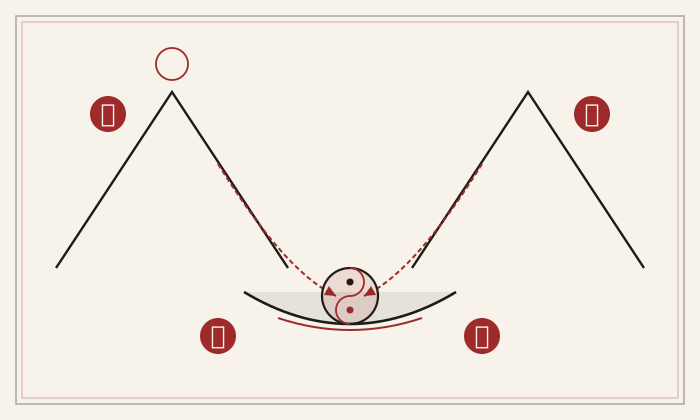
Classical diagram illustrating Tao Te Ching Chapter 28: sunlit mountain peaks flowing down into a deep receptive ravine and uncarved center

How Tao Te Ching Chapter 28 unites awareness of the high, bright peak with abiding in the deep, receptive ravine.

  1. ① Know the Masculine, Keep to the Feminine (Zhi Qi Xiong, Shou Qi Ci): Fully understanding active strength while choosing to rest in receptive stillness.
  2. ② Know the White, Keep to the Black (Zhi Qi Bai, Shou Qi Hei): Perceiving bright outward distinctions while conserving the quiet dark root.
  3. ③ Become the Ravine & Valley of the World (Wei Tian Xia Xi, Wei Tian Xia Gu): The low, open basin where all mountain streams naturally converge.
  4. ④ Unbroken Virtue Returning to the Uncarved Block (Chang De Nai Zu, Fu Gui Yu Pu): Wholeness preserved like the infant and unsplit timber.

3. Knowing Martial Power While Abiding in Softness on the Wudang Training Floor

In Wudang Taijiquan and internal martial arts, Chapter 28 explains why softness is never weakness. A person who is merely weak does not 'know the masculine' (zhi qi xiong)—they have no structure, no root, and no capacity to issue force. By contrast, a trained Wudang practitioner understands structure, leverage, and storing and issuing energy (Xujin and Fajin) intimately, yet chooses to abide in receptive listening (Shou Qi Ci).

Like a mountain ravine (Xi 溪) that lies lower than the surrounding peaks, the practitioner in Push Hands (Tuishou) yields beneath an aggressive push so the partner's force flows downward into emptiness, returning naturally to the uncarved simplicity of Pu.

4. A Daily Practice: Conserving One Third of Your Energy in Speech and Action

You can practice 'knowing the white, yet keeping to the black' throughout a busy day by deliberately holding back the impulse to display everything you know or expend every drop of energy. In conversation, listen twice as long as you speak; in solo Qigong or Taijiquan practice, keep thirty percent of your awareness resting quietly in the lower abdomen and soles even during expansive postures.

Safety note: this philosophical and movement study guide is educational and supports everyday composure and balance; it does not replace medical advice or clinical care.

Seeker’s Q&A · Frequently Asked Questions

What is the core takeaway of Know the White, Yet Keep to the Black (Zhi Bai Shou Hei)?

Explore Tao Te Ching (Dao De Jing) Chapter 28 ('Know the masculine, yet keep to the feminine; know the white, yet keep to the black') alongside Zhuangzi Chapter 33 and Wudang internal martial arts.
