
TAOIST PHILOSOPHY · 道家哲学

Nothing in the World Is Softer Than Water & True Words Seem Paradoxical: Mo Rou Ruo Yu Shui and Zheng Yan Ruo Fan in Tao Te Ching Chapter 78 天下莫柔弱于水与正言若反:《道德经》第七十八章的水德攻坚与太极知行合一

An examination of Tao Te Ching (Dao De Jing) Chapter 78, exploring why nothing excels water in overcoming the hard and rigid, why everyone knows that the soft overcomes the hard yet few practice it, and the meaning of Zheng Yan Ruo Fan.


A quiet Taoist study room: a black guqin on a low wooden console beside a pink lily arrangement and tea set, and a dark-glass study table set with white lotus-shaped cups, an incense holder and a floral branch, with straw cushions and a grey curtain.

Why Nothing Excels Water in Overcoming the Hard: Yi Qi Wu Yi Yi Zhi

Chapter 78 of the Tao Te Ching (Dao De Jing) brings Laozi's reflections on water—introduced in Chapter 8 ('The highest good is like water') and Chapter 66 (Why Rivers and Seas Lead the Hundred Valleys)—to their sharpest philosophical culmination: 'Nothing in the world is softer and weaker than water, yet for attacking the hard and strong, nothing can surpass it, because nothing can alter its nature' (天下莫柔弱于水,而攻坚强者莫之能胜,以其无以易之). As Wang Bi (王弼) and the Huainanzi (Yuandao Xun, 淮南子·原道训, studied under Taoist Classics) explain, the decisive phrase is Yi Qi Wu Yi Yi Zhi (以其无以易之): you can strike water with a blade and leave no wound, compress it into a square or round vessel without damaging its substance, or freeze and vaporize it without destroying its capacity to return to fluid flow. Because water has no rigid shape to fracture, even the hardest granite boulder in the gorges of Wudang Mountain is gradually hollowed out by its patient, uninterrupted passage.

Everyone Knows It, Yet None Can Practice It: Tian Xia Mo Bu Zhi, Mo Neng Xing

Laozi immediately follows this observation with a penetrating diagnosis of human habit: 'That the weak overcomes the strong and the soft overcomes the hard—there is no one in the world who does not know this, yet no one is able to put it into practice' (弱之胜强,柔之胜刚,天下莫不知,莫能行). Why is this principle universally acknowledged in theory yet abandoned in practice? On the training floor of Wudang Taijiquan (and for every newcomer beginning at Start Here), the answer becomes tangible the moment a partner pushes against our chest or wrist. Intellectually, every student agrees with yielding; somatically, the startled nervous system instantly braces the shoulders and pushes back with raw force (Zhuoli, 拙力). Turning 'knowing' (Zhi, 知) into 'practicing' (Xing, 行) requires thousands of hours of quiet standing, form work, and Push Hands so the body trusts fluid adaptation under pressure.

Nothing in the World Is Softer Than Water & True Words Seem Paradoxical: Mo Rou Ruo Yu Shui and Zheng Yan Ruo Fan in Tao Te Ching Chapter 78

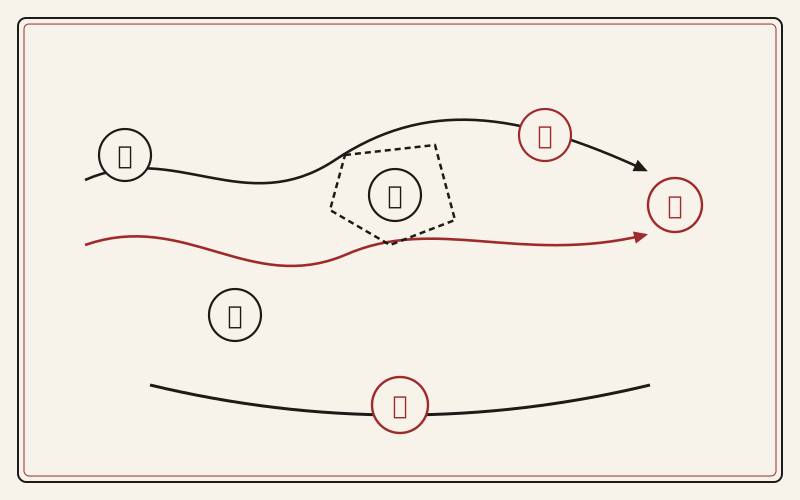
Classical diagram of Tao Te Ching Chapter 78 (Nothing Softer Than Water & True Words Seem Paradoxical): ① UnchangingFluid Nature of Water (Mo Rou Ruo Yu Shui, Wu Yi Yi Zhi — continuous yielding without fixed shape), ② Rigid Obstacle & Unyielding Stone (Jian Qiang — brittle resistance eroded by continuous flow), ③ The Soft Overcoming the Hard (Rou Zhi Sheng Gang — fluid enveloping and bypassing rigid force), ④ Gap Between Knowing and Practicing (Tian Xia Mo Bu Zhi, Mo Neng Xing), ⑤ Receiving the Lowly and Inauspicious (Shou Guo Zhi Gou / Bu Xiang — the basin that accepts all runoff), and ⑥ Upright Words Seem Inverted (Zheng Yan Ruo Fan — paradoxical harmony of The Tao itself).

Bearing the Sediment of the Valley: Shou Guo Zhi Gou

The chapter then shifts from physical mechanics to ethical capacity: 'Therefore the sage says: One who receives the humiliation and sediment of the state is called Lord of the Altars of Soil and Grain; one who receives the misfortune of the state is called King of the World' (是以圣人云:受国之垢,是谓社稷主;受国不祥,是为天下王). Like a great river basin that accepts muddy runoff, fallen leaves, and mountain torrents without losing its depth or clarity, true leadership and internal cultivation rest on the capacity to absorb friction without resentment. Where a brittle ego demands only praise and favorable conditions, one aligned with The Tao itself remains unshaken when absorbing difficulty or an opponent's incoming momentum.

Zheng Yan Ruo Fan: Why Upright Words Sound Like Their Opposite

Chapter 78 closes with a four-character seal that illuminates the entire text of the Tao Te Ching: 'Upright words seem like their opposite' (正言若反). To ordinary habit—which equates stiffness with strength (Soft and Supple at Birth in Chapter 76) and accumulation with security (The Bow of Heaven in Chapter 77)—statements that softness overcomes hardness or that yielding preserves root sound paradoxical or inverted. Yet once examined across long cycles of time and somatic practice, these 'inverted' words prove to be the most direct description of reality.

Seeker’s Q&A · Frequently Asked Questions

How does Nothing in the World Is Softer Than Water & True Words Seem Paradoxical guide daily Wudang cultivation?

An examination of Tao Te Ching (Dao De Jing) Chapter 78, exploring why nothing excels water in overcoming the hard and rigid, why everyone knows that the soft overcomes the hard yet few practice it, and the meaning of Zheng Yan Ruo Fan.
