TAOIST PHILOSOPHY · 道家哲学

The Swimmer at the Lüliang Cataract in the Zhuangzi: Entering with the Vortex and Emerging with the Eddy 《庄子·达生》吕梁丈人蹈水解:与齐俱入、与汩偕出的顺水之道

Explore the parable of the Lüliang swimmer in Zhuangzi Chapter 19 (Dasheng) — descending with the vortex (Yu Ji Ju Ru), rising with the eddy (Yu Gu Xie Chu), and how following the water's own Way illuminates Wudang Taijiquan's principle of yielding and following incoming momentum.

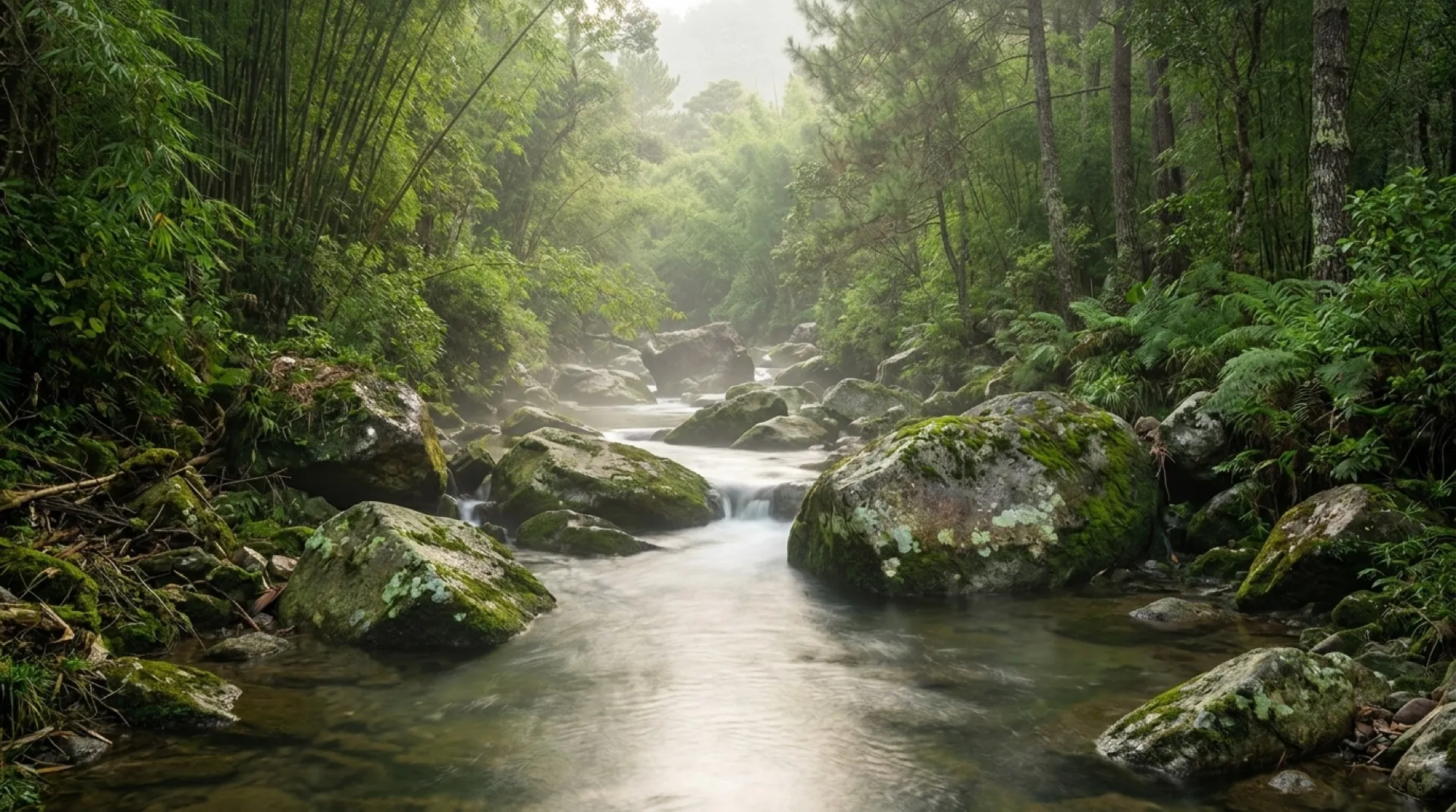
A clear mountain stream running between mossy boulders through bamboo and forest in soft morning light.

1. Textual Foundation: Confucius at the Lüliang Cataract in Zhuangzi Chapter 19

In Chapter 19 of the Zhuangzi (Dasheng 达生, "Mastering Life"), Confucius views the cataract at Lüliang (吕梁悬水), where the water plunges thirty ren and churns in frothing rapids for forty li — a torrent so swift that neither water-turtles, alligators, nor fish can swim in it (悬水三十仞,流沫四十里,鼋鼍鱼鳖之所不能游也). Catching sight of a man swimming in the midst of the boiling whitewater, Confucius assumes the man has suffered some grave sorrow and wishes to end his life, and hurries his disciples along the bank to pull him out. Yet after the water has carried the man several hundred paces downstream, he steps ashore with his hair unbound, strolling and singing at ease beneath the embankment (行歌而游于塘下).

Astonished, Confucius approaches and asks whether he possesses a special Way for treading water (蹈水有道乎). The swimmer replies: "No, I have no special Way. I began with what was native and familiar to me, grew up with my natural disposition, and reached completion with destiny (吾始乎故,长乎性,成乎命). I go down with the swirling vortex and come up with the surging eddy (与齐俱入,与汩偕出), following the Way of the water without imposing any private self upon it (从水之道而不为私焉). That is how I tread the water." Alongside the parables of Cook Ding, the Cicada Catcher, and Woodcarver Qing, this passage in the Dasheng chapter forms one of classical Taoism's clearest teachings on effortless responsiveness (wu-wei 无为) in the midst of turbulent conditions.

2. "Entering with the Vortex, Emerging with the Eddy": Reading the Current Instead of Fighting It

Why would an ordinary swimmer drown in the Lüliang rapids while the old swimmer emerges singing? An inexperienced swimmer treats the river as an enemy to be overpowered: seeing the downward whirlpool (ji 齐, the central navel of a vortex), they panic, stiffen their limbs, and thrash upward against the suction, exhausting their breath (qi 气) within seconds. The Lüliang swimmer does the exact opposite. Because he imposes no egotistical agenda (bu wei si 不为私) upon the torrent, he senses the internal geometry of the water: every downward vortex that pulls water to the riverbed must, by hydro-mechanical necessity, rebound off the rocks and rise downstream as an upward surging eddy (gu 汩).

By yielding to the descent at the center of the whirlpool (yu ji ju ru 与齐俱入) and riding the upward current where it naturally surfaces (yu gu xie chu 与汩偕出), he borrows the river's own force to carry him to shore. This directly echoes Chapter 8 and Chapter 43 of the Tao Te Ching (Dao De Jing) in the Taoist Classics: water benefits the ten thousand things without contending (shang shan ruo shui, shui shan li wanwu er bu zheng 上善若水,水善利万物而不争), and the softest thing under heaven gallops through the hardest because it enters where there is no gap (wu you ru wu jian 无有入无间). To follow the Way of the water is not passive helplessness; it is lucid, fearless alignment with the real structure of forces in motion.

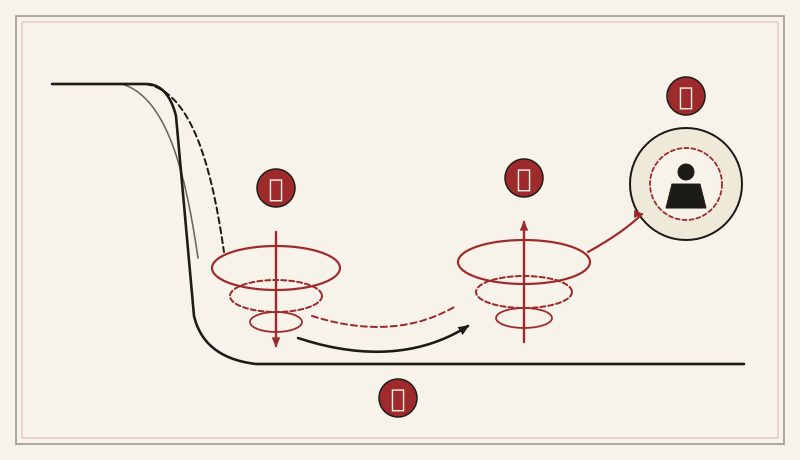
Classical ink-and-cinnabar schematic of the Lüliang cataract with four numbered markers (①–④) illustrating the downward vortex, the upward eddy, the unforced current path, and the triad of native ground, natural disposition, and destiny.

Figure 1: The Swimmer at the Lüliang Cataract (Zhuangzi Chapter 19, Dasheng) — ① Descending with the center of the vortex (Yu Ji Ju Ru); ② Emerging with the surging upward eddy (Yu Gu Xie Chu); ③ Following the water's own Way without imposing private self (Cong Shui Zhi Dao Er Bu Wei Si); ④ Harmonizing native ground, natural disposition, and destiny (Shi Hu Gu, Zhang Hu Xing, Cheng Hu Ming).

  1. ① Descending with the Vortex (Yu Ji Ju Ru 与齐俱入): Entering the downward spiral of the torrent without stiffening the frame or fighting the pull.
  2. ② Emerging with the Eddy (Yu Gu Xie Chu 与汩偕出): Riding the natural upward rebound of the current back to the surface without frantic striving.
  3. ③ Following the Water's Way Without Self-Will (Cong Shui Zhi Dao Er Bu Wei Si 从水之道而不为私焉): Moving in continuous accord with objective momentum rather than subjective resistance.
  4. ④ Native Ground, Natural Disposition, and Destiny (Shi Hu Gu, Zhang Hu Xing, Cheng Hu Ming 始乎故 · 长乎性 · 成乎命): Cultivating familiarity until second nature and calm acceptance of reality become seamless.

3. Beginning with the Familiar, Growing with Nature, Completing in Destiny

When Confucius asks what the swimmer means by "beginning with what is native, growing up with natural disposition, and reaching completion with destiny" (始乎故,长乎性,成乎命), the swimmer explains carefully: "Being born among the hills and feeling at peace among the hills — that is what is native and familiar (gu 故). Growing up by the water and feeling at peace in the water — that is natural disposition (xing 性). Not knowing how I do it and yet doing it so — that is destiny (ming 命)."

In the contemplative curriculum studied in the historic temples of Wudang Mountain and taught to modern students in Singapore, these three stages describe the maturation of all authentic internal cultivation. First comes Gu (故) — patient daily habituation in foundational stances, breathing, and quiet sitting until the practice feels like one's native home rather than an awkward foreign task. Second comes Xing (性) — allowing the body's innate structure and vital breath to reorganize naturally without artificial strain, as explored in Dual Cultivation of Xing and Ming. Third comes Ming (命) — the stage where conscious calculation drops away and the practitioner responds spontaneously to changing circumstances without self-conscious deliberation, much like the Drunken Man Falling from a Cart whose spirit remains whole (shen quan 神全).

4. Wudang Martial and Contemplative Practice: Following Incoming Force in Tuishou

In Wudang Taijiquan and Push Hands (Tuishou), the Lüliang swimmer's maxim — "following the Way of the water without imposing any private self" (从水之道而不为私焉) — translates directly into Wang Zongyue's classical rule in the Taijiquan Lun: "Give up your own subjective plan and follow the partner" (sheji congren 舍己从人). When a partner presses forward with heavy force, colliding head-on is like thrashing against the Lüliang cataract. Instead, through Listening Energy (Tingjin) and Silk-Reeling Spirals (Chansijin), the practitioner absorbs and folds with the incoming vector (yu ji ju ru — entering with the vortex through Peng 掤 and Lü 捋), then guides the partner's over-extended momentum into an effortless release (yu gu xie chu — emerging with the eddy through Ji 挤, An 按, or Diagonal Flying).

Try this three-minute reflective practice before your next Standing Post (Zhan Zhuang) or form session, or when facing a sudden wave of pressure in daily work: 1) Exhale slowly through the nose and feel your weight settle into the soles of the feet, noticing where your shoulders or jaw have braced against the current of the day; 2) Instead of fighting the fact that a situation is moving quickly, ask quietly where the downward vortex (ji 齐) is pulling and where the natural upward eddy (gu 汩) is opening; 3) Act along the path of least resistance with a clear, unhurried heart-mind. As always in traditional Wudang training, philosophy and Daoyin cultivate mental equanimity and physical coordination and never replace professional medical care.

Seeker’s Q&A · Frequently Asked Questions

What is the core takeaway of The Swimmer at the Lüliang Cataract in the Zhuangzi?

Explore the parable of the Lüliang swimmer in Zhuangzi Chapter 19 (Dasheng) — descending with the vortex (Yu Ji Ju Ru), rising with the eddy (Yu Gu Xie Chu), and how following the water's own Way illuminates Wudang Taijiquan's principle of yielding and following incoming momentum.
