

TAOIST PHILOSOPHY · 道家哲学

The Parable of the Empty Boat (Xu Zhou) in Zhuangzi: Why an Unoccupied Skiff Never Provokes Anger and How to Empty the Self 《庄子·山木》“虚舟触舟”详解:为什么空船撞来人不会发怒?“虚己以游世”的修心智慧

How a 60-character river scene in Zhuangzi Chapter 20 (Shanmu) reveals the hidden root of reactive anger—and what “emptying the boat” means in daily relationships and Wudang Push Hands.

A clear mountain stream running between mossy boulders through bamboo and forest in soft morning light.

Why does the exact same physical bump—a delayed reply, a brusque remark in traffic, or a sudden shove in partner training—provoke blazing anger in one moment and leave us completely unruffled in another? In Chapter 20 of the Zhuangzi—The Mountain Tree (《庄子·外篇·山木》)—Zhuangzi answers this question with one of the sharpest psychological parables in world literature: “The Empty Boat” (虚舟, Xu Zhou).

1. The Classical Passage from Zhuangzi: The Mountain Tree (《山木》)

Suppose a person is crossing a river in lashed boats, and an empty boat (虚船, xuchuan) drifts along and bumps into their hull. Even if the person has an irritable, narrow temper (惼心之人), they will not get angry.

Yet if there is a single person aboard that other boat, they will immediately shout at them to steer clear or haul back! If they shout once and are not heard, they will shout a second time; if they shout three times and are still not heard, a torrent of curses will inevitably follow.

Earlier they were not angry, and now they are furious—why? Because earlier the boat was empty (虚, xu), and now it is occupied (实, shi). If a person can empty themselves to wander through the world (人能虚己以游世), who then could harm them?

2. Why Do We Rage at the Boatman Rather Than the Wooden Hull?

Notice what remains identical in both halves of Zhuangzi’s thought experiment: the wooden prow of the drifting skiff strikes your boat with the exact same momentum and makes the exact same thud. Yet your emotional reaction is night and day:

  • When the other boat is “full” (有一人在其上 · 以实撞实): The moment you see a person sitting in the other skiff, your mind projects personal intention—“They are disrespecting me! They should have yielded to me!” Ego collides against ego, turning a simple physical problem (pushing a hull aside with a bamboo pole) into a moral battleground (Honour, Disgrace, and the Self).
  • When the boat is “empty” (虚船来触舟 · 无心则无怨): When there is nobody aboard, there is no target for blame. You simply guide the drifting hull away and continue across the river, your heart-mind as clear as a bronze mirror.
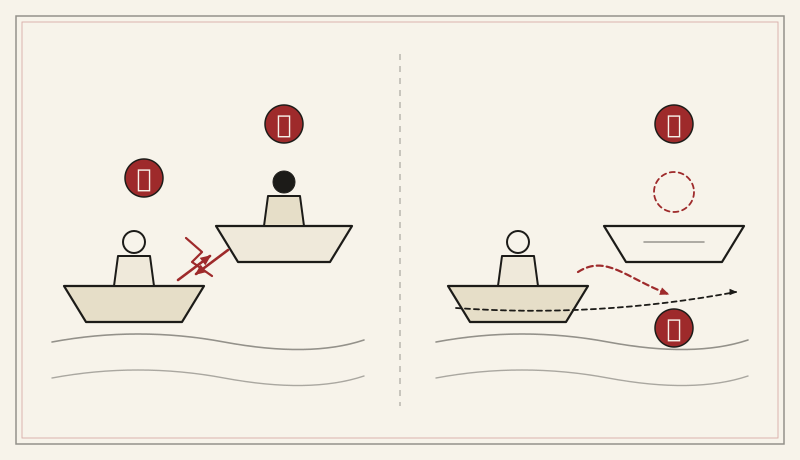
Classical ink-and-cinnabar diagram of Zhuangzi's Empty Boat Parable (Xu Zhou) comparing a manned boat collision on the left with jagged friction sparks and an unoccupied skiff on the right gliding harmlessly along the current

Two Modes of Encounter on the River of Life in Zhuangzi: Shanmu (《庄子·山木》实舟相撞与虚舟游世图解).

  1. The Occupied Boat (有一人在其上 · 我执对立): when both hulls carry rigid self-importance, every bump is interpreted as a personal insult
  2. Three Shouts and Curses Follow (三呼而恶声随之 · 嗔心骤起): resistance against resistance generates heat, shouting, and exhaustion (Tao Te Ching Chapter 24)
  3. The Unoccupied Skiff (有虚船来触舟 · 虚怀无心): an empty vessel carries no malice and offers no ego target for resentment (You and Wu: The Value of Empty Space)
  4. Emptying the Self to Wander Through the World (虚己以游世 · 顺流相化): like water parting around a drifting skiff (The Softness of Water), you resolve the contact calmly and keep moving

3. Two Ways to Practise “The Empty Boat” in Daily Life and Wudang Taijiquan

Zhuangzi’s parable works in both directions—how you perceive others, and how you carry yourself:

  • In everyday friction — See the other person’s reaction as an unsteered skiff: When someone speaks sharply out of fatigue, stress, or habit (bound by their own narrow well), treat their outburst like a boat that has slipped its mooring in the wind. Respond practically to steer clear, without taking the bump into your heart (Xinzhai).
  • In Wudang Push Hands (Tuishou) — Become the Empty Boat yourself: In partner training, if your chest and shoulders are stiff with the desire to win (“a person stiffly braced inside the boat”), your partner’s push immediately finds a solid target to uproot you. When you relax your chest and waist (distinguishing Empty and Full), your partner touches an “empty boat” that yields along the curve of the water and redirects their force effortlessly.
A small empty weathered wooden skiff with an oar across it, floating on still misty water below green mountain ridges and shoreline pines.

The Empty Boat (Zhuangzi Chapter 20): if an empty boat bumps your own, even a hot-tempered man will not be angry.

4. Cultivating Unhurried Equanimity Between Wudang Mountain and Singapore

Connecting the contemplative heritage near Wudang Mountain’s UNESCO World Heritage ancient Taoist temples with our regular classes in Singapore, Wudang.Org helps practitioners embody classical Taoist wisdom in posture, breath, and daily life. Begin your study on Start Here.

Seeker’s Q&A · Frequently Asked Questions

Where does the Parable of the Empty Boat (Xu Zhou 虚舟) appear in classical Taoist texts?

It appears in Chapter 20 of the Zhuangzi, titled Shanmu (《庄子·外篇·山木》, “The Mountain Tree”), illustrating how emptying the ego (“xu ji yi you shi” 虚己以游世) frees a person from reactive conflict.


Why does an irritable person stay calm when bumped by an empty boat, yet become furious when someone is aboard?

Because anger is triggered not by the physical bump itself, but by the mind projecting personal blame and disrespect onto another ego (“formerly it was empty, now it is full”).

How does “emptying the boat” apply to Wudang Taijiquan Push Hands (Tuishou)?

When you meet a partner’s push with stiff shoulders, you offer a solid hull that can be shoved backward; when your joints and waist remain supple and empty, your partner’s force glances off like water against a floating skiff.
