
TAOIST PHILOSOPHY · 道家哲学

Woodcarver Qing’s Bell-Stand (Ziqing Xueju) in Zhuangzi: Seven Days of Fasting to “Match Heaven with Heaven” (Yi Tian He Tian) 《庄子·达生》“梓庆削鐻”详解:斋七日忘四肢形体,何谓“以天合天”?

Why the master woodcarver refused to touch a chisel until he had fasted his mind of reward (3 days), praise and blame (5 days), and his own ego-body (7 days)—so his inner nature could meet the natural grain of the forest.

An ancient tree with massive exposed roots beside stone steps and a stone balustrade descending through misty forest, with peaks beyond.

If Cook Ding shows us how a master moves through complex joints without dulling his blade, and the Cicada-Catcher shows how undivided intent steadies the hand, the story of “Woodcarver Qing Carving the Bell-Stand” (梓庆削鐻, Ziqing Xueju) in Chapter 19 of the Zhuangzi (Mastering Life, 《庄子·外篇·达生》) reveals how a practitioner prepares their inner state before beginning any great work. Its concluding phrase—“Matching Heaven with Heaven” (以天合天, Yi Tian He Tian)—is the highest expression of Taoist naturalness (Ziran).

1. The Classical Account in Zhuangzi: Mastering Life (《达生》)

Woodcarver Qing carved wood to make a bell-stand (鐻, ju). When the bell-stand was finished, all who saw it were astounded, as though it were the work of spirits and ghosts (鐻成,见者惊犹鬼神). The Marquis of Lu went to see it and asked: “By what art have you made this?”

Qing replied: “Your servant is merely a workman—what art could I possess? Yet there is one thing. When I am about to make a bell-stand, I never dare to squander my vital Qi (未尝敢以耗气也); I must fast in order to quiet my heart-mind (必齐以静心):

After fasting for three days, I no longer dare to harbor thoughts of congratulations, rewards, titles, or stipends (齐三日,而不敢怀庆赏爵禄);

After fasting for five days, I no longer dare to harbor thoughts of blame or praise, skill or clumsiness (齐五日,不敢怀非誉巧拙);

After fasting for seven days, I become so still that I forget that I have four limbs and a physical body (齐七日,辄然忘吾有四肢形体也)…

Only then do I enter the mountain forest and observe the Heaven-nature of the trees (然后入山林,观天性). When I find a tree whose natural form is complete, only then do I see the finished bell-stand within it and put my hand to the work; if not, I let it be. Thus I match Heaven with Heaven (则以天合天)—is this not why the vessel seems like the work of spirits?”

2. The Three Concentric Rings of “Fasting to Quiet the Mind” (斋以静心)

Notice how Woodcarver Qing’s preparation deepens Yan Hui’s Fasting of the Heart-Mind (Xinzhai) and Sitting and Forgetting (Zuowang) into three clear, practical thresholds:

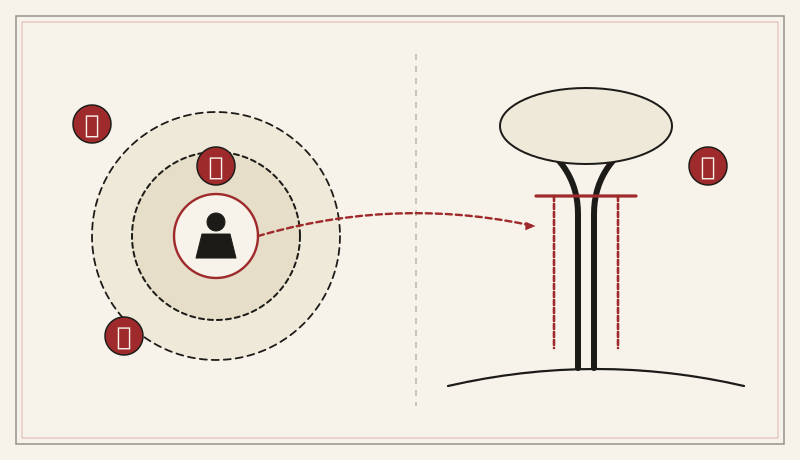
Classical ink-and-cinnabar diagram of Woodcarver Qing's Bell-Stand (Ziqing Xueju) in Zhuangzi showing the three concentric rings of fasting on the left (3 days, 5 days, 7 days) and entering the mountain forest to match Heaven with Heaven on the right

From Seven-Day Fasting of the Mind to “Matching Heaven with Heaven” (《庄子·达生》“梓庆削鐻·以天合天”四维图解).

  1. Day 3 — Dropping Greed for Reward & Rank (斋三日 · 忘庆赏爵禄): peeling off the outermost layer of utilitarian calculation (profit, bonus, status)
  2. Day 5 — Dropping Anxiety Over Praise, Blame, Skill & Clumsiness (斋五日 · 忘非誉巧拙): releasing the subtler vanity of “looking skillful” or fearing criticism (Honour and Disgrace)
  3. Day 7 — Forgetting the Four Limbs & Ego-Frame (斋七日 · 忘四肢形体): when self-consciousness dissolves (Wu Sang Wo), vital Qi is completely conserved
  4. Entering the Forest — “Matching Heaven with Heaven” (入山林观天性 · 以天合天): the artisan’s unclouded inner nature meets the tree’s natural grain without forcing

3. What Does “Matching Heaven with Heaven” (以天合天) Mean?

When an anxious craftsman approaches a block of wood thinking of money (Day 3) or applause (Day 5), they impose a rigid human agenda (Ren 人) onto the material, fighting against its natural grain. By contrast, when Qing’s own heart-mind has returned to its congenital simplicity (his inner Heaven), he walks into the forest and immediately recognizes the tree whose natural curves already hold the bell-stand (the tree’s Heaven). His chisel merely removes what does not belong—inner nature meeting outer nature without a hair’s breadth of violence.

4. Applying Woodcarver Qing’s Method to Wudang Practice Between Wudang Mountain and Singapore

  • Before stepping onto the practice floor (Taijiquan, Qigong, or Calligraphy): Take sixty seconds to pass through Qing’s three gates—let go of rushing for results, let go of worrying whether your posture looks impressive, and let your limbs soften until breath and movement follow nature itself.

Connecting the ancient forested peaks near Wudang Mountain’s UNESCO World Heritage Taoist temples with our regular classes in Singapore, Wudang.Org welcomes you to study in this unhurried spirit. Begin on Start Here.

Seeker’s Q&A · Frequently Asked Questions

What are the three stages of fasting (3 days, 5 days, 7 days) described by Woodcarver Qing in Zhuangzi?

After 3 days of mental fasting he forgets rewards and titles; after 5 days he forgets praise, blame, skill, and clumsiness; after 7 days he forgets his own four limbs and physical ego—conserving his Qi completely before entering the forest.

What does Woodcarver Qing mean by “Matching Heaven with Heaven” (Yi Tian He Tian 以天合天)?

The first “Heaven” is the artisan’s own congenital nature once stripped of greed and vanity through fasting; the second “Heaven” is the natural grain and form of the living tree in the forest. When unforced human nature meets natural material without ego interference, the work seems divine.

Why does Woodcarver Qing say “I never dare to squander my Qi” (未尝敢以耗气也)?

In Taoist cultivation, worrying about rewards, fretting over criticism, and trying to show off one’s cleverness drain vital Qi far more than physical labour itself. Quietly fasting the mind preserves full vitality for the task.
