

TAOIST PHILOSOPHY · 道家哲学

Forgetting Scheming beside the Gull-Stream (Ouniao Wangji): How Ulterior Motives (Jixin) Break Natural Trust in Classical Taoism 道家“鸥鸟忘机”与“机心”详解:为什么心存算计连海鸥都不肯落下?

Why a hundred sea-gulls played beside a young man every morning until the day his father asked him to catch one—and how Zhuangzi and Liezi define the uncalculating heart (Wu Jixin).

A stream rushing out of a rocky ravine into a calm green lake that reflects forested hills and drifting mist.

Can a living creature sense an ulterior motive inside your chest before you even lift a finger? In classical Taoist philosophy, two famous passages—the story of the young man and the sea-gulls in the Liezi (《列子·黄帝》) and the old gardener’s warning about “the scheming heart” (机心, Jixin) in Chapter 12 of the Zhuangzi (《庄子·外篇·天地》)—gave East Asian culture the beloved four-character idiom Ouniao Wangji (鸥鸟忘机, “forgetting scheming so even the gulls are at ease”).

1. The Classical Parable of the Gulls by the Sea (《列子·黄帝》)

There was a man who lived by the sea and loved gulls (沤鸟 / 鸥鸟). Every morning he went down to the shore to wander and play with the gulls, and the gulls that gathered around him numbered in the hundreds without ceasing.

One day his father said to him: “I hear the gulls all follow and play with you—catch a few and bring them to me so I may play with them too!”

The next morning, when he went down to the sea, the gulls wheeled in the sky above him and did not alight (沤鸟舞而不下也).

Notice that on that second morning, the young man carried no net, no snare, and no weapon. He walked down the exact same footpath at dawn. Yet because a single calculating thought—“Today I want to catch one”—had taken root in his chest, his breathing, gaze, and subtle bodily tension changed, and the birds immediately stayed aloft.

2. What Zhuangzi Calls “The Scheming Heart” (机心, Jixin)

In Chapter 12 of the Zhuangzi (Tiandi 《庄子·天地》), when Confucius’s disciple Zigong offers a clever mechanical lever to an old gardener watering his plots with a clay pitcher, the old man smiles and explains why he guards his inner simplicity (Pu):

“Where there are cunning contrivances, there are sure to be calculating affairs (机事); where there are calculating affairs, there is sure to be a scheming heart (机心). When a scheming heart lodges in the breast, pure wholeness is impaired; when pure wholeness is impaired, the spirit and vitality grow restless (神生不定).”

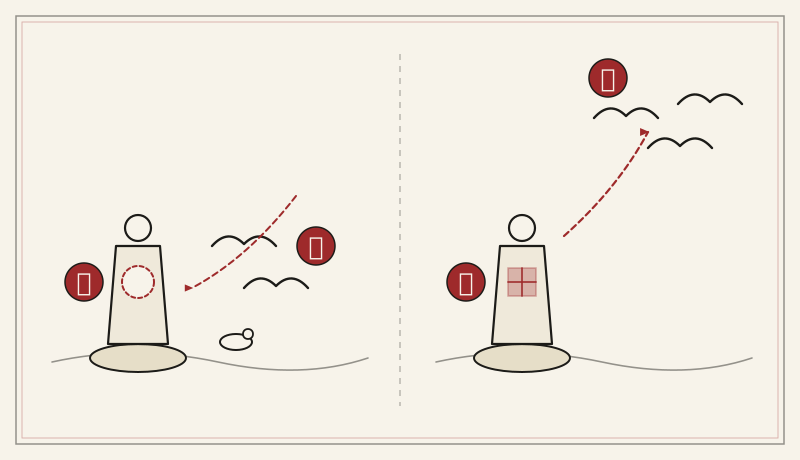
Classical ink-and-cinnabar diagram of Forgetting Scheming Beside the Gulls (Ouniao Wangji) comparing an uncalculating open heart on the left with gulls alighting in trust, and a scheming heart on the right with gulls wheeling high in the sky without descending

How Inner Intention Shapes Outer Resonance in Ouniao Wangji (鸥鸟忘机与机心存胸对比图解).

  1. Pure Simplicity Without Ulterior Motive (纯白备于胸中 · 无机心): when the heart-mind seeks nothing to seize (Tao Te Ching Chapter 49), breath and posture remain completely unforced
  2. Hundreds of Gulls Alighting in Trust (鸥鸟至者百住而不止 · 物我相亲): living beings naturally relax around a presence that carries no predatory tension (Haoliang zhi Bian)
  3. A Calculating Motive Lodges in the Breast (机心存于胸中 · 欲取玩之): even without a visible trap, the hidden desire to manipulate or capture stiffens the spirit
  4. Wheeling Aloft Without Descending (鸥鸟舞而不下 · 神生不定): subtle micro-tension immediately telegraphs intent and breaks natural rapport

3. Why “Having a Scheming Heart” Immediately Gives You Away in Wudang Push Hands

Every experienced teacher of Wudang Push Hands (Tuishou) and Tingjin (Listening Energy) uses the story of the gulls to explain why greedy force always fails:

  • The “Gull-Catcher’s Hand” in Partner Practice: The moment a student thinks, “Now I am going to shove my partner off balance!” (Jixin 机心), their shoulder, wrist, and breath involuntarily stiffen a fraction of a second before they push. A sensitive partner feels that telegraph immediately—and just like the gulls wheeling into the sky, yields away into an empty boat so the shove falls into nothingness.
  • Moving Without Premeditation (Mirror-Like Mind): When you touch hands with no greedy scheme—simply listening and following what is actually there—your partner feels zero warning tension, and natural openings arise by themselves (Wu Wei).
White gulls standing on a pebble shore and wheeling over a calm misty lake at dawn, beside a single weathered wooden post rising from the still water.

The gulls of the sea (Liezi): the birds came to play with the boy until he formed the thought of catching them—then they only circled overhead.

4. Cultivating Uncalculating Presence Between Wudang Mountain and Singapore

Connecting the quiet mountain lakes and pines near Wudang Mountain’s UNESCO World Heritage ancient Taoist temples with our regular classes in Singapore, Wudang.Org invites you to lay down mental calculation through movement and stillness. Begin on Start Here.

Seeker’s Q&A · Frequently Asked Questions

What does the Taoist idiom “Ouniao Wangji” (鸥鸟忘机) mean?

Derived from the gull parable in Liezi (Huangdi) and Zhuangzi’s concept of Jixin (scheming heart), it describes a heart-mind so free of calculation and ulterior motives that even wild waterbirds feel safe to alight nearby.


Why did the gulls refuse to land on the second morning even though the young man carried no weapon or net?

Because once the intention to capture them (“Jixin” 机心) entered his heart, his subtle breathing, gaze, and muscular tension changed—and living creatures immediately sense that loss of natural ease.

How does “Wu Jixin” (having no scheming heart) improve Wudang Taijiquan Push Hands?

Premeditating an attack stiffens your shoulder and wrist before you move, warning your partner in advance. Practising without a scheming heart keeps your touch soft and responsive so you follow your partner’s actual momentum.
